

Welcome to the AI in Policing Learning Hub
Developed by The Open University with Avon and Somerset Police, this learning hub responds to the Strategic Training Needs Analysis on AI by supporting any policing professional who wants to build foundational awareness and strategic understanding of artificial intelligence.
The programme combines practical learning with real-world policing examples, helping learners to explore:
- how AI technologies are currently being used
- where future opportunities may emerge
- how ethical, legal and operational considerations shape responsible adoption.
Whether you are completely new to AI or already exploring innovation within your force, these courses are designed to support informed conversations, critical thinking and confident engagement with AI-enabled policing.
Explore AI in policing
Studying the courses in this learning hub will help you to:
- build AI confidence, developing a practical understanding of AI concepts and language
- support ethical practice by exploring responsible, transparent and accountable AI use
- strengthen strategic thinking, discovering how AI can influence workforce transformation and policing priorities
- encourage innovation by taking part in informed conversations about future opportunities and adoption.
It provides practical, accessible and strategic learning opportunities to understand the opportunities, risks and future implications of AI in policing. Operational staff, leaders and strategic decision-makers can build confidence and capability in AI with:
- two interactive courses
- national pilot availability
- strategic and operational focus
- open learning approach
- real-world policing examples.
Transcript
SARAH CREW: The policing environment is changing rapidly and artificial intelligence will play an increasingly important role in how we deliver our services to the public. As a service, we must embrace innovation, but always in a way that respects our values and responsibilities. Our use of AI must be grounded in legitimacy, ethical practise and drive public confidence. Technology should enhance policing, not undermine trust, procedural justice or our safeguarding responsibilities to the communities we serve.
The successful use of AI is not about the technology alone – really, it's about our people. Officers, staff and leaders must feel confident, informed and professionally curious when engaging with AI-enabled systems.
AI can support decision-making, but it does not replace professional judgement. We must continue to critically assess outputs, challenge where necessary and take responsibility for the decisions that we make. And policing capability will increasingly require digital confidence, critical thinking and a strong understanding of data and information.
We hope this training will go some way to support this. Ethical awareness and reflective practice will be as important as technical knowledge going forward. Leaders at all levels have a responsibility to create the conditions for success. This includes supporting teams to use AI appropriately, encouraging challenge, and identifying risks or unintended consequences as early as possible.
We must create an environment that listens and learns, drawing insight from experience, feedback, complaints and emerging practice. Sharing learning across the service and – where appropriate – our partners will also be critical to ensuring AI is used safely, consistently and proportionately.
And our ultimate test is the impact on the communities we serve. We must ensure that the use of AI strengthens public trust, supports fair and effective policing, and delivers better outcomes for victims and communities.
So AI presents a significant opportunity, but it's our responsibility to ensure that it's used with care, professionalism, and with integrity. By investing in our people and maintaining our commitment to ethical policing, we can harness these technologies to improve the service we provide to the public.
Transcript
AL MURRAY: Hi. My name is Al Murray, and I am the interim Director of PoliceAI. It's good to be with you today to introduce this training.
AI is here to be embraced by policing, but it must be responsible. The one thing we know that is really important in British policing is maintaining trust and legitimacy. And that's why we need PoliceAI to set standards, to set requirements, to set levels of training and evaluation across the country so that people in Avon and Somerset, and people in all the other forces in the UK, know what to expect and know that they can trust the AI being used.
This means following the NPCC covenant that has got a number of tenants, including being robust but also being responsible, being explainable and being transparent. And below that, the responsible AI checklist that dives into things like bias associated with AI and how do people interpret the outputs of AI, and whether AI is proportionate, legal and necessary. These are all hugely important tenets of adopting AI.
Now, forces move at speed, and it is great to see the innovation taking place in forces around the country, including Avon and Somerset, which has always been a leader in this space. And what we're trying to do in PoliceAI is encourage people to collaborate across force boundaries. So when Avon and Somerset, for example, develop something that is great – that they've embraced the responsible AI checklist and the NPCC covenant principles, and that we know a product has been tested and evaluated pretty rigorously – that it's shared with other forces and PoliceAI can come along forces like Avon and Somerset, and spread the use of AI across the country.
The other thing to say with AI is that things change every day. You know, it's a famous saying now, but AI and the capability of AI will never be as slow as it is today. Things change every day, so it is hugely important that we, as police officers and police staff, stay abreast of developments.
As things change and as capabilities change, we change. But there are some things that must remain consistent: thorough testing and evaluation, sticking to the responsible AI principles and following the NPCC covenant on AI.
I hope you have a great training session. Thank you very much.
-
Copyright: The Open University
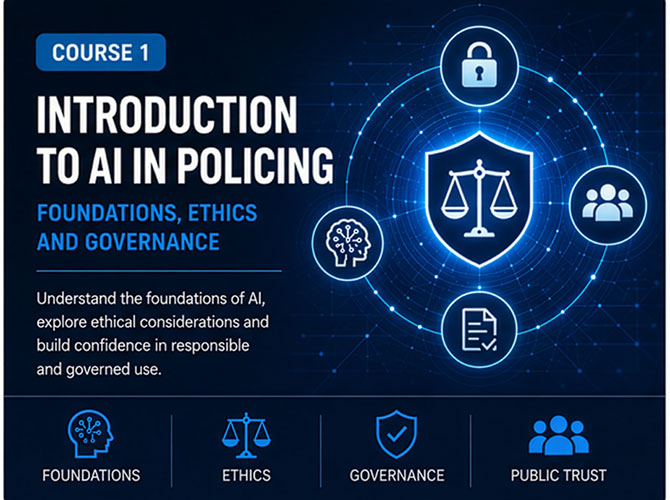
Introduction to AI in policing: foundations, ethics and governance
This course is designed to help you navigate GenAI tools and safely deploy them in your context while being mindful of their inherent associated ethics, risks and biases.
Course
3 hrs