Unit 3: Learning and Memory
| Site: | OpenLearn Create |
| Course: | Learning Languages with Senior Learners 1_2024 |
| Book: | Unit 3: Learning and Memory |
| Printed by: | Guest user |
| Date: | Wednesday, 7 October 2026, 10:01 AM |
Description
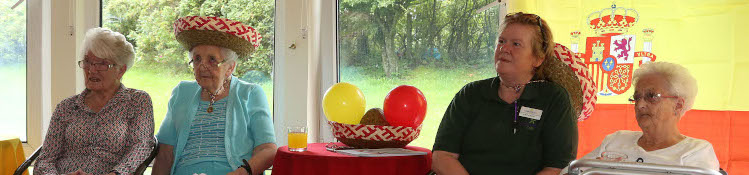
Table of contents
- 1. Introduction
- 2. How Does Memory Change in Older Age?
- 3. How Can Learning a Language Help to Preserve Memories?
- 4. Which Learning Approaches might be useful for Senior Learners?
- 5. The Correlation between Learning Together and Social Cohesion
- 6. Attending the Online Tutorial
- 7. Language Learning Example for Social Cohesion
- 8. Community Link: The Goethe-Institut Glasgow
- 9. Further Reading
- 10. Unit 3 References
- 11. Acknowledgements
1.0 Introduction to Unit 3
In Unit 3 you will examine the link between learning and memory. Key questions you will find answers to in Unit 3 are:
- What is memory?
- How does memory change in older age?
- How can learning a language help to preserve memories?
- Which learning approaches might be useful for senior learners?
- How can care workers and senior learners learn a language together?
1.1 What is Memory?
Step A
To start off your work in this unit, you will think about the concept of ‘memory’, what memory actually is and means to people. There might be many different ways in which this phenomenon can be described.
Take some notes that explain how you would define ‘memory’. Then compare your answer with the model answer.
Step B
For this part of the activity, do a
little test with yourself and note down a memory that is important to
you.
When thinking of this memory,
consider the following questions:
What is at the heart of this memory? Is it a person, a place, a smell, a sound…? Or all of these?
Can you explain why it was this particular memory that came to mind for this activity?
Use your learning diary to record
your answers to these questions. Then look at our model answer and review your answers to the two questions.
2.0 How Does Memory Change in Older Age?
In the previous activity you learned that the brain tends to ‘clean
up’ more often when people get older, and with each ‘clean-up’
some memories get lost.
This article on Helpguide.org on ‘Age-related memory loss’, will provide you with an overview of reasons for memory loss in older age, but also information that helps you distinguish between ‘normal’ memory loss and memory loss that is related to degenerative brain diseases such as dementia.
In your learning diary, note down at least 5 facts from this article that you think are useful to help you understand the senior learners you will be learning a language with.
Then compare your notes with the model answer.
How Does Memory Change in Older Age?
2.1 How does Alzheimer's affect memory?
This activity will provide some illustration of the loss of memory when people suffer from age-related degenerative brain diseases such as Alzheimer's, which seriously impacts people’s ability to recall memories.
Watch this video, "People with Alzheimer's tell us memories they don't want to forget" by CUT (opens in a new tab), which eloquently and movingly conveys what it is like for people who suffer from this disease to try and remember. (If you would like to watch this video with closed captions, please switch these on in the YouTube player by selecting this icon 
When watching this video, note down three key aspects that particularly strike you about these people talking about their memories.
-
In view of the theme of this unit, also take some notes to outline what you could learn from the video with a view to helping your senior learners recall and preserve memories?
-
Then compare your notes with the model answer.
3.0 How Can Learning a Language Help to Preserve Memories?
In this part of Unit 3 you will be learning more about the connections between learning and memory. You will also find out more about the reasons why language learning in older age and also for people with degenerative brain diseases such as Dementia can be beneficial for their brain health.
First of all, read this extract from Francis Bailey and Ken Pransky’s book Memory at Work in the Classroom (2014). This extract revolves around the connections between memory and learning.
While reading this extract, make notes on information you find here to answer the following questions:
What are the five most important things you are taking away from this extract to help you remember the connections between memory and learning?
Which information in the text will be useful for your work as carer learning a language with someone you care for?
Once you have finished reading and answering the questions, compare your response with our model answer.
How Can Learning a Language Help to Preserve Memories?
3.1 A Closer Look at Language Learning and Memory Loss
In the course materials, you have come across the mention of language and language learning in relation to memory and positive effects of learning a language. Now you are exploring the links between language learning and memory loss in some more depth.
1. For this activity, use your search engine and find one article on the effects of language learning on the brain, and specifically language learning in older age.2. Read the article and write a brief summary of its main points, which you then share with your fellow students in the Forum (opens in a new tab). In your forum post include:
- the year of publication
- the title of the article
- the link to the article
3. Then explore the summaries shared by your fellow students and read at least one of the articles they found.
4. You might want to comment on some articles shared by the group.
Please note: You might come across articles that contradict each other and it would be useful if you commented on these contradictions, also in the light of what you have learned so far in this course.
4. Which Learning Approaches might be useful for Senior Learners?
In the previous activity, you considered the benefits of learning a new language to help preserve memory. In this activity, you will find out more about specific methods and strategies you could use to make learning with a senior learner as effective as possible.
Step A
Read "How to maximise the language learning of senior learners" by Kieran Donaghy which offers a wealth of effective techniques for teaching senior learners where you will find advice that can be very useful for teaching a language session.Note down one specific strategy and think of an activity you might want to design to train this strategy with your language student/s. This will help you prepare the application and reflection task in this unit.
Step B
Senior learners can spend a lot of time sitting down, being quite still. This is not always conducive to learning because you get tired more quickly. Research has shown that your brain and memory are also not working at their best capacity. In order to maximise learning, find out now how including energisers and concentration activities into the learning can make the idea you have developed in Step A even more effective.
Watch the video by Epic Science: "Physical movement helps language learning".
Now explore Sharita Forrest's article "Gestures help students learn new words in different languages, study finds". From Forrest's suggestions select an idea to teach 5 new words supported by gestures which you would like to try out with your learner/s as part of the activity idea you have developed in Step A and take a note of this in your learning diary.
Note: Please do consider Health and Safety regulations to determine which activities your own learner/s could safely do. Could they do some energisers sitting down? How might you need to adapt the room, the seat etc. to allow them to try some easy energisers?
5. The Correlation between Learning Together and Social Cohesion
In this activity, you will examine what happens when care workers and senior learners start to learn a new language together and whether this has an impact on their relationship. You will also examine how you can create common ground through learning together, as well as the difference between creation and co-creation. Finally you will learn about in-the-moment experiences, what they are and where they can take us.
Complete steps 5.1 to 5.3
The Correlation between Learning Together and Social Cohesion
5.1 Preparation for Tutorial
As a carer, you will probably be planning your time with a person you care for in terms of help you provide to them. Every activity you do is purposeful, and you will have to pack a lot of single care activities into your (working) day. However, in these activities you will often be the more active participant. Learning together can change the relationship between a carer and a senior learner because it takes both of them outside of their usual context and relationship and both can take on different roles.
To prepare for the online tutorial, look back on what you have explored in Activities 1-4 of this unit and consider the questions below. Take a note of your answers in your learning diary log.
Why is learning something new, such as a language, of importance to senior learners?
Where do you see your own role in this learning process?
In what way do you expect that learning something new together might change the relationship between a carer and a senior learner?
Compare your answer to our model answer.
The Correlation between Learning Together and Social Cohesion
5.2 Co-creating with Learners
As you have identified in 5.1, learning together can bring about changes in relationships. You can adopt new roles. A carer may become a teacher or a student when working together with a senior learner. A senior learner may not need as much help with learning a new language as with everyday tasks and might be happy to take the lead and become a teacher when learning something new together with someone else.
Learning together also creates common ground and the new purpose of developing knowledge together. In educational research this is often referred to as “co-creation”. This can be defined as follows:
“Co-creation involves developing deeper relationships between student and teacher, and between students and other students. Education is perceived as a shared endeavour where learning and teaching are done with students not to them (Cook-Sather et al. 2014).”
Reference: Cook-Sather, A., Bovill, C., Felten, P. (2014), Engaging students as partners in learning and teaching: a guide for faculty. San Francisco, Jossey Bass.
What could co-creation look like?
Read more about the European project “Co-creating welfare” and watch the video “How the Co-Creating Welfare training is used”.
Note down 3 key points of this project and compare your answer with our model answer.
Then check out the Co-creating Welfare Training Toolkit for ideas or helpful tips for issues you may encounter in the context of co-creation activities.
Finally, think about how you could co-create knowledge with your learner. Write down ideas and tips in your learning diary.
The Correlation between Learning Together and Social Cohesion
5.3 In-the-moment Experiences
Co-creating knowledge in a care setting can make a profound difference to both the carer and the senior learner. At the same time, when working with senior learners who have degenerative brain diseases, differences that arise through co-creation may only be small, and some differences may only be momentary. But even an in-the-moment experience of a difference may provide you as the carer with new information about and a better understanding of the person you care for.
But why should we invest in “in-the-moment experiences” in care settings?
6. Attending the Online Tutorial
You are invited to attend the Unit 3 online tutorial, where you can meet your tutors and fellow students and discuss how you can best support senior language learners using the concepts you have come across in this unit. You will also start planning your next language learning activity.
This is an overview of the programme for the Unit 3 online tutorial:
- What factors may affect the learning process, and what could you do to optimise learning with your senior learner/s?
- What role does the changed relationship between the carer and the cared for play in the learning process?
- Planning your application task together.
Remember to bring your learning diary with the notes you have taken in Unit 3 so far to the tutorial.
Refer to your study planner for the date and time of the Unit 3 tutorial and where to access it.
If this is your first Zoom tutorial, please complete steps 1-2.
1. Take some time to familiarise yourself with the Zoom software here, in advance of your online tutorial. This link will also provide information on how to check that your computer has the minimum system requirements to run Zoom.
2. To ensure you have the best possible experience during the online tutorials, we advise you to use a headset with microphone to avoid interference and any background noise. This is the same type of headset you would use for any online conferencing, you do not have to buy an expensive headset to use Zoom.
There is no expectation that participants use the camera during the live tutorial sessions. Yet, we do welcome all who are keen to use this tool as it supports engaging and interactive tutorial experiences.
Activity 7.0 Language Learning Example for Social Cohesion
This activity will help you prepare your next language learning activity with your learners.
Step A
In order to give you some ideas for the next language learning activity with the people in your care, listen to the experiences of Rosi, Learning Development Officer at Lingo Flamingo, and see which props and materials she has used to help people engage with herself and other learners through another language.
To prepare for your own application, focus on the following in the recording and take notes:
- The optimal learning environment for this activity
- The resources/materials you want to use for the activity
- The vocabulary items you want to use
- The cultural information you want to convey
Please listen to each of these audios with Rosi, Learning Development Officer at Lingo Flamingo:
Next, look at Props and Materials Rosi uses to engage with learners.
Step B
Now listen to another short recording by Sylvia Warnecke, a Language Lecturer at the Open University, who has undertaken research on language learning anxiety and approaches to supporting different learning styles.
The audio recording focuses on why languages sessions can cater for different levels of engagement and ability and what aspects of communication support this. When listening, take some notes on this in your learning log.
Click here to listen to the recording by Sylvia Warnecke.
To follow up on what Sylvia talked about in the recording, you could find out more on non-verbal communication through touch, silences, sitting positions, gender and more in the VIRTUALSPEECH article by Sophie Thompson ‘Cultural Differences in Body Language to be Aware of’ (8 September 2022) and lingoda’s article '18 common gestures around the world’ (Andrea Byaruhanga., 15 October 2024).
7.1 Application and Reflection:
In this activity you will finalise your plan for a language learning activity and try it out in your own care setting.
In Activity 3 of Unit 3 you explored how language learning can help to preserve memories, and in Activity 5 of this unit you learnt about co-creation and different ways of co-creating with learners.
In your Application and Reflection task, you will consider how you could use language learning activities to help preserve your learner/s memories, and in which you and your learner take turns in leading the activity.
Step A
Develop an idea for a language learning activity for either a small group or for working with just one senior learner, which you would like to try out in your care setting. If you have the opportunity to work with a small group, it will be useful to try out a language session with more than one learner.
As topics for the activity you could, for example, consider:
- talking about family members, friends or a favourite person
- comparing past and present (food and drink, music, shopping)
In your planning you should focus on:
- how your activity can help preserve memories and support co-creation with the senior learners in their small group, for example by talking about a memory they might have in common.
- suitable resources/materials you want to use for the activity.
In addition, consider the following aspects in your planning:
- you might want to apply strategies for learning you encountered in Activity 4 of this unit,
- you could try out an energiser for learning in your activity as encountered in Activity 4,
- you could take turns with your senior learners in leading the activity.
Importantly, remember to focus on:
- revision and consolidation of prior learning, which will enhance your learners confidence and motivation
- provide memory aides for your learners, these could be multi-sensory, i.e. images, objects to touch, put into a specific order, label etc.
Once you have a rough plan for your activity, have a look at our model answer, to help you finalise your planning.
Step B
Now try out your activity with your learner/s. You might want to gather some feedback from your learner/s about the lesson as well, which you can bring to the course and share with your fellow students.
Step C
Once you have tried out your activity/lesson idea in your care setting, write a reflective account of 300 words, explaining what you did with your learner/s and why, highlighting the successes and challenges you encountered when applying what you have learned in terms of language learning, memory/ies, social cohesion and co-creation.
These questions might help you write your account:
- What was the activity you had planned?
- Why had you planned this particular activity?
- Which materials and energisers did you try out? Why these?
- On reflection, how did the activity work? What went well, what did not go as planned?What would you do differently next time and why?
- What was your learner/s' feedback?
- What are the next steps for your learner/s?
- How will you provide further opportunities to practise and reinforce the new language?
To help you with your reflective account, have a look at our model answer.
Step D
Now go to the Forum (opens in a new tab) and post your reflective account. To help your fellow students imagine your activity and how you approached it, please attach the teaching template you completed in Step A of this activity.
Then read and comment constructively on a least one post by a fellow student.
Step E
A) Once you have tried out your language learning activity and shared it with your peers, it will be useful to think about what you have learned from sharing your experience and ideas with your fellow students. You might want to note down some key points in your Reflective Learning Log. Some aspects for reflection you may want to consider:
- Is there any teaching idea you want to try out in your own setting?
- What aspects of your fellow students' teaching worked well?
- Where did your peers see problem areas, and why did they think this was problematic?
- Where do the group's reflections coincide with yours, and where do they not?
- Were there any posts you particularly agreed or disagreed with and why?
B)This final step in activity 7.1 is specifically designed for you to contribute to the collaborative research project between The Open University and Lingo Flamingo.
In your Reflective Learning Log, make notes capturing your reflections during the study and application of content of this unit on the following aspects, which will be particularly important for the research project:
- your own learning journey applying the skills you are learning in this course in your care context, in particular:
- your motivation and confidence as you go through the course
- whether your relationships with your learners are changing due to the language learning
- any impact this learning has on your opinion of good care practice
- any views colleagues, your learners and/or families have shared regarding
- the language learning activities
- your observations on you senior learner(s)’ learning journey (the individual as well as the group), particularly:
- on their motivation for participating in this learning
- the impact the learning has on their overall confidence and participation in the sessions and the learning group (if there is one)
- aspects of how they learn and engage (for example you could share some
- relevant incidents during the language learning sessions and other examples)
Please note: This part of the application and reflection is NOT assessed and is primarily a tool for you to feed into our research whilst encouraging you to think more closely about your own learning journey and the wider impact of the language learning activities. Your tutors will read your entry and provide some brief comments, although the main focus here are your own insights and reflections.
8.0 Community Link: The Goethe-Institut Glasgow
The Goethe-Institut is the German equivalent to the British Council. It is an organisation responsible for promoting German language and culture across the world and has UK offices in Glasgow and London.
Explore the Goethe-Institut Glasgow's website, then watch the video "'The Complete German Experience' at the Goethe-Institut Glasgow", which highlights not only the language classes available to learners but also further resources such as the library, book club, informal meetings and cultural events. If you would like to watch the video with closed captions, please switch these on in the YouTube player by selecting this icon 
9.0 Further Reading
Further reading:
-
Find out "What are memories made of?" in this article by Hugo Spiers (2012) https://www.theguardian.com/lifeandstyle/2012/jan/14/what-are-memories-made-of (accessed 16/08/2025)
-
Learn more about "How ageing affects our memory: does our intelligence decline as we age?in this article by Mark Williams (2016). https://www.psychologytoday.com/us/blog/the-art-and-science-aging-well/201611/how-aging-affects-our-memory (accessed 16/08/2025)
-
In order to find out more about living with Alzheimer's disease, you might want to find out about Sion Jair: Meet the man living with Alzheimer’s who climbs the same mountain every day https://www.theguardian.com/lifeandstyle/2018/mar/25/meet-the-man-living-with-alzheimers-who-climbs-the-same-mountain-every-day (accessed 16/08/2025)
- Nick Stockton argues that memories constantly remake and reshape your brain in this article: Your brain doesn't make memories. It is memories. www.wired.co.uk/article/how-memories-work-brains (accessed 16/08/2025)
Unit 3 References
Bailey, F., Pransky, K. (2014) Memory at Work in the Classroom [Online]. Available at https://ascd.org/books/memory-at-work-in-the-classroom?chapter=five-core-memory-and-learning-concepts (Accessed 16 August 2025).
Camic, C. (n.d.) ‘Why does a moment matter and how can it be defined?’ [Online]. Available at https://www.futurelearn.com/courses/dementia-arts/0/steps/44914?main-nav-submenu=main-nav-courses (Accessed 16 August 2025).
Cook-Sather, A., Bovill, C., Felten, P. (2014), Engaging students as partners in learning and teaching:a guide for faculty. San Francisco, Jossey Bass.
CUT (2016) ‘People with Alzheimer's tell us memories they never want to forget’ [Online]. Available at https://www.youtube.com/watch?v=WysoapqcXVs (Accessed 16 August 2025).
Donaghy, K. (n.d.) ‘How to maximise the language learning of senior learners’, British Council’ [Online]. Available at https://www.teachingenglish.org.uk/article/how-maximise-language-learning-senior-learners (Accessed 16 August 2025).
Ferlazzo, L. (2015) ‘Physical movement helps language learning’ [Online]. Available at https://larryferlazzo.edublogs.org/2015/02/21/video-of-the-day-physical-movement-helps-language-learning/ (Accessed 16 August 2025).
Forrest, S. (2019) ‘Gestures help students learn new words in different languages, study finds’ in PhysOrg [Online]. Available at https://phys.org/news/2019-01-gestures-students-words-languages.html (Accessed 16 August 2025).
Goethe-Institut Glasgow Website (2020) [Online]. Available at https://www.goethe.de/ins/gb/en/sta/gla/ueb.html (Accessed 16 August 2025).
Goethe-Institut Glasgow (2020) "The Complete German Experience” at the Goethe-Institut Glasgow [Online]. Available at https://www.youtube.com/watch?v=epJ8KMkqjeo (Accessed 16 August 2025).
How the CoCreating Welfare Training is being used(2019) [Online]. Available at https://www.youtube.com/watch?v=59yaDpFLzvI&feature=emb_err_woyt (Accessed 16 August 2025).
Lingo Flamingo (2020) What is memory? Mastin, Luke (2018) ‘Memory’ in The Human Memory [Online]. Available at http://www.human-memory.net/intro_what.html (Accessed 16 August 2025).
RRI Tools (2019) ‘Co-creating welfare. A European project about skills for practitioners in the healthcare, social care, educational and youth sectors’ [Online]. Available at https://ccw.southdenmark.eu/#toolkit (Accessed 16 August 2025).
Smith, M., Robinson, L., Segal, R. ‘Age-Related Memory Loss’ in HelpGuide [Online]. Available at https://www.helpguide.org/articles/alzheimers-dementia-aging/age-related-memory-loss.htm (Accessed 16 August 2025).
Young, C. (2015) ‘How memories form and how we lose them’ [Online]. Available at https://www.youtube.com/watch?v=yOgAbKJGrTA (Accessed 16 August 2025).
Acknowledgements
Every effort has been made to contact copyright holders. If any have been inadvertently overlooked the publishers will be pleased to make the necessary arrangements at the first opportunity.
Grateful acknowledgement is made to the following sources:
Unit 3 image: Supplied by Rosi Mele, Lingo Flamingo
Unit 3, Activity 5.3b, In-the-moment Experiences - statements from family members: Supplied by Rosi Mele, Lingo Flamingo
Unit 3, Activity 7.0, Audio 1: Overcoming Anxiety: Supplied by Rosi Mele, Lingo Flamingo
Unit 3, Activity 7.0, Audio 2: Setting the Scene: Supplied by Rosi Mele, Lingo Flamingo
Unit 3, Activity 7.0, Audio 3: A Practical Example: Setting the Scene: Supplied by Rosi Mele, Lingo Flamingo
Unit 3, Activity 7.0: Lingo Flamingo Pictures of Props & workshop materials: Supplied by Rosi Mele, Lingo Flamingo
Unit 3, Activity 7.0, Audio 4: Why languages sessions can cater for different levels of engagement and ability: Supplied by Dr Sylvia Warnecke, The Open University