
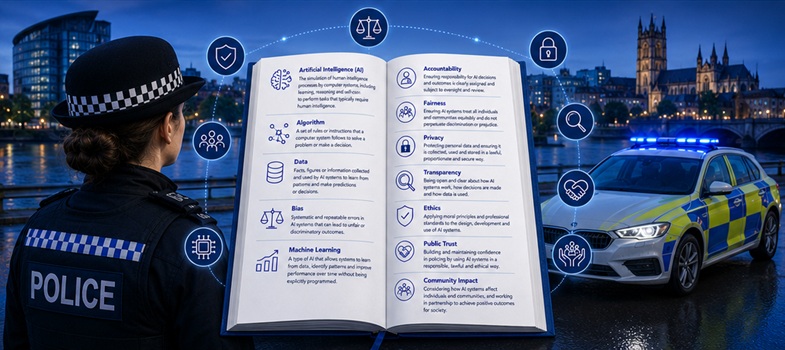
AI in policing: glossary
Special | A | B | C | D | E | F | G | H | I | J | K | L | M | N | O | P | Q | R | S | T | U | V | W | X | Y | Z | ALL
A
AI Decision and Impact MatrixA framework used to assess the impact of AI use and the consequences of incorrect outputs, guiding appropriate levels of oversight. An officer or police staff equivalent could use the matrix to assess whether facial recognition requires higher supervision. | |
AI literacyA framework to critically understand, evaluate and use new technologies and one that requires a ‘self-reflective mindset’. | |
AI personaA tailored set of characteristics, mannerisms, key skills and behaviours that you want the AI to adopt during your interaction. | |
artificial intelligence (AI)Technologies that aim to replicate aspects of human intelligence in machines. In a policing context, an example would be where AI is used by an officer or police staff equivalent to analyse crime data and identify patterns across neighbourhoods. | |
auditabilityThe ability to track and review how AI tools are used and how outputs are generated. In a policing context, an example would be where a force ensures that an officer or police staff equivalent can review AI-generated reports and decisions if challenged. | |
automation biasThe tendency to trust AI outputs without sufficient critical evaluation. In a policing context, an example would be where an officer or police staff equivalent accepts an AI-generated risk score without questioning its accuracy. | |