Use 'Print preview' to check the number of pages and printer settings.
Print functionality varies between browsers.
Printable page generated Thursday, 24 September 2026, 9:13 AM
Session 4 Case management 1: the reporting process
4.1 Introduction
Every organisation should have a

Learning outcomes
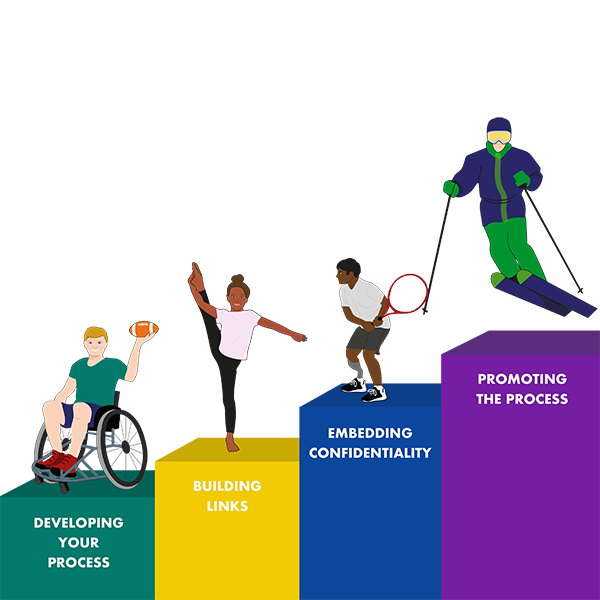
In this session, you will cover:
Developing your reporting process. |
Building links between safeguarding, disciplinary/ethics, and recruitment processes to make sure they work together. |
Embedding confidentiality, information sharing, and data protection when responding to safeguarding concerns. |
Promoting the reporting process. |
4.2 What are the essential features of a robust reporting process?
The reporting process is one of the most fundamental parts of safeguarding. Reporting arrangements make it clear how everybody can pass on concerns. Without a robust reporting process your organisation may not know about, and therefore won't be able to address, safeguarding issues, and victims will remain unprotected and exposed to further harm. In addition, your organisation may also be vulnerable to significant reputational risks.
It is very important that the reporting process includes reliable systems for handling reported concerns and managing cases linked to your organisation’s disciplinary or ethics
Let’s think about the key features of a robust safeguarding reporting process.
 Activity: Identify the important features of a safeguarding reporting process
a.
True
b.
False
The correct answer is a.
a.
All stakeholders including staff, athletes, children and parents need to know about and understand the process.
a.
True
b.
False
The correct answer is b.
b.
Although written reports may be clearer, all reports require a response, including verbal reports.
a.
True
b.
False
The correct answer is b.
b.
Everyone should report their concerns – it is for experts and professionals to decide whether or not someone has been abused.
a.
True
b.
False
The correct answer is a.
a.
Everyone must be aware how to report and who to contact.
a.
True
b.
False
The correct answer is a.
a.
Versions should reflect the needs of different groups (for example, children and coaches), and be promoted in different ways (for example, in inductions, on the website, during safeguarding training, in posters).
a.
True
b.
False
The correct answer is b.
b.
Everyone has a responsibility to report concerns.
a.
True
b.
False
The correct answer is a.
a.
Including concerns about breaches of the safeguarding
a.
True
b.
False
The correct answer is b.
b.
It must be promoted to everyone as anyone may be made aware of a concern – directly (for example, by seeing or hearing something) or indirectly (for example, by being told something concerning).
a.
True
b.
False
The correct answer is b.
b.
Although children are a priority, it must be used to report concerns about the welfare of any person involved in your organisation’s activities as well as breaches of the safeguarding code of conduct.
a.
True
b.
False
The correct answer is a.
a.
You need to have monitored systems in place to receive reports – for example, there’s no point in having a mailbox that never gets checked. This might mean you need to have more than one person appointed to check or receive reports.
Discussion
There are four basic principles to remember:
- There should be good awareness of the reporting process across your organisation.
- Everyone in your organisation must report concerns.
- Individuals do not need to be certain that a child or vulnerable adult has experienced abuse before reporting.
- The process should be victim and child-friendly to use.
These key points might be useful in your communication about why the reporting process is important.
4.3 Developing a reporting flowchart
Flowcharts are a simple step-by-step guide to reporting that should be promoted and accessible to everyone involved in your organisation – staff, volunteers, athletes, parents, or spectators.
As a reminder – here is the sample flow chart from Course 2:
What to do if you have concerns about someone

You can use this as the basis to develop a flowchart that works for your organisation. It can be helpful to include key names and contact details in your flow chart, so everyone knows how to report and to whom.
4.4 Messages for staff and others about reporting or discussing concerns

For everyone in sport the message is clear and simple: always report safeguarding concerns to the Safeguarding Lead in line with the organisation’s procedure. It is therefore very important to promote ways for anyone to contact the Safeguarding Lead to report concerns.
Often people may be unsure whether their concerns are legitimate or are serious enough to justify reporting. They may worry that they will cause unnecessary trouble if they report them. In these situations, it is important to offer people opportunities to discuss their concerns with you or someone else with an understanding of safeguarding.
 Activity: Patience describes her experiences

Listen to Patience again and reflect on what it means for reporting.
Transcript
Comment
Patience shows us that although you need a robust formal reporting process, you also need to provide chances for people to consult with the Safeguarding Lead to discuss and clarify their concerns.
Now you will look more closely at reports from other departments.
4.5 How to make sure different safeguarding systems work together effectively

One of the biggest challenges in safeguarding is making sure concerns don’t fall through the cracks.
One way to prevent this is to make sure your system works effectively with other systems that apply to your sport.
Activity: What safeguarding systems from other organisations apply to you?
Think about any other bodies that are connected to yours, either legally or through sport regulations.
What safeguarding responsibilities might they have towards your organisation, and vice versa?
Comment
Sport for development organisations might be local members of an international organisation, or local sports clubs might be governed by a national federation or governing body, which in turn sits under an international federation.
It is really important that the system you develop, whatever level you are in the structure, works with the other parts. Get to know the Safeguarding Leads in your sister organisations, understand their policies and procedures and how they apply to your organisation. Make sure you understand any reporting requirements and work together to make sure that information flows to the people who need to know and take action.
Getting this right is particularly important during competitions, where it may not be clear whose system should apply. You will look at this in more detail in Session 7.
4.6 How to respond to reports from other parts of your organisation
Safeguarding concerns may emerge during investigations by your organisation’s Human Resources, disciplinary, integrity, and/or ethics department.
Sometimes, concerns come to light through your organisation’s recruitment process, for example, during a reference or safeguarding check.
These situations show why it is important to know who works in the relevant departments, and make sure they have a process in place to confidentially share information with the Safeguarding Lead.
 |
| Establish close working relationships with disciplinary, ethics, integrity, and Human Resources staff |
Colleagues involved in these teams need support and training to help them recognise information that may have wider safeguarding implications. |
4.7 Links between safeguarding and disciplinary processes
Patience describes her experience of responding to safeguarding concerns that were identified by the organisation’s disciplinary committee.
Activity: Patience describes her link with the disciplinary panel

Identify the main learning points from Patience's experience.
‘The chair of our disciplinary committee rang my manager for advice. He was dealing with a complaint about a male coach that was made by two female athletes. The allegations were that the coach unfairly favours some members of the team and ignores others, and that he responds to criticism by becoming verbally abusive. Based on the complaint, the chair of the disciplinary committee was initially looking into this matter as a complaint about bullying.
However, after speaking to the two athletes who made the complaint, he was concerned that the situation was more serious and had wider implications for the safety of the athletes. I was asked to meet with the committee chair to offer advice and discuss a way forward.
During the interviews with the two athletes, it was clear that the coach liked to hug and kiss his favourite athletes and invite them to his home for meals and drinks. The athletes said the coach expected his favourite athletes to go along with this, and those who refused were verbally abused and lost their place in the team. Most athletes were in their early twenties plus a few teenage girls. Some athletes had started to think that this was the price they had to pay to play sport.
This situation has highlighted the need for close links between the organisation’s safeguarding and disciplinary functions. This helps make sure that safeguarding issues from disciplinary processes are passed on to me as the Safeguarding Lead. The disciplinary committee chair also recognised the need for the committee to receive safeguarding training from me. I also saw that I needed to better understand our organisation’s disciplinary processes.’
Comment
There was danger that concerns about this coach’s behaviour may not have been recognised as having safeguarding implications by someone looking into the case as just bullying behaviour. The involvement of the Safeguarding Lead meant that she could recognise the possibility that the coach may have abused women and girls in the team. Close links between safeguarding and other functions of the organisation are essential.
4.8 Patience describes promoting the reporting process
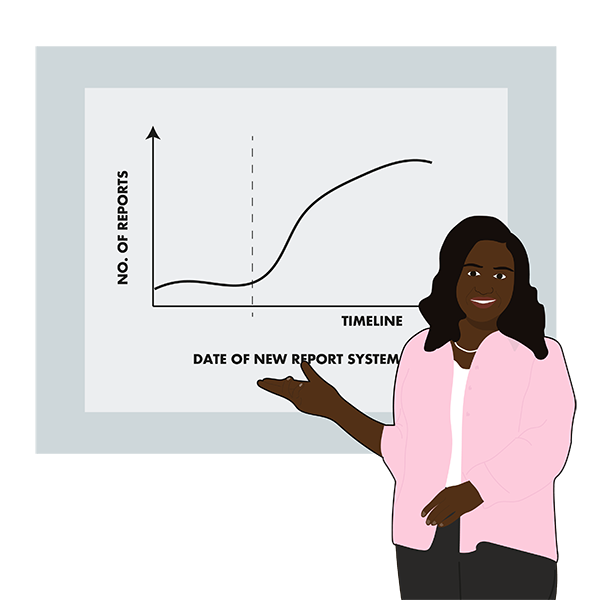
You are going to hear again from Patience, about the ways she promoted the reporting process, including some of the consequences for her and the organisation.
Activity: Patience describes promoting the reporting process
As you read this, think about any ideas Patience mentions that you could use in your own organisation to promote your reporting process.
‘Once we had established a central safeguarding reporting process, the next stage was to make everyone aware of it.
'We involved the organisation’s communication team who were very helpful with the use of social media and the website.
'We also engaged a group of young people to design a way to share the information with young athletes. They recorded a video, explaining the reporting process in a fun way.
'One consequence was that I started to get more calls and emails from people. Mostly they were asking for advice, but there were also reports about more serious things that our organisation needed to address. My workload certainly increased, and I had several cases that needed an urgent response.
'My manager’s reaction was that we were making our own problems by encouraging people to report concerns – and that this could damage the organisation’s reputation. But I didn’t agree. More reports coming in meant that incidents had already been happening, but people hadn’t known who to tell before our promotion campaign.
'For me, the increase in reports was a success and showed our new process was working and that the organisation is taking safeguarding seriously. That is good for our reputation. I think more organisations should speak publicly about their success in raising awareness and receiving more concerns, because it shows people understand and trust the system and feel safe to raise issues’.
Comment
You may recognise some of Patience’s experiences.
Putting a reporting procedure in place and making it widely known is likely to lead to an increase in contacts with the Safeguarding Lead – that is its purpose.
Remember it’s not the process that creates the safeguarding issues – these are likely to already exist. It’s in the interests of those experiencing abuse and the organisation, to make sure issues are known about. Action can then be taken to prevent further harm.
4.9 Confidentiality and information sharing
In Course 2, you looked at the role of confidentiality and information sharing in safeguarding when receiving and responding to reports. These principles apply to all information about a reported concern – including the details of the alleged victim, abuser, or witnesses.
Confidentiality helps make sure that sensitive information is not widely and unnecessarily shared – within the organisation, in the wider community, or in the media.
Information sharing helps make sure that information is shared with individuals with a specific role to play in responding to the concern (within the sport or in external organisations), and/or those who have a need or right to know.
The basis for both principles is to safeguard and protect all parties involved, and to ensure that a fair investigation can take place. You might wish to remind yourself of the fuller details on these two principles.
4.10 Protecting people’s personal information and information-sharing principles
Protecting people’s personal information (sometimes called ‘data protection’) relates to the arrangements that organisations need to have in place to hold and manage information, including sensitive information. There are close links between data protection, information sharing, and confidentiality.
Activity: Seven information-sharing principles
Select each of the seven principles below for an explanation.
These principles will help you decide what information the organisation should hold – and with whom, when and how much information should be shared.
The most important consideration is whether holding and sharing information is likely to support the safeguarding of someone.
4.11 Applying information-sharing principles in practice
Now you will see how these principles apply in practice.
Activity: Information sharing and confidentiality in practice
Read the scenario below and complete the exercise that follows.
You receive a call from the police. A physio who works at a youth training centre is being investigated following several serious physical assaults on his partner – some of which were witnessed by the couple’s young children. The police advise you that the man will soon be taken to court. While the police investigation continues, he is not being held in custody, but he has been banned from going near his home or family. When the police learned that the man is employed by your organisation, they contacted you so that you can take any appropriate action.
Due to the seriousness of the allegations, including that the assaults took place in front of children, there are potential implications for the safety of both children and adults in the physio’s work environment. You decide that he should be suspended from the training centre until the criminal case has been held, and until your organisation can investigate and decide whether he should continue in his role.
Think about this scenario. Consider the following departments or groups that may or may not need to know something about this situation.
- What would each group need to know?
- Why would they need that level of information?
To help you start, we have provided one example.
In the table below, use the drop-down menu to select what level of detail each group should be able to access, and then click on ‘check’ to reveal the explanation ‘why?’ for each.
Comment
There will be individuals and groups who will ask or perhaps demand to be told more – but your responsibility is to make sure that information is only provided to those that need it to fulfil their safeguarding responsibilities. Being clear about the rules for information sharing will help you to make defensible decisions and respond confidently to inappropriate requests for information.
4.12 Recording – using a standard form
For anyone wanting to record a concern, the use of a standard safeguarding report form is very helpful.
Having received a report, the Safeguarding Lead is responsible for making and securely storing a detailed record of all subsequent conversations, advice given or received, and actions taken. This includes recording the rationale for any actions taken (including when no action was taken).
Records should clearly show what is factual information and what are observations and conclusions reached by the Safeguarding Lead or others.
The Safeguarding Resources site includes a template reporting form you can adapt for your context.
4.13 Summary of Session 4

|
| The main learning and messages from this session are: |
|
When you are ready, move on to Session 5 Case management: managing concerns, where you discover more about some of the main principles you can follow in responding to concerns.