Pharmacodynamics
Note that you will not be tested on this section in the end-of-course quiz.
Pharmacodynamics parameters are a measure of the ability of an antimicrobial to kill or inhibit the growth of the infecting organism. Pharmacodynamics parameters include the following:
- The time for which the serum concentration of a drug remains above the
minimum inhibitory concentration (MIC) for a dosing period T (T > MIC). This is the most important parameter for time-dependent antimicrobials. - The ratio of the maximum (peak) antimicrobial concentration, Cmax, to MIC (Cmax/MIC). This is the most relevant measure for antimicrobials whose efficacy depends on reaching a specific concentration.
- The ratio of the area under the curve (AUC) during a 24-hour period to MIC (AUC24/MIC). This can be a useful parameter for both time and concentration dependent antimicrobials.
- The post-antibiotic effect (PAE); that is, where antibiotics continue to be effective after treatment.
Figure 6 illustrates the pharmacodynamics parameters with examples of relevant antimicrobials.
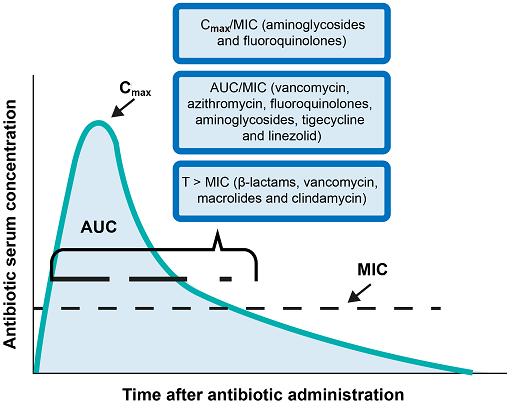
To determine the appropriate dosing levels and frequency for any antimicrobial, it is necessary to understand which parameter correlates with the efficacy of the antimicrobial. For example, the efficacy of aminoglycosides (antimicrobials that inhibit protein synthesis) correlates with AUC/MIC and also Cmax/MIC. This implies concentration-dependent killing, which means that larger doses will have an optimal effect.
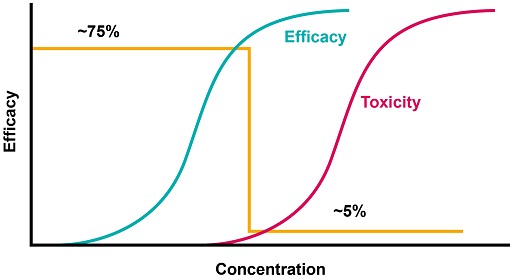
β-lactams, on the other hand, require dosing to maintain the concentration above the MIC for longer periods for maximum efficacy. However, it is not that simple, as we need to understand the relationship between the therapeutic and toxic effect of drugs.
Figure 7 shows that the dose of a drug can be increased progressively until a desired response is achieved; however, if it is further increased, no additional desired effects are achieved, and unwanted effects can be seen. The orange line shows an optimal dose, above which toxicity occurs.
Depending on the drug it will be necessary to consider other factors such as other medications, renal function or weight.
Pharmacodynamically, the rate and extent of the bactericidal activity of an antimicrobial agent depend on:
- drug concentration at the site of infection
- bacterial load
- phase of bacterial growth
- the MIC for the pathogen.
It follows that a change in any of these factors will alter the activity of the antimicrobial agent against a particular pathogen, and may affect the outcome of therapy.
Pharmacokinetics