2.1 Challenges in LMICs
Rapid growth in demand for animal protein has accelerated food animal production in LMICs. To meet this demand, food animal production in LMICs is shifting from small-scale landholders to large-scale and intensive farming. Small-scale farms that are expanding to intensive enterprises, and many existing intensive farms often use antimicrobials to keep animals healthy, maintain productivity and maximise economic returns.
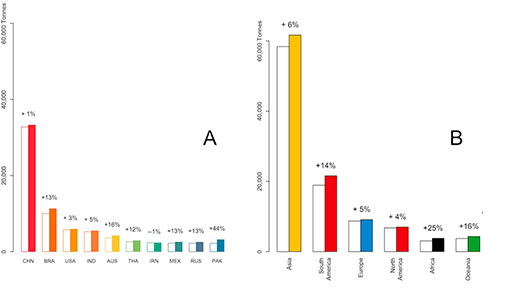
Studies have shown that in 2020, five countries made up 58% of global AMU and were predicted to remain the top 5 in 2030. The top 5 consumers in 2020 were China, Brazil, India, the USA and Australia (Figure 5A). Pakistan is predicted to have the largest relative increase in AMU (44%), followed by Australia (16%). In 2020, 59% of AMU came from Asia, with 56% (32,776 tonnes) from China alone. By 2030, it is estimated that there will be a 6% relative increase in Asia (Figure 5B), but Africa, Oceania and South America having predicted higher relative increases of AMU by 25%, 16% and 14% respectively (Mulchandani, 2023).
The inability to control access to antimicrobials is one of the biggest challenges facing many LMICs when responding to AMR.
In LMICs, farmers often do not have ready access to veterinary expertise, or they cannot afford their services. In such scenarios, farmers turn to other sources to access antimicrobials. Agrovet shops, open markets, online stores and feed mills fill this gap. Selling antimicrobials is an important source of income for non-veterinary services, and often little is done by governments to regulate their activities.
Access to high-quality antimicrobials is seen as a critical factor in ensuring effective management of animal health and food safety. Conversely, substandard or counterfeit antimicrobials, where the concentration of active ingredients is below therapeutic levels or a different active ingredient is used to what is on the label, are ineffective and promote AMR development.
LMICs face challenges with substandard or counterfeit antimicrobials in both human and animal health settings. An evaluation by the WOAH of national animal health systems in more than 130 countries showed that many LMICs either do not have appropriate legislation or have no legislation at all to regulate the import, manufacture, distribution and use of antimicrobials in animals. The WOAH also found that antimicrobials were adulterated in many of these countries (WOAH, 2015).
‘Thousands of tonnes of adulterated antimicrobials destined for use in animals are circulating worldwide’
The challenge for us all is to understand how it is possible to reduce overuse and misuse of antimicrobials, including access to substandard drugs and sub-optimal dosing, especially in LMICs.
For many LMICs, where challenging farming environments prevail, antimicrobials are perceived as necessary to prevent and control animal diseases. However, many farmers have a limited understanding of AMR and AMS. Easy access to antimicrobials via non-veterinary channels poses a major barrier to adopting antimicrobial stewardship principles. Improving the regulatory capacity of LMICs to control the antimicrobial supply chain and increasing the number of veterinarians and veterinary
Activity 4: Addressing AMR – the challenges.
List some of the biggest challenges facing many LMIC responses to AMR? What can be done to address these challenges?
Discussion
Some of the biggest challenges faced by LMICs include:
- few veterinarians, veterinary paraprofessionals, and well performing laboratories available to service farming communities
- farmers getting antimicrobials and advice from non-veterinary suppliers
- inadequate knowledge about appropriate antimicrobial use
- poor quality/counterfeit antimicrobials
- poor regulatory systems (including reinforcement) to control the manufacturer, supply and use of antimicrobials in animals
- limited or no AMR and AMU data to demonstrate the scale of the issue in the animal health sector and to inform data-driven policies and practices.
Government investment in regulatory systems and in increasing the number of veterinarians and veterinary
2 Access to antimicrobials