

The window of tolerance
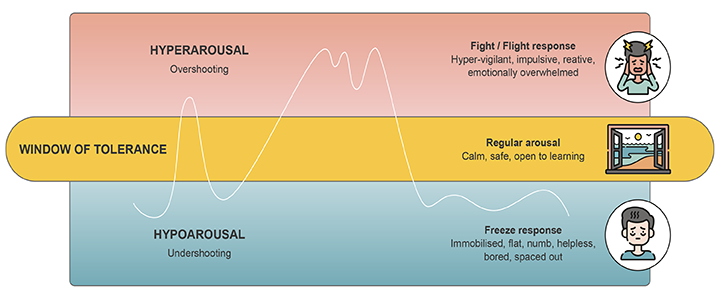
The behaviours in the table you have just reviewed arise when a person is pushed out of their window of tolerance.
The window of tolerance is similar to a person’s comfort zone. there are certain places, activities and groups of people who you may feel calm, comfortable and confident with but there may be other situations where you would feel nervous, panicked or uneasy (for example, speaking before a large crowd or your first day working as a teacher).
For people who have lived safe, stable and secure lives with strong social connections, their window of tolerance will enable them to cope with most situations without panicking or feeling under threat.
However, for a person who has experienced trauma, their window may be much smaller than it used to be and everyday situations such as a noisy classroom, a fire alarm or a slamming door may be enough to push them out of their window and into either hyperarousal or hypoarousal.
Read the diagram below to learn more about each response.
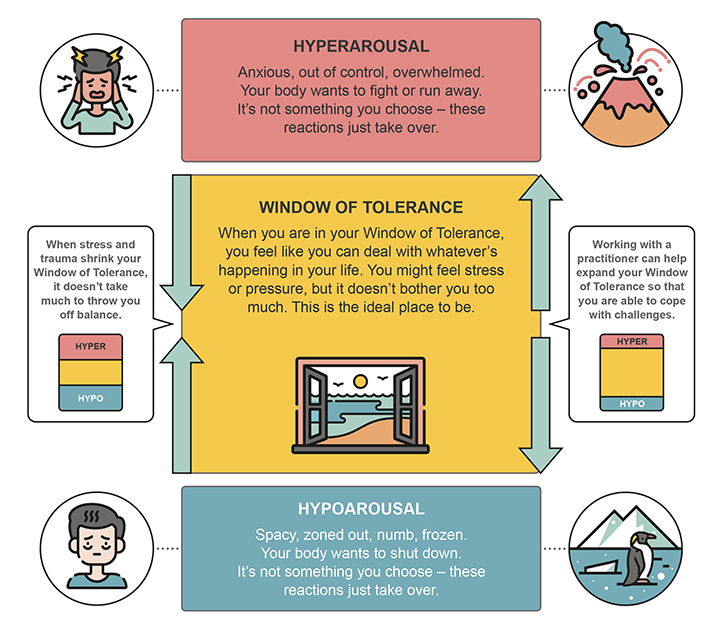
When pushed out of their window of tolerance, students can go into hyperarousal which is where they may feel anxious, out of control and in a fight or flight mode. They might appear to have too much energy and be fidgeting or tapping.
Students can also go into hypoarousal which can leave them feeling lethargic, spaced out or frozen. Neither of the responses are chosen by the student. They are, just like the fight, flight, freeze response, involuntary.
The window of tolerance is the state in which we can best learn, connect and play, be present and self-soothe. When a student is within their window of tolerance their internal voice is quiet, and they can better tolerate challenges independently.
When a child is out of their window of tolerance it is important to either energise them or calm them down to help them regulate their body and their behaviour.
Grounding and mindfulness exercises can be helpful to a child who is hyperaroused and physical activities can be helpful for a child who is hypoaroused.
How can you bring a person back into their window of tolerance?
Read through the diagram below to learn more about bringing a person back into their window of tolerance
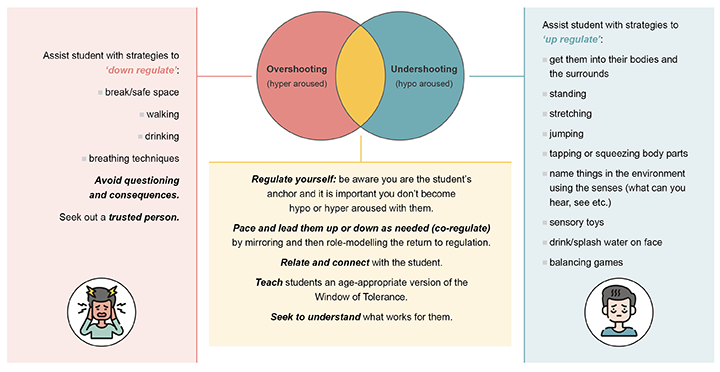
Next, you will explore the method of co-regulation, a useful tool for educators to use when working with children to return to their window of tolerance.
Effects of toxic stress