

Co-regulation
Co-regulation can be an effective way of helping a student return to their window of tolerance.
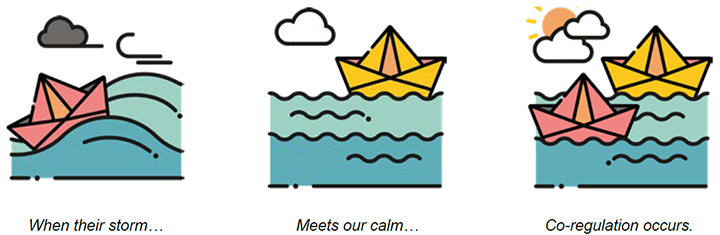
Remember you must stay calm in these situations and not mirror the panic or frustration of the student – even if what you are witnessing is upsetting you.
The images below provide a helpful guide for educators to remember so that they can effectively co-regulate with a student.
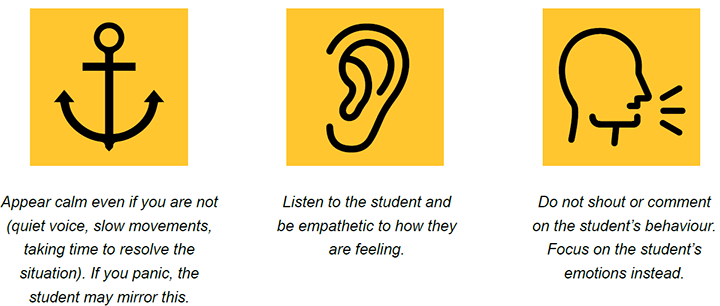
You are their anchor in the storm, and the student needs you to stay calm, collected and objective when they are out of their window of tolerance.
In the task that follows, you will work through an example from a teacher working with a student impacted by toxic stress. You will be asked to apply the technique of co-regulation and consider how this teacher can adapt their response should they be faced with a similar situation in the future.
 Task 2: Working with a student impacted by toxic stress
Part 1
Read the following account from a teacher working with a student impacted by toxic stress.
I remember when I was working with a class of refugee students, teaching them intermediate English. One student, Samir was so confident speaking in English and would be the first to jump in to answer any questions.
However, in one class, I was preparing my students for their exam, and we needed to focus on writing, as it was the weakest area for the whole class. Samir wasn’t writing anything but was answering verbally instead.
I asked him to write his answer so the other students wouldn’t take his answer and write it down and he refused. Taken aback by this usually polite student, I said “you need to write because this is the written exam”. He refused again and the other students stopped to watch what was going on.
The atmosphere in the room changed and became quite tense. “If you’re not going to do the work then you’ll have to leave”, I said. Samir got up and left, and the rest of the class was silent until the students finished their work and left. I couldn’t understand why Samir had been so rude out of the blue and refused to do his work.
I caught up with Samir the following week and chatted to him about what had happened and how we were both upset by it. He explained that he suddenly felt stressed, nervous about getting the answer wrong, and suddenly felt like he had to get out of the classroom.
Everything you have reviewed so far in the course could apply to any person with any kind of trauma and is not specific to refugees and asylum-seeking people.
In the following section, you will review some key information about the global situation of forced displacement and then zoom in on the specific types of trauma that a forcibly displaced person may have experienced.
This background knowledge can help inform your practice and allow you to lead informed conversations with your students about why people flee their homes, the types of experiences they may have on their journey to safety, and the challenges they may face upon arriving in a resettlement country.
The window of tolerance