Trauma and toxic stress for refugee and asylum-seeking people
You will now read some key information about the current global issue of forced displacement. This can help develop your foundational knowledge about this issue and consider the impacts on refugee and asylum-seeking children you work with and may work with in the future.
Currently, over 117 million people are forcibly displaced globally (UNHCR, 2024) and the numbers increase every single day.
People are displaced “as a result of persecution, conflict, violence, human rights violations or events seriously disturbing public order” (UNHCR, 2022). This figure is made up of internally displaced people, asylum seekers, refugees and undocumented forced migrants. It is the highest it has been in recorded history. We have more forcibly displaced people today than we did at the height of WW2.
In 2022, 53% of those under the protection of the UNHCR were from just three countries: Syria, Ukraine and Afghanistan and of those under the care of the UNHCR, 38% were hosted in just five countries: Turkey, the Islamic Republic of Iran, Colombia, Germany and Pakistan.
Of all forcibly displaced people globally, roughly 86% stay in neighbouring countries. Very few people can afford to make the trips to Europe or North America and many of those who attempt to reach these countries lose their lives on the perilous journeys they are forced to take in the absence of safe routes.
As most people struggle to find safe countries, with the support they need to meaningfully rebuild their lives, 1.9 million babies were born with refugee status in 2022. Overall, it is estimated that less than 1% of displaced people are ever able to resettle and find a new life in safety and security.
Due to ongoing conflicts and crises across the globe these numbers increase daily. Climate change is predicted to have a significant impact on the numbers of people becoming forcibly displaced and this is already happening in places most vulnerable to high temperatures, extreme weather events and rising sea levels.
Most refugees live in refugee camps rather than being able to live with the host country’s communities in houses or apartments.
Here are some of the largest refugee camps in the world today. Click on each tile to learn more.
Europe
Across Europe, refugee camps and detention centres have been on the rise since 2015. The conditions in most refugee camps have adverse impacts on people’s physical and mental health. Many refugees living in camps suffer from skin conditions, mental health issues and digestive issues due to the substandard conditions.
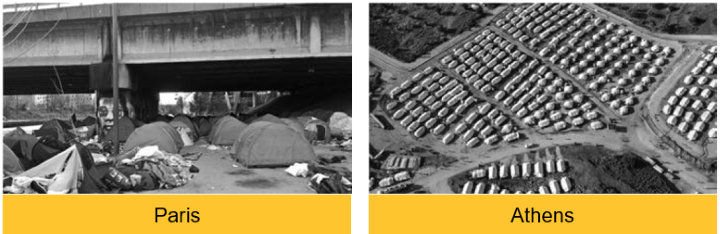
Refugees often have to pass through several countries to be reunited with family members or to find a country which can offer language classes, legal employment, safe housing, and education for their children so they can meaningfully rebuild their lives.
Several borders have been closed in Europe since 2016 to stop the free movement of people seeking sanctuary which has caused increasing numbers of people to get stuck in countries like Greece and Italy.
A closure of programmes offering safe routes from conflict-affected countries directly to safe countries has caused people to spend years trying to reach the countries where their friends and family are without proper assistance from organisations or governments, instead having to trust in smugglers to cross borders by land, air or sea.
Once children and their families arrive in our towns and schools, they may require support to feel safe and welcome as they may have experienced severe hostility, violence and abuse on their way to safety. Unfortunately, people seeking sanctuary are often treated with scepticism rather than being given the compassion and empathy that we would all need if we were forced to flee our homes in the UK.
You will now review a useful tool for imagining what a person may have experienced before entering your classroom – the Triple Trauma Paradigm.
Co-regulation