

Educator wellbeing and impacts
Wellbeing and impacts of working with students impacted by trauma
Working in an environment where you are supporting those impacted by displacement and trauma can take its toll on educators and other school staff. It is important to monitor your wellbeing continuously as you do this work.
Vicarious trauma and compassion fatigue can come about from working in high-pressure environments where you are hearing traumatic stories on a regular basis.
As you read the following impacts, reflect on your own wellbeing.
| Vicarious trauma | Compassion fatigue |
|---|---|
Dealing with personal trauma is challenging but so is helping others work through their trauma – and it may result in vicarious trauma. Vicarious trauma is the accruing effect of being exposed to someone else’s trauma – trauma that you have not personally experienced, but you’ve learned about from others. | People feel that they cannot commit any more energy, time, or money to the plight of others because they feel overwhelmed or paralysed by pleas for support and that the world’s challenges are never-ending. |
This is a type of trauma.
|
This is not a type of trauma.
|
How to identify vicarious trauma:
| How to identify compassion fatigue:
|
If you are experiencing any of these signs, speak to your colleagues or senior leadership team to gain the support you need. If you feel the signs are impacting your daily life significantly, reach out to your GP for further support and consider adaptions your school may need to make to ensure you are well enough to continue your work in the future.
Community care
Community organisers and most non-Western cultures have stronger focuses on community care than self-care. Community care can solidify practices long-term to support everyone in school from staff to students to their families.
Recommended strategies to promote and maintain staff wellbeing can help staff who need support now and build resilience for those who may need it in the future.
In the following task, you will review some examples of community care strategies that could be used to support staff in a school setting.
 Task 5: Support for staff in your workplace
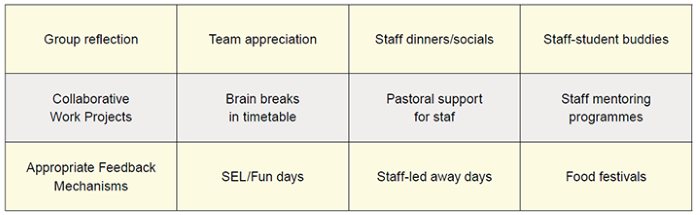
Read through the table of strategies above.
Choose three suggestions and explain what these could look like in your setting and how they could help provide support for staff in your workplace. To make your selection, you may want to consider how well they fit with existing activities or policies you have in your workplace and with any needs, gaps or concerns that have been expressed in staff meetings recently.
If you feel comfortable doing so, take one suggestion to discuss with your senior leadership team or raise in your next staff meeting. If you are not comfortable doing this, consider if you could try one of these strategies on a smaller scale, for example, in your subject department instead of the whole school.
Make notes in the text box below.
Comment
This activity demonstrated the various ways schools can adapt their policies, procedures, routines and ways of working to better support their staff and student community.
Consider which ones may best fit your setting and start conversations with management/leadership to see what can be improved in your setting to better support everybody in school.
Individual trauma and collective trauma