
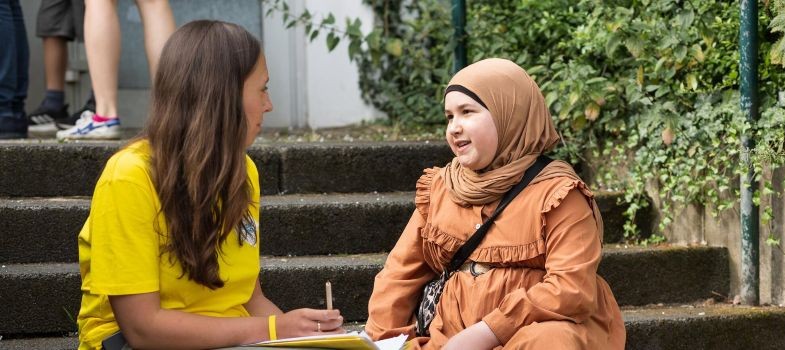
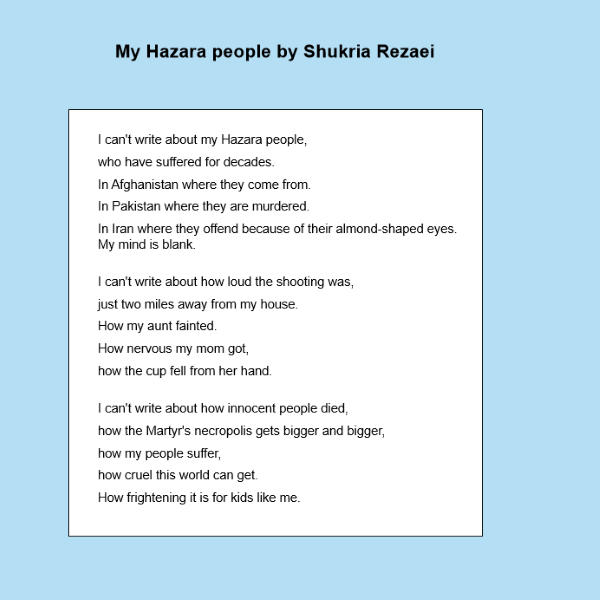
Poem – My Hazara people by Shukria Rezaei
In her poem, Shukria Rezaei explores the importance of identity when exploring an individual’s trauma.
Many refugees flee war and physical violence which is putting them in danger, but many face overlapping issues such as xenophobia, racism, ethnic cleansing as well as war.
Shukria wrote this poem when she was 15 years old.
As in Unit 1, you have the option to listen to the poem if you prefer. Or why not read and listen at the same time?
Transcript
These audio poems are a great resource to use in class.
In this unit, we will explore trauma-informed approaches with a detailed examination of identity and how this can impact a person’s experience of trauma and their route to healing.
Culture is a significant part of every person’s identity including music, food, crafts, beliefs and knowledge. Our senses can provide powerful moments of grounding and healing such as listening to a song from back home, smelling our favourite dish and working on a traditional craft we learnt as a child.
We often consider smells, sounds and images to be potential triggers when working with displaced children and youth. These can also be a part of the healing process. Sensory boxes can be a wonderful way for students to get back to a state of calm. They can be filled with sensory toys, scented objects, postcards, and nature (for example, leaves, stones or sticks) and can be useful for students of all ages.
In the next task, you will create a sensory box for yourself.
Take a quick moment to imagine what you would have taken with you to remind you of home if you were in Shukria’s situation.
Sensory boxes are a useful tool that can be used for mindfulness and grounding but can also be linked to academic tasks. For example, taking an item from the sensory box as a prompt for a story. If you are looking for ways to use sensory boxes in your classroom, in your own time, you may want to read the article, Using Sensory Experiences to Support Elementary Students [Tip: hold Ctrl and click a link to open it in a new tab. (Hide tip)] .
When creating activities, building lesson plans and considering resources to use in lessons, it is important to work through a trauma-informed lens to minimise the chance of retraumatising children, make them feel safe and respected and to take chances to rebuild trusting relationships.
Introduction