It’s important to note that not all children who are refugees will be traumatised by their experiences of conflict, displacement or resettlement and that no two people will experience traumatic events in the same way.
Schools can be excellent places to provide sanctuary to students who have endured conflict and displacement. They can also be places where trauma is worsened.
The following table shows common risk and protective factors for you to consider when welcoming refugee students.
| Risk factors | Protective factors |
|---|
Lack of adequate language support:- No translators during key conversations.
- No adaptions to lessons made to help student learn the new language.
- No trusted adult available for student to seek out when they need support.
| Opportunities for relationship building:- Buddy schemes to help students understand rules, schedules and to have a friendly face when they start their new school.
- Group work so student can rely on peer support to learn the content and the language.
- Structured play/games in lessons.
- Staff who actively try to get to know the student. Staff student buddy schemes can help achieve this.
|
Limited support during transition:- Key information is not translated for families.
- No translators so families can’t communicate properly with school.
- Key information about the family and student are not obtained during initial meetings so staff can’t give appropriate support to help the student to thrive.
- Child is not given school tour, translated timetable or time to prepare for starting school.
- Child is not given information about extra-curricular activities or are not provided with support to access them (e.g., transport/funding).
- Family may not be able to afford uniform or school equipment if no support is offered.
| Engaging parents/caregivers:- Coffee mornings for local parents and newcomers to mix.
- Language classes to provide integration support for adults.
- Cultural/religious celebrations planned by those in the community.
- Parent buddy schemes to help newcomers gain support from local parent volunteers.
- Regular check-ins about student’s wellbeing and progress.
- Signposting to other necessary services.
- Tour of school and local area.
- Key contact in school.
- Translated letters and invites.
- Explaining expectations of parents, students and teachers in your school.
|
Punishment-based behaviour management:- Detentions, shouting, being withdrawn from activities can further marginalise at-risk students.
- Shouting can also be a trigger reminding students of prior conflict and violence they may have endured.
- Detention is a term frequently used in asylum systems globally to refer to an enclosed camp which you cannot freely leave. Often people are sent to detention after a rejection before they get deported. Students may easily misunderstand this term when used in a different way in schools.
| Programmes to suit students’ needs:- Consider student’s learning gaps, talents and aspirations.
- Have explicit conversations about student’s interests and hobbies.
- Use growing knowledge of student to link learning to their prior knowledge to allow for more participation in lessons.
- Introduce student to extra-curricular activities.
|
Environments which are not inclusive:- Students may feel they need to hide their culture, religion, identity or experiences and struggle to feel safe or welcome in school.
- School may not consider the specific needs of a student so the student may find they have no place to pray, no suitable food to eat and no uniform options which comply with their religion.
- School may not be behaving in a trauma-informed way when dealing with student’s behaviour, or teaching and learning, so the student does not feel safe and is unable to progress academically.
| Use of interpreters. If children are able to communicate their needs, schools will be able to meet them:- Use interpreters for key conversations and to get to know the student better.
- Assign student a staff buddy who meets with them regularly (e.g. at the beginning or end of each day for a 5-minute check-in).
- Without interpreters, key information can be missed, which could save a lot of time and confusion down the line.
|
Lack of adequate anti-bullying procedures:- Schools does not have clear anti-racism policies, anti-xenophobia policies and anti-LGBTQIA+ policies and student has no one to talk to about bullying they are experiencing.
| Continued support responsive to needs:- Goal settings activities.
- Regular feedback to encourage student during this challenging time.
- Conversations about aspirations.
- Monitoring students’ progress and supporting with any gaps.
|
When making policy, teaching and interacting with students, always remember to work in line with these principles so as to not retraumatise a student accidentally. Ensure these are utilised when working with parents and families too, keeping in mind that parents have not only experienced these things themselves but had to protect their children from them simultaneously.
To provide more insights into what trauma-informed care can look like in the classroom, you may watch the following video.
Interactive feature not available in single page view (
see it in standard view).
To ensure trauma-informed care is implemented properly, ensure these principles are used to guide policy, programming and individual behaviour. Above all, school staff must ensure that they do no harm.
You must never push a child to share what happened to them or expect them to have the same response as another child with similar traumatic experiences. Singling out students for their behaviour can also seem very threatening to them.
Next, you will complete a task reviewing three scenarios and adapting them to ensure they follow the six principles of trauma-informed care.
 Task 5: Responding in a trauma-informed approach
Timing: 5 minutes
Using the six principles of trauma-informed care, how could you respond to the situations below in a trauma-informed way?
Read the first example and then complete your own responses to the second and third examples in the text boxes below.
| NOT trauma-informed | Trauma-informed approach |
| “Everybody else is in their seats and again we’re waiting on YOU to listen!” | I would take time to sit with the student and decide on appropriate classroom behaviour together is a way of involving mutual collaboration. Involving the student in the process and discussing why we should behave this way can help get more buy-in from the student and help build rapport by showing I am a trusted adult who is honest and transparent with them. |
| “Ayesha has also come from Syria and she’s not using it as an excuse to misbehave.” |
To use this interactive functionality a free OU account is required. Sign in or register.
|
| “He won’t share anything about what happened to him in Afghanistan so how can I figure out how to help him?” |
To use this interactive functionality a free OU account is required. Sign in or register.
|
Interactive feature not available in single page view (
see it in standard view).
Comment
No matter the situation or your needs as educators or as schools, you must always ensure that you do no harm.
The task may have helped you to consider other ways you can manage behaviour using positive classroom management, the clean slate approach and collaborative rulemaking as a class.
You will cover these in Units 3–5 as you complete more tasks and reflections using the recommended Healing Classrooms strategies.
Healing Classrooms is an example of trauma-informed care.
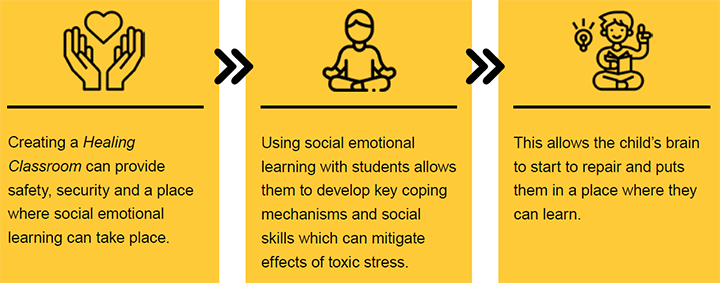
Show description|Hide descriptionCreating a Healing Classroom can provide safety, security and a place where social emotional learning can take place. Arrows to. Using social emotional learning with students allows them to develop key coping mechanisms and social skills which can mitigate effects of toxic stress. Arrows to. This allows the child’s brain to start to repair and puts them in a place where they can learn.
Next, you will learn about identity-informed approaches to healing.
Identity-informed approaches are an integral part of trauma-informed care and are especially important when working with people who have a culture different to your own.
All of the Healing Classrooms strategies are based upon trauma-informed and identity-informed approaches to reduce the chance of retraumatisation and to put the specific needs of refugee students at the centre of your work.