The Social GRACES Framework
The Social GRACES Framework is an acronym standing for Gender, Geography, Race, Religion, Age, Ability, Appearance, Class, Culture, Education, Employment, Ethnicity, Sexuality, Sexual orientation, and Spirituality. It is another tool to help us understand our intersecting identities.
Created by John Burnham and Alison Roper-Hall, it is a tool used to understand how different aspects of personal identity intersect to create power and privilege differences. It explores how out intersecting identities can also put us at risk of different oppressions depending on the society we are currently in (Burnham and Roper-Hall, 2017).
For example, a student who belongs to the Pashtun ethnic group in Afghanistan will gain certain privileges due to how this group is treated and viewed in Afghanistan. However, if that student is displaced to Pakistan, he will likely face persecution and oppression due to his ethnicity, as Pashtun people are often shunned and targeted by the Pakistani military and government. His identity has not changed but the way it impacts him has.
The Social GRACES Framework is often used by social workers, healthcare professionals and teachers to analyse the unconscious biases we may hold towards certain groups and how that impacts the work we do with individuals belonging to those groups.
The invisible backpack framework when combined with the Social GRACES Framework can create a useful activity for reflecting on the multiple and overlapping identities every person in school has. In the following task, you will explore how these frameworks combine to make a useful tool.
 Task 6: The invisible knapsack
Look at the GRACES model below and note what each letter stands for.
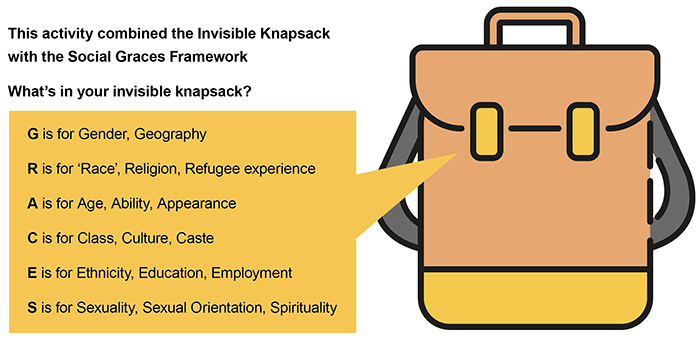
Use this model above to complete the blank version of the knapsack below with your own personal information.
| G |  | |
| R | ||
| A | ||
| C | ||
| E | ||
| S |
Comment
Hopefully, this activity helped you to gain deeper clarity over your own overlapping identities and gave you time to reflect on just how important these are in shaping your experiences in society. Take this knowledge back into your classroom and consider facilitating an age-appropriate version of the invisible knapsack (e.g., what makes you who you are) to help get to know your students better and use this knowledge to provide appropriate support where needed.
This tool can be adapted to be age appropriate. With younger children you can ask them to decorate their backpack with things that make them who they are. Students should only be encouraged to share what they are comfortable with, and teachers can model this activity for the class to show they types of things students can choose to share.
The invisible knapsack helps you to analyse how our identities can and do impact everyone's life and the way people view and treat others – this goes for your students too.
For some students, they will see people of their race and culture widely represented throughout the curriculum and be able to better identify with the content as it reflects their lived experiences. For others, they may only see their culture represented in a History or Geography lesson very occasionally or in a background character in a novel or play.
Some students will see people of their race regularly linked to crime in the news or on social media and they may notice that their behaviour is challenged or punished more than other students in class who are behaving in the same way.
It is vital that educators and other school staff become better at seeing and understanding these prejudices linked to identity so they can unlearn them, unteach them and examine their own behaviour towards their students which they may not have noticed before.
People's identities shape the way they are treated, the way they exist in their societies and, ultimately, the ways in which they can heal. If schools are not inclusive, both in their treatment of all students and the inclusion of their identities in the curriculum and school life, students may struggle to feel safe, welcome and to heal. It may be uncomfortable to have these conversations and to reflect on your own assumptions and behaviour, but it is vital work if schools are hoping to support all our students effectively.
Bringing identity into the classroom
Healing can take place through learning as well as focused wellbeing support. One way to aid this is through improving self-worth for your students by celebrating parts of their identities in lessons.
Think of a topic you have taught previously. Reflect on how you could bring elements of your students’ identities into their learning.
Consider the following examples for inspiration.
“I’m a Food Technology teacher and I encourage the children to bring in recipes from their cultures. They help to teach the recipes to the class and share information about the origins of the food. The students look so proud to be able to share a part of themselves and show off who they are.”
"I'm a History teacher and I ask each of my students to choose an event that they believe had a significant impact on the country of their ancestors."
"I'm an English teacher and I set homework for my students to find and translate poems from a country they have ancestral links to."
"I'm a Geography teacher and I asked each of my students to bring a case study of a natural resource found in a country they have a family link to."
In this section, you have looked at using an identity-informed approach to help you better understand and support all students. This is an important aspect of trauma-informed care. Another important aspect is psychosocial support that you are going to study next.
Identity-informed approach