
Positive behaviour management
1. Co-creating classroom rules

Engaging students in understanding and creating rules to govern classroom behaviour can support a sense of control and a positive learning environment.
Establishing clearly defined classroom rules that compliment class routines boosts a sense of stability and calmness in the atmosphere.
By actively involving students in the creation of classroom rules, it will likely increase their adherence to the defined boundaries as they feel a sense of ownership and stronger incentive to cooperate (University of Kansas, 2000). When students feel that they have a voice in the way the classroom is run, they are more likely to take responsibility for self-monitoring classroom behaviour.
Another component is that disciplinary measures should be applied consistently and in a manner which prompts students to think about and learn from their mistakes. For example, a teacher or other staff member can meet with a student involved in disruptive behaviour to discuss what the student felt before and during the incident, why they made specific choices, and alternative actions they could have chosen (Pasi, 2001).
2. Five core rules

Having students choose rules gives a sense of control and ownership over the classroom. By keeping the list focused and limited to five rules, it allows all students to remember the rules.
Teachers should guide this rule-making activity around acceptance, respect, and compassion to help students choose rules that make the classroom a healing, safe space. Allow students to vote on rules to teach democracy, community building, and empathy.
Students can work together to create a poster displaying the rules of their classroom on the door or wall. Examples of rules could include “we show respect when a student is speaking but listening and being quiet”, “we don’t touch other people’s things unless we have asked first”, “we work as a team and offer help if another student is struggling”.
3. The clean slate

Mistakes are forgiven – every lesson offers a fresh start and chance to succeed. Provide a safe space for children to grow and learn.
Refugees may display certain behaviours in response to trauma – and it is vital that teachers move on from these, every lesson, and see the potential for change. Focus on emotion regulation games and lessons as a solution, rather than punishment and a hostile classroom.
4. Clear and consistent consequences

Students who are aware of boundaries are more likely to feel calm and in control of their behaviour. Students lose faith in rules and consequences if they are not applied consistently and fairly.
Dedicate a lesson to deciding fair consequences for students who break the rules. These should be common sense-based, for example, “we are putting the paint away now and stopping this activity because people are throwing paint around and being silly. We will have to spend our time cleaning up now instead of using it to finish our paintings”.
5. High expectations for all

Never assume that refugee students will not succeed or are not intelligent due to education gaps, language barriers and potential trauma. We must set high expectations for all students and identify ways to fill any learning gaps they may currently have.
The EAL Academy (an organisation that supports schools to provide better support to English learners) strongly encourages schools to place refugee children in high ability sets or on high ability tables so they can see good models of learning and use of English.
Placing newcomer refugee students in lower ability sets or tables isn’t necessarily the appropriate place for all students. It can often mean they won’t be academically challenged appropriately for their individual needs, and they could miss out on learning opportunities that other students in their year are getting. Students should be given time to settle in and then placed in the appropriate ability group.
Students in higher ability groups can often provide more support to new students, as can teachers, as the students in these classes are often more independent.
6. Meaningful praise

Using praise for small achievements academically, socially and behaviourally can help guide a student’s behaviour in a positive way rather than using the threat of punishment to push students into line.
Some newcomer refugee students may have had traumatic experiences in school before, such as experiencing the use of corporal punishment, racism and xenophobia from students and staff and other kinds of bulling.
Teachers collaborating with students and showing that they are noticing the work they are doing can help rebuild this trust and show students that they are valued and important members of the school community.
7. Personal goals

Refugee students have been disrupted in monumental ways.
Many have gaps in their education and may not have been given space to think about their future and goals. Teaching children to set achievable goals for themselves serves to increase their self-efficacy which leads to improved task performance and an increase in motivation.
Consider setting goals in a holistic rather than purely academic way, focusing on social skills, feelings, behaviour and participation to encourage the child’s inclusion in your school community.
For example, I will try to take part in one game at lunch time; I will use the breathing exercise if I feel overwhelmed; I will put my hand up to give a suggestion today. Remember that even the smallest steps can be huge for children who have experienced so much.
A staff member should work with the child on these and check in with regular rewards even for little wins to show that the child’s success is noticed and valued.
Strategies sheet and seating plan
Please download the Strategies Sheet [Tip: hold Ctrl and click a link to open it in a new tab. (Hide tip)] so you can refer to this list as you complete the remaining tasks in this unit.
Below you will find a seating plan activity to download and use in your own time. This helps you consider if the students in your classroom are seated in the best places to support and challenge each other.
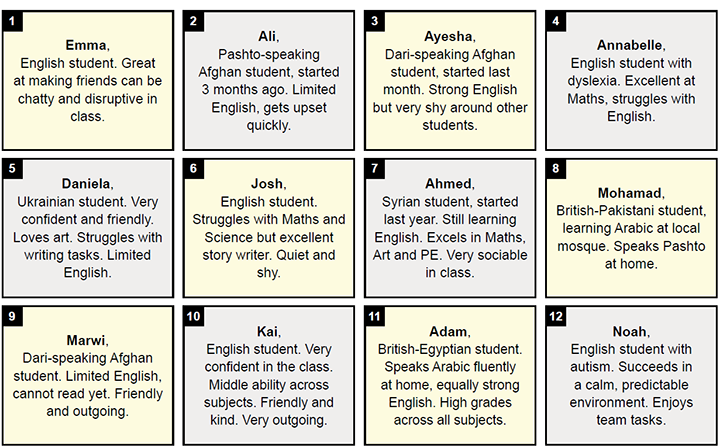
You may wish to use this in a staff meeting and work in small groups to discuss which students should be placed where and the reasons justifying this before asking your colleagues to reflect on their seating plans and how they are utilising students’ strengths, knowledge and skills to support each other and work well together.
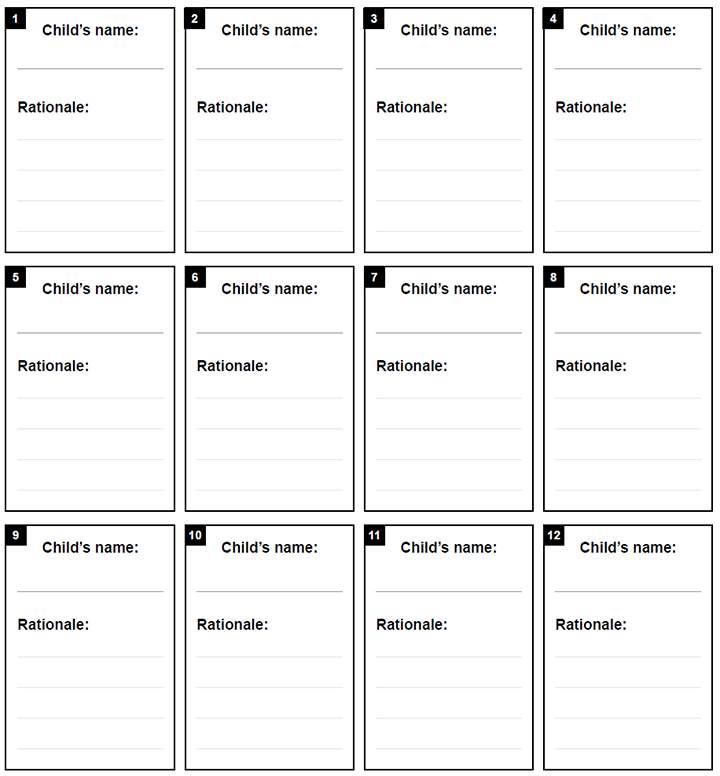
You can download a PDF of the Seating Plan.
 Task 10: Case study – Abdullah from Sayyan, Yemen

Now you have had time to familiarise yourself with the strategies, take a moment to read through the following case study and choose three strategies that you believe would be most appropriate to support this specific student.
Complete the table below justifying why you chose each strategy and how it could help that specific individual.
Abdullah from Sayyan, Yemen
Age: _________________ (Choose an age group that you work with)
Abdullah fled Yemen with his brother and father due to the famine and frequent bombings from Saudi Arabia.
His mother – a university lecturer – was invited to a conference in Europe and overstayed her visit visa to claim asylum and escape the war. Unfortunately, the process is slow, so the rest of the family had to leave before she could apply for reunification for her sons and husband.
They instead had to trust in smugglers to reach the UK. Abdullah is now at your school. He has made a few friends through the football team and speaks English well but is struggling to keep up with the school rules.
Which three strategies would you use to prepare a safe space for Abdullah to land?
| Chosen technique | How I would use it | How it could help |
Comment
Utilising personal goals and meaningful praise could help guide Abdullah's behaviour as well as co-creating five core rules as a class.
Yemen, located on the southern tip of the Arabian Peninsula, is plagued by war, poverty, malnutrition and cholera, amounting to one of the world’s most severe humanitarian crises. The IRC provides lifesaving assistance and emergency aid. Find out more about IRC’s work in Yemen.
Establishing consistency