Recommended strategies for building a community for learning
Group work

Research conducted by Harvard University found that refugee students settled easier in schools where “group work was the norm”. This gave students space to work together, chat, support each other and build relationships which provided extra support for them in their new community (UNHCR, 2022). Teachers should choose groups carefully and select students who might get on well with the new student to help form friendships in the classroom.
Focus on inclusion

Harvard University researchers found that the decisions made by school staff regarding classroom culture, school ethos and curriculum adaptions often determined whether new refugee students were included or excluded (Lander, 2020). UNESCO found that when practical adaptions were not made, it impacted the quality of education for refugees and their feelings of belonging within the school (UNESCO, 2019).
Strong rapport with teachers and other staff

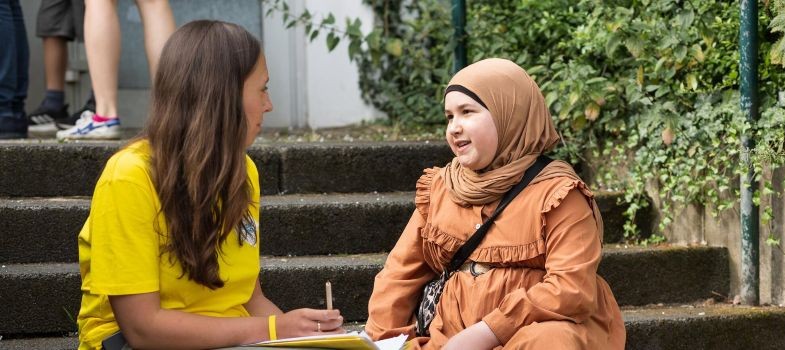
Getting to know your new students is vital to them settling into the school. Finding time to ask questions in class, speaking to support staff to find out about specific needs, and having conversations during breaks will help the student feel valued and important in your classroom. It may also help explain behaviour issues and challenges they face in class.
Encourage extra-curricular activities

Extra-curricular activities can help students to utilise an existing skill or hobby or develop new ones. They also give space to meet new people outside of the classroom, learn English in a non-formal environment, and to gain a sense of self-worth outside of academic classes.
Build cultural competence and humility among students and staff
To meaningfully resettle refugee children, staff and students must show “respect and appreciation of diversity and a willingness to examine one’s own cultural values and beliefs”. Most importantly, they must understand that “one culture is not superior to another” (Ballard-Kang, 2017).
Nurture respect throughout the school

Schools should embed an ethos of respect through assemblies, mottos, weekly aims for students and staff, celebrating key figures from other cultures, and awareness of religious and cultural holidays – also by actively teaching and learning about refugees. There are lots of ready-made resources online from UNHCR, Amnesty International, the Red Cross, Oxfam, UNICEF, Refugee Week, YouTube, and more.
School beautification projects

Staff and students can take on creative, hands-on projects to build a sense of belonging and community. Examples could include designing a school garden, making display boards, completing pieces of artwork like a school mural, or redesigning an area of the school like the library to make it a welcoming place for students to spend time.
Relationships with families/caregivers

Schools should seek to work with families to help them access services and support them where they can. Some schools have dedicated an hour a week to teaching English to parents and family members, others have welcomed families to the school for tours. Additional ideas could include afterschool meet and greets, fun days on the weekends, family bake-sales, and charity fundraisers.
You can download a PDF of the Unit 4 Strategies Sheet [Tip: hold Ctrl and click a link to open it in a new tab. (Hide tip)] .
Watch this video to see how one school has implemented similar strategies and the impacts it is having on their students.
IRC UK has free Social Emotional Learning Games Banks and Lesson Plans available online.
In your own time, feel free to download them and select activities you would like to try in your school. See IRC’s Approach to Social and Emotional Learning for more information.
The next section demonstrates an example game from the Games Bank which is a great way to bring new students into the class.
Importance of self-worth