Working towards cultural competency
Cultural competence is the ability to effectively and respectfully communicate, interact, and work with people from different cultural backgrounds by understanding, appreciating, and adapting to diverse beliefs, values, behaviours, and practices.
Review the table below to explore the different steps towards cultural competency.
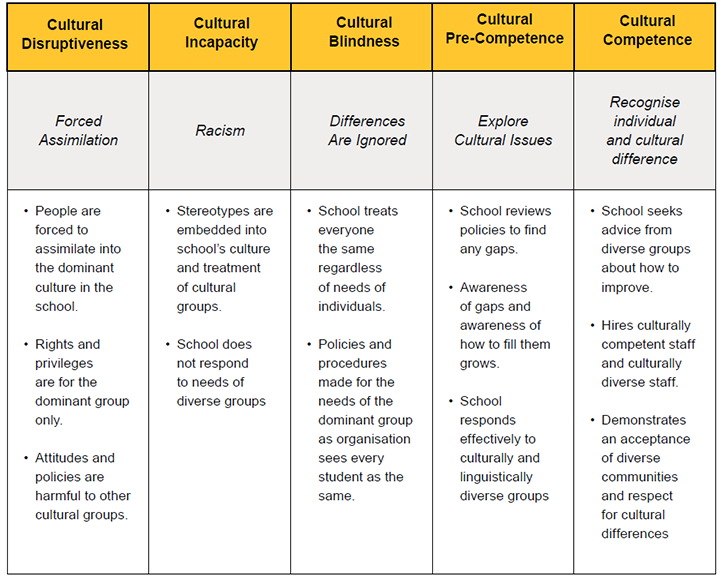
Take a moment to reflect where your school, the staff and the students may fit on this scale. Reflect on any areas for improvement you may notice and any areas where your school is doing well. It is important that schools seek to understand the basics of new students’ cultures and religions so their basic needs can be met.
Click on each number to reveal some examples.
The table above on the different steps towards cultural competency may make it appear as if cultural competency is an aim that can be completely fulfilled where a person can become a so-called expert in another’s culture.
Cultural humility is the overarching understanding that as we seek knowledge and understanding about each other’s cultures, to ensure we can work together in respectful ways, we will never truly be an expert in a culture other than our own.
Cultural humility helps us to move away from an expert-subject relationship which may include a certain power dynamic. It is a lifelong process of self-reflection and critique to understand different perspectives, a commitment to addressing power imbalances and promoting justice, and a willingness to develop partnerships with others based on mutual respect.
To understand the difference between the two:
| Cultural competency | I completed a workshop on Culture X. I am now an expert of Culture X. |
| Cultural humility | I understand that learning is a life-long process, and we must critically self-evaluate while listening to others advocate for themselves. |
Cultural humility can help you to avoid making assumptions based on your knowledge of a culture and see the individual in front of you and their specific needs whilst being respectful of their culture.
Watch the following video to learn more.
An excellent activity to get to better know your students, their cultures and them as individuals is by making Identity Mirrors.
These are display boards made by and for your students and can include a variety of things:
- I Am From poems
- Self-drawn portraits
- Handprint from building a unified class activity
- Cultural items (or photos of cultural items) important to student
- Student work that links to culture
- Letters written to past/future selves
- Languages they speak
- Photos or items from celebrations important to them
Building a unified class