Culturally responsive pedagogy
You will now explore a theory which all of this unit’s recommended strategies fit into – culturally responsive pedagogy.
CRP helps all students to learn better by using a vast range of teaching and learning techniques, making the content relevant to the lived experiences of students, and developing growth mindsets in students so they persevere even when the learning is challenging.
CRP helps develop an academic mindset to prepare students for further and higher education where they are required to mull over information until it makes sense.
Where CRP has been used effectively, children experiencing extreme adversity have gained higher grades, have improved school attendance, and have better mental health outcomes overall (Hammond, 2014).
CRP can be broken down into three key components, as shown in the diagram below.
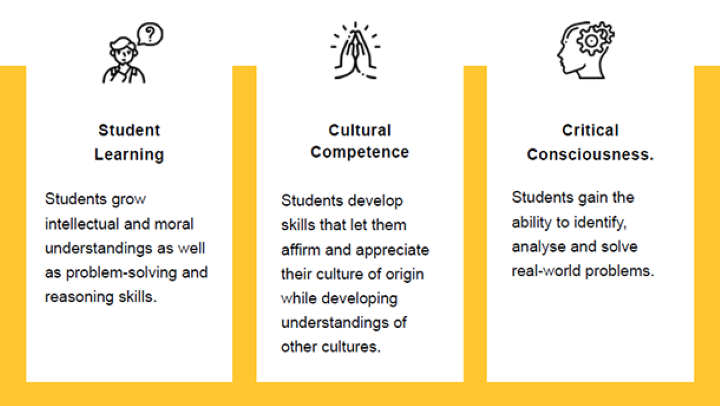
CRP teaches students about the process of learning itself, helping them to appreciate challenge and struggle, rather than always getting to the correct answer straight away. It explores a learning pit, where students may get stuck trying to figure out a task or a concept and it celebrates that moment of confusion and struggle before a student reaches an understanding of the content.
This struggle is what helps students to get into an academic mindset and build the skills required for further and higher education and life after school.
Why is culturally responsive pedagogy vital for refugee students?
Click on each number to learn more.
Strategies for fostering academic success