This is just the beginning, so what now?

Congratulations! You have now completed the Healing Classrooms Course.
You have explored an introduction to trauma, different routes to healing including trauma-informed and identity-informed approaches, and the 3-step Healing Classroom Approach – the IRC’s trauma-informed approach to educating children exposed to crisis, displacement and potential trauma.
You have covered key theories such as trauma-informed care, identity-informed care, psychosocial support, cultural competence and humility and culturally responsive pedagogy – all of which are combined in the recommended strategies you have read in this course.
Now, consider the following ways that you can utilise what you have learnt:
Sign up your school for a whole staff training with a Healing Classrooms facilitator – for the 3-part Basics course [Tip: hold Ctrl and click a link to open it in a new tab. (Hide tip)] or for the 5-part accredited CPD course. Alternatively, book a free Healing Classrooms Conference by emailing healingclassrooms.uk@rescue.org.
Sign up to become a Healing Classrooms Champion (our train-the-trainer programme) running since 2024.
Come along to our Monthly Monday Munch Club (a community of practice where we hear IRC speakers and others discuss refugee education). To sign up simply, drop us an email to healingclassrooms.uk@rescue.org.
Share the information you learnt and the resources with your colleagues, as well as recommending that they also study this online course.
Read through the IRC resources to see what you can use to benefit your students.
Arrange meetings/discussions with school leadership team to discuss what you have learnt.
Make adaptions to schemes of work. Add diverse images and examples as a first step.
Reach out to local charities who work with refugees to set up links and share resources.
Set up Social Emotional Learning clubs using the IRC’s Games Bank and Lesson Plan Bank, days or assemblies to introduce the topic to your school.
Consider practical changes that can be made instantly in your school.
Consider the needs of refugee families:
Can your school offer English classes?
Can staff/parents donate items needed for a new families’ homes?
Can school pay for uniforms if the family cannot afford them or donate good quality second-hand uniforms?
Schools should translate all key documents and staple them to original forms so families can know what needs to be completed and how. Sit with families while they fill out important forms rather than sending papers home which may not be understood.
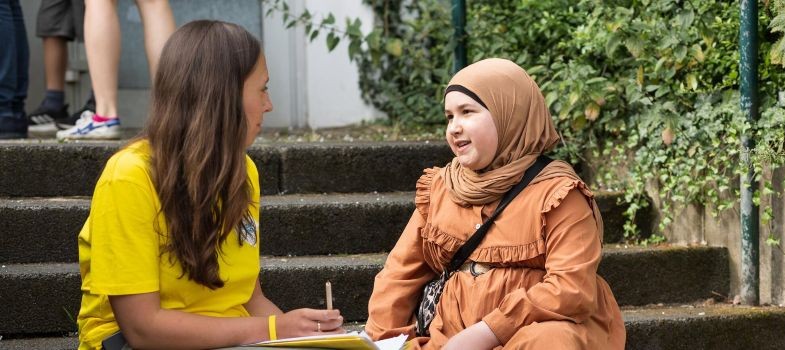
The IRC maintains a strong commitment to supporting teachers throughout the UK. We recognise that for many newly arrived children school can often represent the only sense of normality and routine in their lives and that teachers are a fundamental part of helping them to recover and thrive.
We regularly update our website with new resources and hold monthly meetings where we invite guest speakers to share their expertise and experience. You can also request a 1-1 follow up call with one of our team to talk through your situation and provide tailored advice. You can find all this information and more on the Healing Classrooms UK website.
And finally, thank you for taking the time to complete this training and for your commitment to supporting refugee and asylum-seeking children and youth in the UK. Do not underestimate the impact a few small changes can have on a young person’s life.
Moving on

Unit 5 Summary