
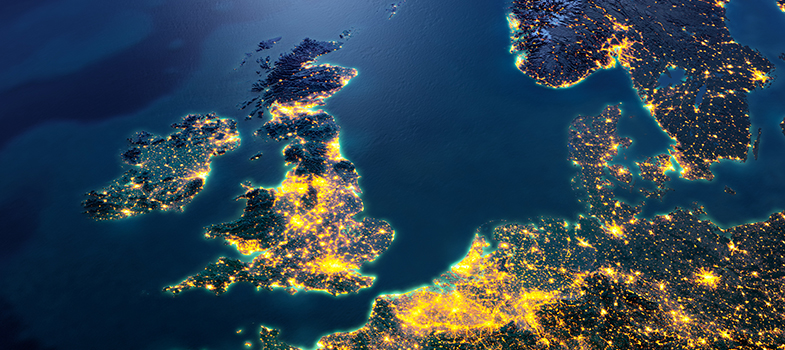
What’s in a name?
Before we look at governments, parliaments and policy across the UK in more detail, we’re first going to look at something fundamental to being a researcher in the UK policy landscape.
We’re going to review and remind you of the names of our territories, nations and states.
This is something that often confuses people – you will often see incorrect names and references in the news or even in policy debates.
For example, did you know that:
- the United Kingdom and Great Britain are different to each other?
- governments and parliaments are different organisations, and different across the UK?
- Ireland is not part of the UK?
Policy language
You will now watch a short video that will take you through the correct names whilst pointing out some common mistakes so that you can avoid them in future.
Transcript
Mind your policy language
What’s in a name?
‘That which we call our nations; By any other names would still make sense.’
With apologies to Shakespeare, we know that the terms and names we call our nations, across these islands, can be complex and confusing, with many of us making common mistakes.
The United Kingdom of … what and where exactly? Our islands … all-Ireland … Great Britain or British Isles … England and Wales … but what about Scotland ...
Lines on the map, names of our nations, it can be confusing.
Here is your PolicyWISE guide to getting it right.
Here are two large islands.
The one on the right is the island of Great Britain.
To the left, is the island of Ireland.
(There are many smaller islands around these two main islands, but we’ll stick to these two larger ones for now).
Great Britain
Great Britain consists of the nations of England, Scotland and Wales.
Each of these joined together, in different ways, over the centuries, to form a union and the political state of Great Britain.
Scotland and Wales have their own parliaments and governments, with powers that have been devolved from the United Kingdom parliament in Westminster.
England does not formally have its own parliament or government.
However, much of the work of UK government departments, and the business of the UK parliament, directly affects only England.
United Kingdom
Along with Northern Ireland, these three nations form a union that is the nation-state named the United Kingdom of Great Britain and Northern Ireland.
Constituencies in each of the four territories elect members of the United Kingdom parliament in Westminster.
Ireland
Northern Ireland covers much of the northeastern territory on the island of Ireland. It also has its own parliament and government.
We use the term Ireland for the whole island – and sometimes call it all-Ireland.
The island of Ireland is traditionally made up of thirty-two counties, and six of these are in Northern Ireland.
The nation state which covers most of the island, and which is not part of United Kingdom, is also generally known by the name Ireland.
It consists of twenty-six of those traditional counties.
This country is sometimes referred to as the Republic of Ireland, to distinguish it from the whole island or Northern Ireland.
Ireland is its own nation state, a member of the European Union, United Nations and other international bodies and agencies. Just like the United Kingdom is … apart from the EU bit …
It is not a part of the United Kingdom – although it was once for a period.
A president is the head of state in Ireland – whereas a Monarch is head of state in the United Kingdom.
How to avoid common mistakes
Whilst we can use Ireland for the whole island and for the nation-state of the Republic of Ireland – we definitely can’t describe it as part of Great Britain, England or the United Kingdom.
Northern Ireland is part of the state of the United Kingdom of Great Britain and Northern Ireland.
But it isn’t part of the island or three territories that makes up Great Britain. And whilst we sometimes use Britain or Great Britain when we mean the whole United Kingdom, this is incorrect.
Whilst some use the term British Isles for the two large islands and the other smaller ones, it’s best to avoid this term, as it suggests that Ireland is part of Great Britain or the United Kingdom in some way.
Historically England was – incorrectly – sometimes used as the name for the whole of Great Britain, reflecting its dominant position and its role in the union of the different countries.
‘England and Wales’ is the term for the legal jurisdiction which covers both nations – although there is now, once again, a growing body of distinct Welsh law.
And that’s your guide to minding your policy language when talking about our nations, territories, Ireland, Britain and the United Kingdom.
This is an essential foundation of building your knowledge of how the UK is constituted. It will help you refer to the different nations, and the UK as a whole, with confidence. As you have seen, different terms can refer to different institutions or levels of decision-making. Therefore, using the correct names helps to make sure that you’re talking about the right place or people – this is important when understanding and engaging with policy or policy-makers.
- Think about an issue you are particularly interested in. It could be something that affects you or your family, or an area of work or research.
- Does your interest or work lie in one nation, such as Wales or Scotland, or does it apply across the whole of the UK, in England, Scotland, Wales and Northern Ireland?
- Remember to note that the Republic of Ireland is a completely different nation state – but it shares the island of Ireland with Northern Ireland, which is part of the UK.
Let’s have a brief re-cap.
United Kingdom
The United Kingdom of Great Britain and Northern Ireland is the state and political union of England, Wales, Scotland and Northern Ireland.
During the 19th and early 20th centuries it included the whole of Ireland.
There are four governments and parliaments across the UK.
Great Britain
Great Britain is the island, and is the name of the union, of England, Scotland and Wales.
It does not include Northern Ireland.
Therefore, it is not the same as the United Kingdom – although it forms a large part of the UK.
Ireland
The island of Ireland includes both the state of the Republic of Ireland (also generally known as ‘Ireland’) and Northern Ireland, which is a constituent part of the United Kingdom.
The Republic of Ireland is not part of the UK and is a separate member of international communities such as the United Nations and the European Union.
It has its own government and parliament.
Reflective activity: Helping a Researcher
A Researcher has produced the following three statements, which include some inconsistencies – especially on the use of terminology related to the UK’s territories, nations and states. Can you identify the inconsistencies in the following sentences and correct them?
- The integration and governance of AI in secondary schools in Great Britain varies substantially across the four nations. This results in inequitable opportunities for pupils, inconsistent approaches to assessment and uncertainty for school leaders.
- Our comparative research on five jurisdictions (viz., England, Scotland, Wales, Northern Ireland and the Republic of Ireland) reveal the unequal distribution of AI policies to guide school education. The findings get more interesting when the whole British Isles are compared.
- The island of Ireland is uniquely positioned to deal with any matter related to Europe because it is a member state of European Union.
Answer
- ‘Great Britian’ is the wrong term . Perhaps Researcher ‘A’ means ‘the UK’ here, as they talk about the integration and governance of AI in secondary schools across four nations. Great Britain only covers three nations: England, Wales and Scotland
- The use of the term ‘British Isles’ is problematic. This term suggests that Ireland is part of Britain or the UK. Instead, if needed, Researcher ‘A’ could say ‘The findings get more interesting comparing the different jurisdictions across Britain and Ireland’.
- Here Researcher ‘A’ considers the island of Ireland as a single nation state, which it is not. It comprises of the Republic of Ireland, which is a member state of the EU, and Northern Ireland, which is constitutionally a part of UK and so not a member of the EU.
Let’s take a quiz to review what we’ve learned.
Quiz
a.
Three
b.
Four
c.
Five
The correct answer is b.
a.
Only when referring to the UK.
b.
You should avoid using it in any context.
c.
When referring to Britain and Ireland.
The correct answer is b.
a.
Constituencies only in England.
b.
Constituencies only in Great Britain.
c.
Constituencies only in the UK.
The correct answer is c.
Discussion
The following video discusses the answers to this quiz.

Transcript
Testing your knowledge