

Mapping your territory
Now that you are ready to engage with policy, with an understanding of the ‘who, what and where’ of policy in the UK, it’s time to share a tool that we use at PolicyWISE.
We call it ‘Mapping your policy territory’.
It is a unique way of understanding and engaging with policy. Unlike other tools, which ignore devolution or focus solely on one context, this tool engages with how the UK is actually governed, where policy happens and who is responsible.
It’s a three-part process:
- Defining and locating the challenge.
- Understanding what’s being done.
- Comparing what’s being done.
At PolicyWISE we map our policy territory each time we write or edit a ‘Wise in 5’ briefing. Wise in 5 is a snapshot comparative guide to public policy issues across the nations of the UK and Ireland.
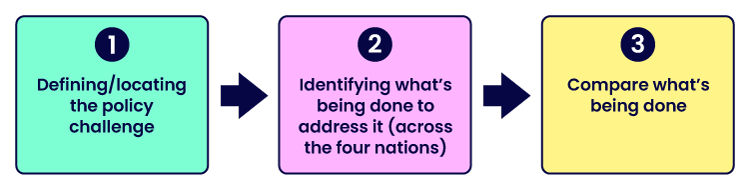
To start, you need to define and locate the policy issue or challenge. Keep these questions in mind:
- What issue(s) or challenge(s) does your research relate to (in the UK)?
- Where does this challenge exist/occur?
- How does your research or work address, or relate to, this challenge?
Then identify and understand what is being done.
- What’s the current legislative or policy situation?
- What are governments doing/what do the governments want to do?
- What’s happening in the parliaments?
- Who else is involved/interested? (Agencies, think tanks, advocates, etc.)
And then, recognising that the situation might be different in the different nations, compare what’s being done:
- What are the similarities/differences across nations/contexts?
- Where is progress/evidence/advocacy most advanced?
- What could the nations learn from one another?
- Where are the best opportunities for engagement?
The figure below is an example of Active Travel as a policy challenge and issue that has been mapped.
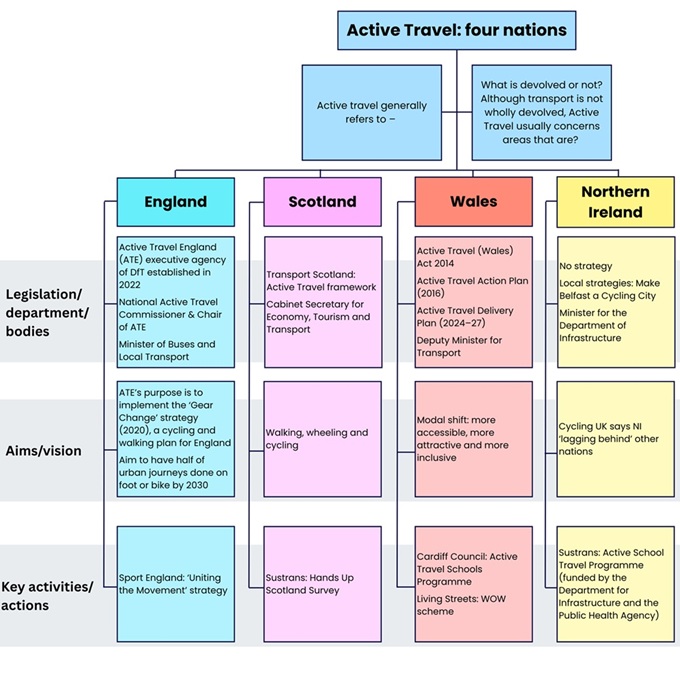
Mapping your territory is a very helpful exercise to conduct before engaging with policy and policy-makers, and it is a tool that you can keep using and updating. It helps you to:
- test whether others have the same view of the challenge as you do
- develop an understanding of the complexity of the issues and actors involved
- build an awareness of what’s happening on the issue across parliaments, governments and other agencies
- anticipate when the issue or challenge might be topical or discussed by policy-makers
- locate what is different in the policies, laws, processes or authorities across the UK.
Remember as you map your territory that each stakeholder might have very different roles and responsibilities – as well as views – on your particular issue or challenge. When you are ready to communicate with them, make sure to bear this in mind.
We’d encourage you think right across the four nations of the UK, but you can equally map your territory, using this model, within one nation or a smaller region.
Remember to:
- define and locate the challenge or issue
- assess and understand what is being done on that issue
- compare what is being done elsewhere on that issue.
Everything you’ve learnt across these modules will help you in that three-part process with the advantage of understanding how policy and power is distributed across the UK.
In following this three-step process, remember to ask yourself the following questions, which apply in any public policy context.
- What’s the current legislative or policy situation? Has there been recent legislation on this issue? Has there been legislation elsewhere? If so, is that legislation subject to regular reviews, and does it set statutory requirements for people or organisations?
- What are governments doing/what do the governments want to do? Does the relevant government (or authority) have plans to do something on that issue? Is there a manifesto or policy consultation? Has the minister made a speech or statement?
- What’s happening in the parliaments? Have members of the parliament been asking questions on this issue? Are any of the committees looking at this issue, or have they already looked at it?
- Who else is involved/interested? Does this issue involve another agency such as a government-sponsored body (for instance, non-ministerial departments of the UK Government staffed by civil servants such as the Food Standards Agency (FSA) and Charity Commission)? Do they have statutory powers to deliver policy? Are any think tanks interested in this specific policy?
You can use all the information across this training to help you answer these questions.
Remember to keep updating your policy territory and filling in the map as you continue to engage with your challenge or issue – or identify a new issue.
Reflective activity: How I engage with policy in the UK
Choose one issue connected to your research or interests and work through the following prompts:
- Step 1: Define and locate the challenge.
- What is the policy challenge or issue?
- Where does it exist (UK-wide, one nation, multiple nations, or a specific place)?
- Which populations or sectors does it affect?
- Step 2: Understand what’s being done.
- Which government(s) is (are) responsible?
- Which parliament(s) scrutinise this area?
- Is there legislation, strategy, consultation or current debate?
- Who else is involved (agencies, regulators, advocates, commissioners, think tanks)?
- Step 3: Compare what’s being done.
- Does this issue need to be addressed differently in Scotland, Wales, Northern Ireland and England?
- Are there noticeable differences in ambition, framing or progress?
Minding your policy language