Environmental management and organisations
Use 'Print preview' to check the number of pages and printer settings.
Print functionality varies between browsers.
Printable page generated Wednesday, 19 August 2026, 8:16 PM
Environmental management and organisations
Introduction
It is believed that environmental management requires action at all levels, including by organisations of all types and sizes. However, it is not always clear what we mean by environmental management, or the roles that organisations do or could play. This unit explores the different interpretations and viewpoints involved by using systems thinking to provide a framework with which to better understand environmental management and organisations.
This OpenLearn course is an adapted extract from the Open University course T219 Environmental management 1.
Learning outcomes
After studying this course, you should be able to:
provide definitions of environment, management, systems and organisations in relation to environmental management
describe organisations as systems and their role in environmental management
understand the usefulness of systems thinking in relation to environmental management in organisations
explain how environmental management can be used as environmental protection and how organisations can define and manage risk.
1 Defining environment
Environmental management is a widely used term covering a very broad topic area. Making sense of it is not always easy. To help you get started, let us begin by looking at the terms themselves. The terms ‘environment’ and ‘management’ are to be found in many contexts, but their meaning and interpretation can vary considerably. Understanding this variation is important to make sense of environmental management policies and actions.
According to the Oxford English Dictionary, ‘environment’ derives from the mediaeval French environnement used to describe the action of surrounding something and also to refer to surroundings and periphery. Today, ‘environment’ is often used to mean:
The physical surroundings or conditions in which a person or other organism lives, develops, etc., or in which a thing exists; the external conditions in general affecting the life, existence, or properties of an organism or object.
‘Environment’ is also often used specifically to mean:
The natural world or physical surroundings in general, either as a whole or within a particular geographical area.
It is also possible to use the term to refer to the social, political or cultural circumstances in which a person lives, particularly with respect to their effect on behaviour and attitude.
This flexibility means it is a very convenient term that can be used in many situations. But this flexibility can create problems. Principal amongst them is reference to ‘the environment’.
1.1 ‘The environment’
Does the phrase ‘the environment’ refer to the totality of the global environment? Perhaps it refers to a national environment of a country? Or maybe it refers to a local area? The images in Figure 1 represent the environment at different scales – the single tree in a field, the wooded area, the European area and the entire Earth. Describing any of them as ‘the environment’ opens up a question of scale and the boundaries between them. When does ‘the local environment’ become ‘the national environment’?
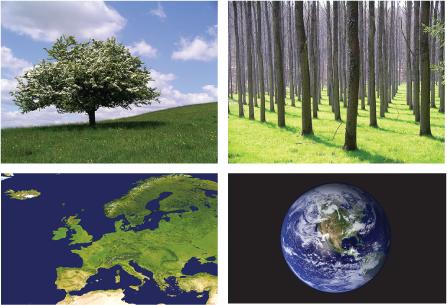
Scale issues apart, the phrase ‘the environment’ also presents significant issues in terms of who is using the term and in what way. Is ‘the environment’ of one person the same as ‘the environment’ of another person? This question opens up the issue of perception. When you look at the single tree in Figure 1, do you see the same environment as someone else? This question is important because using the term ‘the environment’ implies the environment exists independently of the person perceiving it and can be recognised, known and described with some certainty to, and by, others.
In other words, the phrase ‘the environment’ implies everyone perceives and therefore is likely to understand the same thing in the same way. As you will explore in this free course, this is not often the case, with important implications for environmental management.
1.2 Natural or human?
There is also another dimension to the problem of ‘the environment’, which is linked to ideas of nature and naturalness. Does a reference to ‘the environment’ include humans and their activities? The dictionary definitions I presented suggest not – the environment is something surrounding, but it is not part of humans. There are some quite extended philosophical arguments on whether humans are part of nature or the environment, which we won’t explore here, but it is important to be aware that these debates exist. Returning to Figure 1 helps give us a sense of the debates.
The solitary tree sits in a grassy landscape. Some would say it is not a natural environment, even if the individual elements themselves (the grass, tree and insects) are natural. This environment only exists in this particular arrangement because of ancient clearances of woodland for farming and subsequent sheep and deer grazing on the chalk hills in Hertfordshire, UK. A more natural environment here would probably be forest, but this too depends how far back in time one is prepared to consider. Would you include the marine environment that created the chalk bedrock the most ‘natural’ environment?
The stand of trees in the second image is a picture from the Ardennes area in Belgium. The environment here is also not entirely natural: the straight planting lines and uniform age of the trees betray human influence in planting for a purpose.
Few would argue the European environment is wholly natural. Perhaps the view of the Earth from space is the only offering of ‘the environment’, but with pollution and atmospheric changes this too might be considered no longer a natural environment.
Indeed some argue that we have moved into the Anthropocene era (Crutzen and Stoermer, 2000): a new era of Earth’s history where, for the first time, humans are dominant in shaping Earth processes and systems, giving rise to a shift in thinking about human–environment relationships. In 2011, The Economist noted this debate on its front cover.
The Economist also produced this short video of an interview with the ecologist Erle Ellis where he gives his ideas and examples about the Anthropocene era, and the ways in which environments are influenced by humans:
You can access this video here: Tea with Erle Ellis on the Anthropocene
Some of Erle Ellis’s views are quite challenging and the ideas have implications for what is natural and how environments should be managed. There is no agreement on whether we have entered the Anthropocene or when it started, but for many it does have an intuitive appeal as assessments of environmental change at many scales continue to point to direct human influences.
1.3 Whose environment?
There is another consideration to take into account about ‘the environment’ that is raised by the images in Figure 1. They are a particular view of a particular environment from a particular perspective: mostly a western and northern hemisphere perspective. Do they convey your understanding of what is an environment? If you live in a desert landscape or in a highly polluted, highly urbanised city, you may not consider an open landscape and green grass are representative of ‘the environment’, whether natural or otherwise, from your perspective.
For all these reasons, particular care is needed when using the term ‘the environment’. In this free course, ‘environment’ is generally used instead of ‘the environment’. This is deliberate to avoid falling into the trap of assuming there is a single, known, universally recognised and describable set of ‘things’ that exist in relation to each other that everyone agrees constitute ‘the environment’. Where we are forced, for reasons of grammar, to use ‘the environment’ we do so with awareness of its contested nature.
In fact, we use the term ‘environment’ in two main ways. First to refer to a set of things, such as plants, animals, rivers, buildings and so on, which exist in relation to each other as defined by someone. In other words, what is meant by ‘environment’ can include natural and non-natural elements and, most importantly, what is included is also observer-dependent. Your understanding of environment may differ from another person’s. The second use of environment is explored later on in relation to systems.
For the moment, however, the immediate concern is to recognise that ‘environment’ when referring to natural or human environments is a complicated term. The meanings attributed to it shift depending on context, scale and who is assigning the meaning. These aspects make it particularly important that you recognise and understand how and why the term environment is being used when you encounter it. This is also true for the term ‘management’.
2 Defining management
As with ‘environment’, the etymology of ‘management’ is revealing.
According to the Oxford English Dictionary, the English verb to ‘manage’ is derived from the thirteenth-century Italian maneggiare meaning to handle or to be able to use skilfully. ‘Manage’ was originally used in English to refer specifically to the directing or training of a horse. Later instances of ‘manage’ refer to use, manipulation, to conduct, to administer, to organise, to take charge and to supervise or control . It is no surprise then that ‘management’ is generally used to refer to:
Organisation, supervision, or direction; the application of skill or care in the manipulation, use, treatment, or control (of a thing or person), or in the conduct of something.
Whilst ‘management’ can often be associated with a positive interpretation in the sense that something is assumed to require management in order to ensure it is improved, it is notable that the dictionary definition also makes clear that ‘management’ can also refer to cunning, deceit, trickery and connivance!
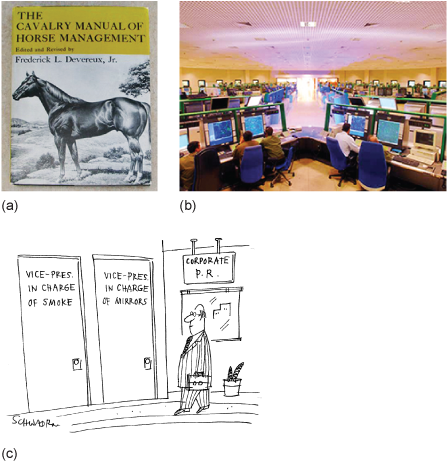
‘Management’ can thus refer to an instance of managing, an administrative act, a governing body of an organisation or business, or the group of employees that administers and controls a business or industry, for example. It is also used to refer to the working or cultivation of land, in particular, control of a forest, environment or nature reserve, and, over time, has been extended to include maintenance, conservation and encouragement of natural resources, such as game, fish and wildlife. As with ‘environment’, you will encounter several uses and meanings of ‘management’.
In this free course, ‘management’ is used to refer to the act of managing to control, organise or put in place various arrangements for using some aspect of an environment comprising natural components (e.g. plants, rivers, soil), technologies and people by an individual, organisation or community.
It is important to add a note of caution here in that ‘management’ tends to imply that there is a known procedure, administrative process or skill set that can be used to control, organise or direct resources for some purpose. Whether these procedures and skills are known and available, and whether some environmental issues can be controlled is debatable.
Having established some sense of ‘environment’ and ‘management’, what do we mean when we combine the two terms into ‘environmental management’?
3 Defining environmental management
Given the definitions of environment and management provided so far, you might not expect defining ‘environmental management’ to be straightforward. You would be right. Here is the definition from the Oxford English Dictionary:
Environmental management (noun): (a) chiefly Psychol. manipulation of the physical or social environment of a person or group; (b) management of human impact on the environment, especially with the intention of preserving natural resources.
Activity 1 Defining environmental management
Review the definition of environmental management provided above. What do you think of it? Are there any surprising elements? Do you think there are any problems with the definition?
Discussion
Given the earlier definitions of the separate terms, it is perhaps a little surprising to find that the Oxford English Dictionary places considerable emphasis on the psychological aspects of environmental management. It is also interesting to note that the term encompasses social aspects. The second part of the definition is perhaps more to be expected, but it is notable that it refers to managing human impact on the environment. Questions to raise might be:
- is environmental management only about managing human impacts on environments?
- is ‘the environment’ in the definition referring to the global environment or something else, and is this easily determined?
- how does understanding management of human impacts change depending on what is meant by ‘environment’?
Defining environmental management is perhaps not as easy as you might first have expected. Drawing on the earlier discussion, the dictionary definition offers as many problems as it attempts to resolve, particularly around the focus on ‘human impacts’, which implies a one-way direction (humans to environment), and the use of ‘the environment’, which, as you have seen already, implies a singular thing to be managed. The definition offers a creative tension, which provides the platform for thinking about environmental management from a systems perspective.
In this unit, the working definition of environmental management is the managing of human–environment relationships, where managing can be interpreted in different ways: controlling, shaping, organising or creating the circumstances for new policies and practices to emerge. You should note that this definition avoids the use of ‘the’ to refer to a singular, definitive environment. It also deliberately uses relationships in the plural form.
A systems approach to thinking about managing human–environment relationships is introduced next.
4 Defining systems
A particular feature of this free course is the prominent inclusion of what can be called a ‘systems approach to environmental management’. But what do system and systems mean?
In one of the earliest modern written texts, Thomas Hobbes offers the following understanding:
By Systemes; I understand any numbers of men joyned in one Interest, or one Businesse.
Echoing some aspects of Hobbes’ understanding, the Oxford English Dictionary provides one definition of system as:
A set or assemblage of things connected, associated, or interdependent, so as to form a complex unity; a whole composed of parts in orderly arrangement according to some scheme or plan.
This has a number of interesting links to thinking about the interrelated nature of environment and environmental management. The Oxford English Dictionary offers more definitions, including the following:
A group, set, or aggregate of things, natural or artificial, forming a connected or complex whole.
Artificial objects or appliances arranged or organised for some special purpose, as pulleys or other pieces of mechanism, columns or other details of architecture, canals, railway lines, telegraphs, etc.
The prevailing political, economic, or social order, especially regarded as oppressive; the Establishment; any impersonal, restrictive organisation, with reference to business and social organisations and the operations or interactions they involve.
These relate to systems that we can look at and see. But the word ‘system’ is more flexible. Here are some more ideas from the Oxford English Dictionary:
A set of principles, etc.; a scheme, method.
The set of correlated principles, ideas, or statements belonging to some department of knowledge or belief; a department of knowledge or belief considered as an organised whole; a connected and regularly arranged scheme of the whole of some subject; a comprehensive body of doctrines, conclusions, speculations, or theses.
This second set, whilst not contradicting the first set, adds a different dimension to understanding ‘system’. The first set of definitions relate to systems that can be thought of as ‘out there’ or ‘in the world’. The second set relates to systems ‘in the mind’ or in abstract. This is an important distinction to understanding what is meant by ‘systems’.
4.1 What are systems?
It is a simple question, but there is no really simple answer. However, the dictionary definitions do give us some pointers. They make clear that there are systems ‘in the world’ as things. For the most part, you can consider the bodies of animals or people, industrial processes and everyday objects like a bicycle or car as these kinds of systems. There are also systems ‘in the mind’. These are systems that are mental models, which are used to help understand how things are and how they work.
For the moment, the focus is on the second definition – systems of the mind – created by an individual or many people to help structure problems or think about difficult things.
You could also think of a system as interconnecting parts functioning as a whole. A system is changed if you take away pieces or add more pieces. If you cut the system in half you do not get two smaller systems, but a damaged system that will not function properly. The arrangement of pieces is important because the parts are connected and work together. The behaviour of a system depends on its total structure. Change the structure and the behaviour changes. In other words, a set of components interconnected for a purpose.
A system is a powerful ‘model’ of a functional whole.
In this unit, systems ideas and techniques, diagrams and models are all being used as sense-making devices.
We call such sense-making devices ‘heuristics’ – a device for shaping your inquiry and learning. The easiest way to get to grips with the idea of systems as a heuristic is to use it.
4.2 System elements
A relatively straightforward way to apply the idea of system as a heuristic is to consider any phenomena and compare it to a systemic ‘type’.
If you compare any ‘thing’ you are concerned about against it, you can find parts in agreement and parts that disagree. In the example below, a local stream visited by Professor Simon Bell is compared with the ‘ideal type’ system.
| Ideal system of a local stream | Simon’s stream |
|---|---|
| Interconnecting parts functioning as a whole. | Yes, but the stream is adversely affected now by occasional floods as drainage off nearby fields has been ‘improved’. |
| It is changed if you take away pieces or add more pieces. If you cut the system in half you do not get two smaller systems, but a damaged system that will not function properly. | The stream is a whole and functions as such, but recently the stream has been shaped and moulded to meet changing field patterns. The stream is intact but changing. |
| The arrangement of pieces is crucial. | As above. As tributary ditches coming into the stream change (e.g. number/silting/damming), so does the stream. |
| The parts are connected and work together. | Absolutely. Another problem is that in very dry spells the stream ‘disappears’. This has impacts on the wider system, a small river. |
| Its behaviour depends on the total structure. Change the structure and the behaviour changes. | Yes indeed. Change local drainage, ditch channels and take into account drought conditions, and the behaviour of the whole stream changes. |
In this simple example, you can see how the stream as a whole (the system) is dependent on the arrangement and interconnected functioning of its component parts. Just as with drought, if you divide the stream into smaller parts – its components – the stream itself ‘disappears’ and you are left with something quite different. As you’ll briefly explore in this unit, managing for the whole (the stream) or managing for one of its components (a tributary) can be profoundly different with different outcomes.
4.3 Perspective
Using systems ideas to compare a system in the world (a local stream) with a system as understood by Simon provides the capacity to think about how the stream is behaving, and to start to structure what, if anything, might be wrong and how it might be managed more appropriately.
There are other useful characteristics of systems that you can use to understand environmental management. Here are some of the key characteristics of a systems approach, which you will find more details about in the Systems Thinking and Practice free course.
A system has:
- a purpose – it does, or can be perceived to do, something
- an environment that affects it
- a name – someone who is interested in it
- a boundary distinguishing it from its environment
- inputs and outputs
- transformational processes that convert inputs to outputs
- parts.
You will notice that the above list includes a reference to ‘environment’. This is the second meaning of environment used in this unit. It is a specific term used in systems and does not refer to environment in a ‘green’ or ‘natural’ sense. Environment in systems language is used to refer to that which is outside the system, but which influences it. This is explained in more detail in Systems Thinking and Practice, but for the moment it is worth remembering that environment has two meanings in this unit. Where there might be doubt as to which one is being used, we will refer to ‘natural environment’ or ‘systems environment’ to help you distinguish meaning.
You will find that these systems ideas will emerge regularly in this and related free courses, but key to understanding them is that they all depend upon perspective – of the person(s) describing the system. It is for this reason that a system is more correctly called a system of interest: i.e. a system dependent on the interest or perspective of the persons describing the system.
If you ask three different people what the problem is with a system – like a city – you will probably get three different answers.
Some people may say its purpose has changed over time (‘it did not used to be like that’). Some that the environment (in a systems sense) has changed (‘they should not have changed it’). Some that the boundary is altered (‘it was alright before the suburbs grew’). Each view may be valid and partially true, but each represents a different perspective of the city as a system.
One of the challenges to a systems or systemic approach, and in particular a systemic approach to environmental management, is to absorb or take account of multiple perspectives.
4.4 Systems diagrams
Finally, in this segment on systems, a brief word about diagrams.
A very effective way to ‘consider’ systems – i.e. to use them as heuristics – is to draw diagrams.
Earlier, you will have noted that a system is a set of interconnected elements comprising a whole within an environment (in the systems sense). Diagrams can be a very powerful way of exploring, learning about, and expressing this kind of connectivity and complexity. Certainly you can talk and write about systems, but one way to make them dynamic and immersive is to draw them. In this unit, you will meet a variety of diagram types to help you explore and learn about your perspective on environmental management systems. An overview of systems diagrams, conventions, use and worked examples are included in the Systems Diagramming free course and also in the Guide to Diagrams. Diagrams then become useful ways of comparing your perspective with others – again as heuristics for learning.
To provide you with an introduction to how important perspective is to environmental management ideas and practices, part of this unit is focused on exploring changing perspectives in environmental management.
5 Systems and environmental management
Systems and environmental management are closely linked. It is almost impossible to imagine one without the other.
You may think this a very bold statement and you would be right to question it (as with anything you come across in this free course or elsewhere). But Activity 2 might offer you some assurances that the statement has some validity.
Activity 2 Systems and environmental management
Note down any instance where the word ‘system’ is linked to something that you think might be associated with or relevant in environmental management.
Discussion
The following list is certainly not exhaustive!
- solar system
- ecosystem
- earth system
- climate system
- river system
- soil system
- hydrological system
- groundwater system
- ocean circulation system
- coastal system
- agricultural system
- political system
- economic system
- social system
- decision-making system
- management system
- accounting system.
Activity 2 should raise your awareness of the links, in language at least, between systems and environment. But it is more than just language. Thinking in terms of systems shapes the way natural and environmental processes are understood: i.e. as a system – a collection of interdependent elements functioning with purpose.
It is not much of a further step to suggest that if an environment is understood as a system it begins to shape the interventions and processes that are put in place to ensure the system is managed. You may have heard of a range of approaches linked to environmental management. Examples might be:
- environmental management system
- environmental impact assessment
- driver–pressure–state–impacts–response (DPSIR)
- life cycle analysis
- footprinting (e.g. carbon footprint, water footprint)
- sustainability assessment.
Some of these approaches understand environment as a system. That said, it is important to be aware that there are often different interpretations of system and its meaning in many environmental management approaches. Many of these interpretations hinge on whether a system is considered to exist ‘out there’ in the real world or whether it is a ‘mental’ model constructed for the purposes of exploring a situation.
You will explore some of these in later sections, but to get you started thinking about systems in environmental management, try Activity 3.
Activity 3 Connecting environmental management and systems
Think of a very ‘simple’ environmental situation where you are involved in the management of something ‘natural’. It could be a potted plant, a lawn or perhaps a pet. What are the management practices you engage in to ensure that the thing being managed continues in its present direction?
Discussion
A living potted plant is an environmental system comprising three main elements: container, soil and plant. For a potted plant, management is about providing it with the right conditions regarding water, temperature, soil type and light or location (and changing these as necessary). To do so requires some knowledge of the plant’s preferences. This knowledge may be gained in several ways: perhaps from reading the label, a book, speaking with others’ or searching on the internet. There is rarely the perfect location in a house or garden, and so some compromise is often reached where the plant eventually is sited. Management of this potted plant system also includes: monitoring the plant’s health, checking if it needs watering, removing dead flowers or leaves and re-potting with fresh soil as it grows. The management system here has to consider more than just the plant – it must take account of the plant, soil, light, water, temperature, etc., and the interactions between them. It must also include the person doing the managing.
The example of the potted plant should reveal to you some of the complexity required in managing something so ‘simple’. The potted plant, as a system, requires a corresponding management system to manage it – and even then this is no guarantee it will flourish as you might expect.
If you extend the scale and complexity of the situation to be managed, the demands upon those engaging in environmental management escalate considerably. Highly complex environmental situations are not easily understood or managed. This is in part because knowledge and understanding, science, political processes, and decision making all occur in context – socially, geographically, culturally, economically and temporally.
Science in particular has tended to be linked to management in a model of policy making where science provides data to inform decision making, often described as an evidence-based policy. But policy making can be selective of what science is used or even funded. The science–policy relationship is therefore not always straightforward and does not always shape policy or actions. The briefest dip into climate change debates and global agreements will reveal the difficulties of assuming science will directly shape actions and environmental management.
As you study this unit, the connection between environmental management and systems will become more and more apparent. What you will also encounter is an understanding of environmental management as an ongoing process of developing ideas and practices for managing human–environment relationships in context. The changing nature of the contexts means that environmental management ideas and practices are underpinned by value systems that are constantly changing, contested and negotiated through a variety of context-based social structures, including science, economics and policy. The result is that the environmental management of one area, region or country will be different to another. Equally, the environmental management of yesterday is different to the environmental management of today, which will be different to the environmental management of tomorrow.
If environmental management is about managing changing human–environment relationships, it follows that environmental management is also about learning how to manage those relationships (but this is not to say all learning leads to entirely positive outcomes). In this unit, you will begin to explore how learning is core to thinking about environmental management ideas and practices.
6 Environmental milestones
In charting the emergence and development of environmental management as a set of ideas and practices, it is not easy to find a convenient anchor point. Perhaps the advocates of the agricultural revolution deserve mention for their efforts to improve land husbandry in the sixteenth- and seventeenth-century model farms? Should the works of Darwin or the early plant geneticist Mendel be included as key to understanding evolutionary theory and the importance of managing for selection of species characteristics? Or should it begin in the nineteenth and twentieth centuries with the marked shift in sciences and technologies associated with understanding and managing biophysical Earth systems for human needs and aspirations?
These and many other historical advances are often held to be important and noteworthy developments in our understanding and practices relating to the way human–environment relationships are managed, at least in a western context. From other perspectives, in other cultural contexts and societies, these points cannot be assumed to have equal significance or be wholly positive. Depopulation of farming because of seventeenth century land enclosures in England, land clearances in nineteenth-century Scotland, or colonial imposition of western farming and land management practices in Africa, the Americas, Australia and India have all resulted in marked and often detrimental changes to human–environment relationships.
Activity 4 Environmental management timelines
Search for a few environmental management timelines on the internet. To help you get started, there is quite an extensive timeline at environmentalhistory.org and a timeline covering the later half of the twentieth century to present day at worldwatch.org. (Note: you may have more luck using a search term of ‘environmental timeline’. There are more of these general timelines to choose from, and you will probably find the additional content to be of interest!)
What do the timelines reveal to you? What do you think is the most appropriate ‘starting point’?
Discussion
Some of the events may be familiar to you, particularly the larger and more recent ones. I expect the timelines you found show that in the second half of the twentieth century and into the twenty-first, the scale and pace of global environmental change has been dramatic. However, the extent to which our understanding of contemporary environmental issues and change and their implications for human–environment relationships has kept pace is questionable.
But each event has at least prompted some reflection and discussion, if not action, about how human–environment relationships should or could be managed. You’ll probably notice in your timelines a reference to Rachel Carson’s book Silent spring, published in 1962. It is often used in many teaching contexts as a key moment of raising public concern about environmental damage and public health from pesticide use, and in particular dichlorodiphenyltrichloroethane (DDT). The story of DDT illustrates how ideas and perspectives about environmental management have changed over time.
7 DDT
DDT is an acronym with a bleak history. But this was not always so. Prior to Rachel Carson’s apocryphal book Silent spring, DDT was hailed as a wonder insecticide and used throughout the 1940s and 1950s to bring real improvement to communities struggling to control typhus and malaria. It was later used, much more widely, as an agricultural insecticide. The Swiss chemist Paul Müller, discoverer of its effectiveness as an insect poison, was awarded the Nobel Prize in Physiology or Medicine in 1948. With such high level endorsement coupled with its properties, it is not surprising that DDT was used with few concerns.
In fact, DDT was considered so safe you could, literally, eat it and breathe it. The next two activities will bring this perspective on DDT and environmental management into rather alarming focus.
Activity 5 DDT
View the following video clip on DDT. It is a clip from a 1940s campaign to control malaria in the Kipsigis tribal area of north-west Kenya. Public health officials are trying to persuade villagers to use the DDT spray on their huts to kill mosquitos.
You can access this video here: DDT so safe you can eat it 1947
What do you make of this film? What does it reveal about different views of what is good environmental management?
Discussion
Viewing this film from our current perspective, with the fuller history of DDT known, it is certainly an astonishing film to modern eyes. Even if the person eating the DDT does not seem too concerned about its safety, it is abundantly clear the villagers are very sceptical. Both sides have a clear difference of views – and perspectives and beliefs – and both believe they are right. While they may not use the term specifically, both groups have very different views of what constitutes ‘good’ environmental management and how it could be implemented.
You might consider the act of eating DDT to prove a particular viewpoint about environmental management and safety is shocking. But it has been used more recently, albeit with different ingredients. During the 1989–90 beef crisis, when British beef was banned across the EU because of concerns about links to the neural disease variant Creutzfeldt–Jakob disease, the then UK Minister for Agriculture John Gummer and his daughter ate British beef burgers in public to prove beef was safe. The horse meat scandal in processed food in Europe in early 2013 has yet to prompt a politician to continue this public practice.
Post-1945, use of DDT increased exponentially as a general insecticide. It was still considered so safe it could be breathed as well as eaten – only this time by the wider public as part of public health.
Activity 6 Silent spring
View the following video clip showing historic footage of the use of DDT in San Antonio, Texas, as part of a public health programme in the USA to protect against polio. At the time, polio was thought to be transmitted via mosquitoes and other flying insects. The video includes retrospective analysis from various interviewees.
You can access this video here: Rachel Carson's Silent Spring
What do you make of the historic footage in the video? What key points are raised by the first interviewee that you think have implications for environmental management?
Discussion
As with the earlier video, today it is quite shocking to see the indiscriminate use of DDT in various settings – particularly sprayed onto children and directly in peoples’ faces and food. But it is a very stark reminder that the spraying programme was considered good environmental management to protect the public against polio – a much feared but poorly understood disease at the time.
The first interviewee raises the point that the spraying was seen by people ‘as a good thing because they got action in solving a problem as they conceived it’. This suggests that the way the problem was understood shaped the responses, management strategy and actions. Simply put, spraying was thought to be effective and was a very visible sign something was being done. The same interviewee also emphasises the combination of government and industry in supporting and driving the wider use of DDT. This was clearly a powerful combination at the time, which Rachel Carson would struggle to change.
The reference to the collaboration of government and industry in furthering DDT use brings to the fore the difficulties of who or what determines ‘good’ environmental management from ‘poor’, and on what basis. The story of Silent spring encompasses the deep opposition to Carson’s critique of DDT from some industry scientists and politicians and, by contrast, strong support from other scientists. At the heart of the DDT issue was the initial failure to understand, or refusal to recognise, the links between chemical use and the wider health of other species, which were being adversely affected by increasing concentrations of DDT in the natural environment and food chain.
The history of DDT is a sobering reminder of what is understood as – and done in the name of – environmental management. It shows that what is considered ‘good’ environmental management is very dependent on the knowledge and values of the day and the perspective of those advocating particular actions. This will vary according to context and issue.
While Silent spring and all that followed is rightly seen as a major milestone in the emergence of contemporary approaches to environmental management, the DDT videos serve to underline that environmental management is not a new invention of recent environmental concerns or something unchanging that can be used in any context. What is considered ‘good’ or ‘bad’ environmental management is often very debatable and context-specific.
The history of DDT also serves to highlight the consequences of not understanding, ignoring or not fully engaging with the complexity of the situation – in this case the links between the chemical, the pathways into the food chain and the natural environment, and the biological effects on other species. In other words, DDT can be regarded as a failure to develop a more holistic or systemic way of thinking and acting in environmental management.
8 Introducing organisations
Why should you focus on environmental management in organisations? This is a good question. And like any good question, it is often worth spending a few moments to explore your own thinking about the possible answers.
Activity 7 Organisations and the natural environment
Why do you think organisations may be important in terms of the natural environment?
Discussion
I think the most immediate reason we might want to study environmental management in organisations is because organisations are so numerous. As a result, the potential for organisations to change the way natural environments are managed is very significant in terms of, for example, resource use, energy consumption and production of waste in various forms. Organisations also exist in every corner of the world – from large urban areas and cities to remote polar regions – and in every society. A focus on organisations therefore provides a way to explore environmental management at local, national and global scales. Finally, almost everyone will have some experience of some kind of organisation, which means it is possible to ‘ground’ some of the discussions in your own experiences and contexts.
It is difficult to be precise about the number of organisations in existence. This is because of geographic spread, definitions, overlaps between organisations, legality and the fact that organisations are created and ended every day. Estimates vary widely from around 200 million to more than a billion organisations globally. While in reality the exact number at any one time is – for all practical purposes – almost unknowable, clearly there are many organisations in existence, each with particular roles and functions, and many with particular impacts on their environment.
If we focus on the UK alone, in 2012 there were over 2 million VAT-registered businesses with employees (ONS, 2012a). In 2010, there were over 160 000 voluntary organisations in the UK, with over 760 000 paid employees (NCVO, 2010). Looking at just one sector within the UK that we might expect to have a direct impact on the natural environment, the construction sector has over 250 000 firms of all different sizes employing over 2 million people in many different roles (ONS, 2012b). The precise figures are less important than the overall picture of many different organisations engaged in activities that affect the environment in some way.
So the short answer to the question at the top of this page is that the number of organisations and their combined impacts mean organisations are key to environmental sustainability at many different geographic scales.
But organisations are not static entities. The parts, functions and processes of an organisation can be very dynamic and have highly complex links to natural resources. It follows that the implications for environmental sustainability can be equally complex and often confusing to many observers trying to make sense of an organisation’s environmental impacts.
It is for this reason that the focus of this free course is about how organisations manage their dynamic and complex relationship with their environment. Systems thinking and practices can be particularly useful in helping to make sense of this complexity. But to understand how an organisation engages in environmental management first requires a better understanding of what is meant by ‘organisation’.
8.1 Reflecting on ‘organisation’
What do you think of when you use the term ‘organisation’? The following activity is designed to help you reflect on what is meant by organisation.
Activity 8 Drawing a spray diagram
Draw a spray diagram of some of the organisations that you have engaged with in the last day or so. You don’t need to provide specific names, just the type of organisation.
Thinking about the organisations you identify, what are their defining characteristics?
(Note: guidance on drawing spray diagrams is available in the Guide to Diagrams.)
Discussion
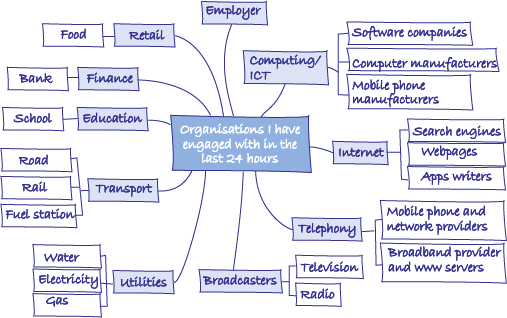
My spray diagram is deliberately general. I could have extended out the engagement for any one. For example, gas or water company could be extended to include meter manufacturer, pipe manufacturer, gas producers, oil companies, gas wholesale markets, safety inspectorate and so on. While this would be stretching the point, the organisation I ‘see’ is just one aspect of a much larger system.
The reasons they seem to be organisations to me is that they have some sense of identity and purpose – they exist and they ‘do’ something, by providing an activity, product or service. They also have more than one person in that organisation all working towards some purpose, even if that purpose may not always be immediately apparent to me or even to those involved at different levels. So I think the defining characteristics of an organisation are:
- a recognisable identity
- a recognisable purpose
- a group of people acting to achieve that purpose.
This activity also made me question what I might interpret by ‘engaged’ – does using a software programme today mean I have, at that moment, engaged with the organisation that developed it some years earlier? If I drive my car, does it mean I have engaged with the company that built it or the transport agency that manages the road networks?
The characteristics identified in my answer to Activity 8 are generic and could be applied to any kind of organisation whether business, government, the third sector, religion, clubs and so on. The definition does not make a judgement about the legality, usefulness or social acceptability of the organisation.
8.2 Defining ‘organisation’
The Oxford English Dictionary offers the following definition of an organisation:
An organized body of people with a particular purpose, [such] as a business, government department, charity, etc.
This definition is probably one that resonates with some of your answers to Activity 8. It is a useful starting point in thinking about organisations because it immediately draws attention to several important characteristics of an organisation. Let me explain further.
First, an organisation consists of people. An organisation is not defined by a building or a website or a product or some other representative item. They might be aspects of an organisation and evidence of its functions and activities, but fundamentally, an organisation is a group of people.
Second, it notes that purpose is important and an organisation is defined by reference to its purpose.
Third, some form of organisation or structure is present within an organisation – which is something I may have missed in my answer to Activity 8
Finally, the dictionary definition also reminds us that organisations do not equate solely to business. A family, school, charity, government or even a terrorist group can also be organisations.
Whatever shape or size, all societies have organisations of some kind or another, and almost everyone engages with some kind of organisation every day. Even in the remotest location on Earth, it is virtually impossible to avoid organisations – turning on a radio (built by an organisation) to listen to a radio broadcast (produced by an organisation), or obtaining a global position signal (GPS) using some kind of equipment marks an engagement of some kind with organisations of some sort.

In addition to geographic coverage, the scale of organisations can range from micro scale partnerships between two people, increasing in size to families, communities and global enterprises. The dictionary definition is a pointer that organisations are entwined in the lives of individuals, communities and societies, and thus the local and wider global environment.
8.3 Purpose
Given their diversity, it is almost impossible to describe all the different purposes of an organisation. But at the most fundamental level, organisations exist to enable people to achieve a set of objectives that would not normally be achievable by an individual in isolation. Understanding the purpose of an organisation is therefore central to understanding what an organisation does and how it does it.
How do you begin to determine the purpose of an organisation? Start by completing Activity 9. For this activity, you will need to select an organisation that is well known to you in some way. Perhaps you are a member of the organisation or you use its services regularly. You will not be expected to know its detailed operations and it does not have to be a business organisation. It could be an organisation you listed in Activity 8. As you will be using the same organisation in other activities throughout this free course, it is worth taking a few minutes to choose.
Activity 9 Purpose and perspective
After choosing an organisation that is well known to you, note down the purpose of the organisation from your perspective.
Now note down the purpose of the same organisation from the perspective of three other organisations that might be linked to it.
Discussion
I have chosen my child’s school. In my view, the purpose of the school is to provide an excellent and enjoyable education for its pupils.
- From the perspective of exam-setting organisations, the purpose of the school is to prepare pupils for exams and host examinations in exam conditions.
- From the perspective of Government, the purpose of the school is to provide education to national standards.
- From the perspective of teaching unions, the purpose of the school is to ensure teachers are paid an appropriate salary, supported and develop their careers.
You can see from my answer that the purpose of the school could vary considerably depending on the perspective of the observer (whether an individual or another organisation).
Your answers to Activity 9 should help you understand that the purpose of an organisation is dependent on whom or what is ascribing that purpose. Understanding that the purpose of an organisation is observer-dependent is important.
Although a focus on purpose gives us considerable insight into what an organisation might be doing, the diversity of organisation types (e.g. profit, public, voluntary, etc.) presents us with a major challenge in terms of environmental management. How can you make sense of an organisation in order to determine its relationship to its environment? One way of answering this is to gain a better understanding of the structure and processes of an organisation.
8.4 Structure
Part of the definition of organisation that was provided earlier describes organisation as a group of people.
Some form of organisational structure and process are needed to manage the activities and interactions of the people in the organisation. This serves as a useful reminder that the structure of an organisation is not purely a physical structure (i.e. relating to buildings etc.). It can also consist of networks of interactions, relationships and activities, which have direct consequences in terms of environmental management. Even in the smallest organisations, these interactions can be complex – as organisations increase in size or scope, more people, resources and activities add to the sense of complexity.
But what does an organisation ‘look’ like? It is often the case that only parts of an organisation are ‘visible’ or engaged with. In addition, your perception or experience of an organisation may not be shared by another.
Activity 10 encourages you to take a step back to enable reflection on what is understood as the organisation.
Activity 10 Draw a rich picture of your chosen organisation
Using the same organisation you selected for Activity 9, draw a rich picture of the organisation. You can refer to anything about the organisation, including physical things (e.g. buildings or people), relationships, influences and activities within the organisation.
Did you learn anything new about your understanding of the organisation in drawing the rich picture?
(Note: guidance on drawing rich pictures is available in the Guide to Diagrams.)
Discussion
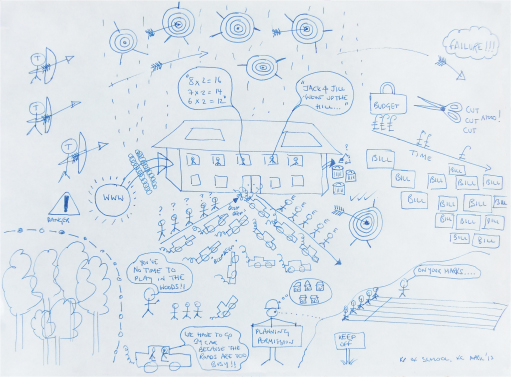
My rich picture shows the school from my point of view. This was harder to draw than I expected, as I kept wanting to focus on the physical aspects of the school and to almost draw a ‘painting’ of the school. I had to resist this (although I did show the school building in the centre) and remind myself that the organisation is fulfilling a purpose – its function.
For example, in the forecourt of the school, a line of uneducated students are walking in and educated students are walking out, emphasising the main purpose of the school. Reflecting the emphasis on meeting targets, teachers are shown as archers, aiming arrows at the ‘rain of targets’ falling out of the sky on to the school. Some targets are hit, but some are missed and become ‘failures’.
To highlight some of the school’s connections to the natural environment, I have shown the waste from the school going into several bins – although I am not sure what happens to the waste thereafter. A wooded area is fenced off – the children have no time to play in the woods. Nearby, traffic problems are shown by the chaotic mess of cars in front of the school, with a driver explaining that they have to go by car because the roads are too busy and, therefore, unsafe. A developer is also planning to turn an athletics track into housing.
In drawing the rich picture, I learnt that the organisation is focused on its core purpose, although perhaps I didn’t represent as fully as I might have the people who work towards this purpose and their interactions – particularly the decision making aspects. I also learnt that when drawing a rich picture I need to avoid my tendency to show ‘literal’ views of the organisation as a set of buildings.
If you showed your rich picture to another person who was also familiar with the organisation you chose, do you think they would be able to recognise it or agree with your perspective? Rich pictures can be very useful for reflecting on your understanding of something. You will build on this in later activities.
But of course, most organisations do not represent themselves using rich pictures. Instead, they use quite formalised ways of thinking about and communicating their structures.
8.4.1 Hierarchies
The most common way of showing how an organisation is structured is in the form of an organisational chart or organogram. By convention, organisations have tended to be represented in the form of a hierarchy: with strategic directors and decision-makers somewhere near the top, administration, operations and implementation somewhere near the bottom with ‘middle management’ in, not surprisingly, the middle. A quick search on the internet will reveal hundreds of examples of hierarchical representations of an organisation. The following is an example taken from the European Commission.
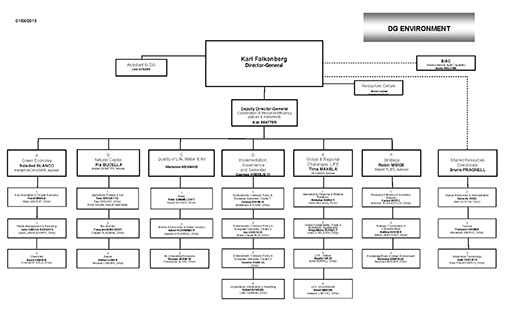
You are not expected to engage with the detail of Figure 6. But it should be evident that this organisation is based on a hierarchical structure.
In general terms, within a hierarchy, those ‘at the top’ are expected to be able to see the bigger picture and make decisions based on wider sets of information, while those at the bottom of the organisation engage in ‘lower order’ activities. If something significant goes wrong within an organisation, the person(s) at the top of the hierarchy is expected to carry the ultimate responsibility for an organisation’s decisions.
But while a hierarchy is a common way of thinking about organisations, it often does not fully represent the way an organisation actually functions. This will be evident to you if you have ever worked in an organisation – practices and processes often emerge that are not always consistent with the official hierarchical model. If you have been taking note of major financial organisational failures in 2009–13, you will also be aware that decision making at the top is not the only locus of strategic decision making (where strategic is defined as affecting the future direction and viability of an organisation). Middle management and operational level decision making has literally bankrupted organisations and destabilised global economies. In these and many other cases it is evident that parts of the organisation – particularly those at the top – are not always aware of what other parts are doing because of the diversity and complexity of activities occurring elsewhere in the organisation.
8.4.2 Alternative structures
There are many other models and ways of representing an organisation’s structure. An organisational structure based on a matrix is one where members of the organisation are drawn together from different functions to work on a specific task or project, such as improving energy efficiency in the organisation. This might require people from different parts (e.g. departments or units) of an organisation to work together, while still retaining their position within the more conventional hierarchical structure.
Organisation structures can also be based on teams, focusing on using the skills within the team to achieve the organisation’s goals, or networks where the organisation networks with other organisations to help perform some of its functions (often described as outsourcing). Newer organisations, particularly start-up companies, often begin with ‘flatter’ organisational forms to avoid bureaucracy, promote responsibility and engender more creative and collaborative approaches to problem solving.
Despite their diverse purposes and types, and however they are represented and structured, organisations tend to have similar elements relating to: decision making, management, administration and operations. Even wholly web-based organisations will need these to support a virtual, online presence. The following is a summary of these in very general terms, although wide variations and overlaps between the elements exist:
- Decision-making structures and processes can vary considerably from the informal to the highly formalised, and can occur at any level within an organisation depending on the nature of the decisions to be taken. Decision making can thus be strategic, perhaps taken by a chief executive (or equivalent) or operational manager. In some cases, an operational decision can have strategic consequences for the organisation (e.g. a routine operation may result in water pollution leading to significant fines for the organisation).
- Management structures refer to the way in which interactions between those within (and outside) the organisation are shaped, organised and managed to achieve goals, establish new activities or deal with issues arising. Again they can be very informal to highly formalised, sometimes very flexible and sometimes very rigidly set up.
- Administration structures enable the organisation to exist and continue as an ongoing entity. In a UK context, administration tends to be associated with more functional day to day structures of an organisation (e.g. a legal office, accounts departments, reception, general office, etc.).
- Operational components tend to refer to the ‘doing’ to enact decisions and policy and often are linked to outward-facing aspects of organisations (e.g. relating to supply of outputs or services, particularly in the case of business organisations).
Organisations usually combine some aspects of all of these, but the particular configuration will reflect how an organisation functions and, by extension, how it relates to environmental issues.
8.5 Processes
Organisational processes refers to the activities undertaken by an organisation to achieve its aims. As with organisation types and structures, these can vary enormously and present a further layer of complexity in thinking about environmental management in organisations.
For example, if a business organisation is manufacturing shoes, the set of processes in Table 2 might be relevant for the organisation’s different sections:
| Section | Process |
|---|---|
| Designers | Develop and finalise shoe specification |
| Sales | Identify buyers and agree contracts to supply |
| Manufacturing | Organise manufacturing |
| Packaging | Source packaging and supply |
| Logistics | Transporting finished goods to retailer |
| Finance | Invoice retailer |
| Customer care | Retailer follow-up as necessary |
This is a very simplified example of the processes that might happen. In practice, it is likely to be much more complex – for example, the manufacturing of the shoes might require sourcing materials from many other companies for plastics, leather and dyes, and managing the consequences of manufacturing, including waste and atmospheric emissions. It is also unlikely to be as linear as implied in Table 2, as the design specification will be strongly influenced by retailers’ preferences and a suite of legal obligations. These might include using certain materials for environmental reasons (e.g. glues or specific materials) or ensuring no child labour is used in manufacturing parts for the shoe. The choices made for each of the processes will be important in shaping the environmental impacts of an organisation.
Some organisations go to considerable voluntary efforts to ensure their processes minimise environmental impacts, and this provides the basis of their approach to environmental management. In many cases, organisations are also obliged by legislation to ensure their processes and products comply with a range of environmental standards. These obligations will, in turn, shape the structures and processes of an organisation.
9 Organisation as a system
In reflecting on structures and processes of an organisation, it is also possible to adopt an alternative way of thinking about an organisation – as a system.
As you will remember from Section 4, a system can be defined as a set of components interconnected for a purpose. This concurs very closely to the earlier definition of an organisation as an organised body of people with a particular purpose.
You may already be familiar with thinking about an organisation in this way. Many parts of organisations are often described as systems (e.g. the financial accounting system, the internal post system, the email system, the IT system, etc.). It is not such a significant leap to see the whole organisation as a system itself.
9.1 The UN as a system
Figure 7 shows the main United Nations (UN) structures (referred to as ‘Principal Organs’) on the left, and their constituent elements expanded in the colour coded boxes to the right of the diagram. The chart shows some of the hierarchical relationships, governance, connections and responsibilities between different elements of the UN. The chart begins to give a sense of how the UN is organised and, to some extent, functions as an organisation, even if you might not know what each of the different elements does.
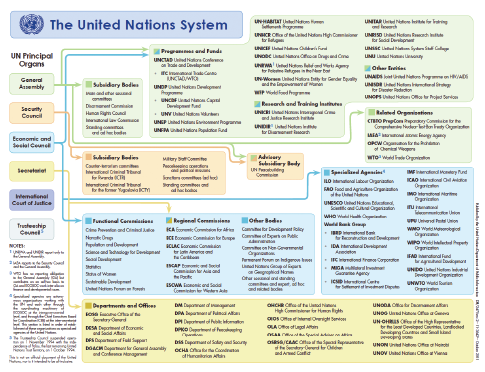
But the UN is much more than just the structures and relationships shown here. Figure 7 is a representation – an abstraction – of the UN system. The authors have had to make choices about what to include and exclude from the diagram and have made choices about the boundary of the UN based on various criteria, such as audience and purpose of the diagram. So what is shown is a particular view of the UN.
How would this diagram look if drawn from the perspective of, say, an IT engineer responsible for upkeep of the UN’s computing system, or perhaps an office cleaner within the UN, or perhaps a recipient of the one of the UN’s funding and aid programmes in Africa? Their views of what constitutes the UN organisation system are likely to be very different to the UN system depicted in Figure 7.
However incomplete or partial, Figure 7 does attempt to show how the UN is made up of different parts and how the relationships between them are organised to form a ‘whole’ – the UN system.
9.2 Purpose and boundary
Thinking of an organisation as a system suggests we pay attention to the diverse elements in an organisation, their connections, their functions, the overall purpose, the boundary aspects and, perhaps most important of all, who is describing and determining each of these.
Activities 9 and 10 were a chance for you to reflect on the purpose of your chosen organisation from your and others’ perspectives, and the key elements of your chosen organisation. You can now take this a step further to think about purpose, boundaries and the structure of an organisation together rather than separately.
Activity 11 Draw a systems map of your chosen organisation
Draw a systems map of your chosen organisation, showing the different elements and boundaries of it from your perspective.
(Note: guidance on drawing systems maps is available in the Guide to Diagrams.)
Discussion
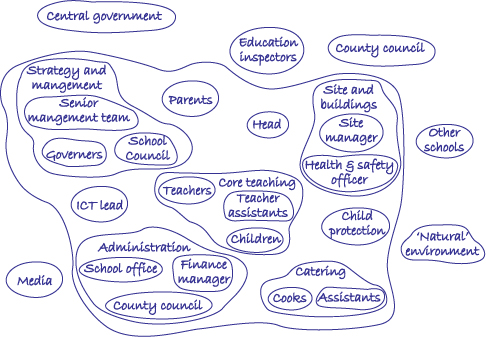
My systems map of the school incorporates some aspects from my rich picture. Several elements, such as strategy and management, site and buildings, and core teaching, are shown as sub-systems – i.e. they have several elements within them. The strategy and management sub-system comprises a senior management team, governors and the school council. I’m not sure what is done as part of child protection, so this is just described as a single element though a teacher would put many more elements in here I’m sure.
I found it difficult to decide where some elements should be positioned. Should I include parents in the core teaching sub-system? In drawing the systems map, I realise I’ve left out some elements – for example, parking, staff training and education inspectors. These need to be included in the next iteration of this map.
Your systems map is likely to differ from others’ system maps of the same organisation, because you assign a different purpose to the organisation and you have made different boundary judgements about what is in the organisation and what is outside.
With this is mind, answers to the question ‘what is organisation X’s purpose, structure and processes?’ are directly linked to the purpose and boundary choices you and others may make about what is part of an organisation and what is outside the organisation. Even where there are differences, you are still talking about the same organisation.
This may seem a somewhat dry and academic discussion, but as you go through the coming weeks, it will become more apparent that the boundary you (and others) assign to any organisation is key to understanding its environmental impacts and responsibilities. The boundaries are often used to mark an organisation’s role and responsibilities, and are sometimes disputed, often through legal means, particularly when environmental impacts occur that are costly to remediate, such as pollution incidents.
For the moment, it is important to be aware that the structure of an organisation and its processes shape how an organisation impacts upon an environment through its activities, and where and how environmental considerations are addressed (if at all).
10 Beyond the organisation
Having explored what might be in the organisation when understood as a system, our attention now turns to what is beyond the organisation. The phrase ‘beyond the organisation’ has an air of cosmic finality, which fans of science fiction might recognise. But really all it is doing is drawing attention to what lies outside the organisation. As explained earlier in this free course, the use of environment here refers to the system environment rather than a natural environment. The system environment is what influences the system, but is outside it. Understanding a system’s environment gives us some clues as to what and how organisations engage in environmental management.
10.1 System environment
Using the notion of a system environment gives us a precise way of thinking about what is inside or outside an organisation. In the case of a business organisation, such as a mining company, a water company or an environmental campaign group, the natural environment might be positioned within the organisation (i.e. part of the organisation as a system) because it might be considered a core part of shaping how the organisation functions. In the case of an organisation like a local accounting business, the natural environment might be placed in the system environment – it is not central to the functioning of the organisation.
Choosing when something is in the system or part of the system environment is not always easy. It may take iteration and require involving and engaging with others to learn about and understand the different aspects of an organisation to determine the system boundary. But it is important to remain aware that identifying something as part of a system or part of its environment is a choice.
To summarise, when you describe something as an organisation, you are making a distinction. You are drawing a boundary around a set of elements that you see as interconnected for a purpose – a system to do something. That which you see as being outside the boundary of the organisation (i.e. influences it, but is not part of it) can be referred to as the system environment.
This provides a powerful language of description and analysis because it can reveal the different ways in which people conceptualise an organisation and its environment (in the systems sense), and the implications this might have for environmental management. As you will see in later sections, the concept of system and system environment is also used in several environmental management approaches.
10.2 Organisation networks
Various authors have attempted to make sense of organisational complexity. The British anthropologist Robin Dunbar proposed a limit to the number of people with whom an individual can maintain a stable and ongoing relationship. There is no precise agreement on Dunbar’s number, but a value of 150 is generally accepted. If just two people constitute an organisation, using Dunbar’s number, up to 300 other individuals might have some bearing on those two individuals’ ideas and practices. Clearly this scale of ‘open’ influence is unlikely to be the case for most organisations, which have a much more structured work pattern and roles that determine how members of the organisation function within and outside the organisation. However, it does give a sense of the possible networks and relationships within and outside organisations.
Interest in the role and function of the networks of relationships led to the development of Network Theory, which has sought to identify patterns of relationships between people or entities in social, organisational, formal and informal settings. Network theorists often use diagrams and graphics to convey the relationships. One such example (see Figure 9) is taken from a paper written by Lee Fleming and Koen Frenken (2007) and shows the networks of key inventors involved in Silicon Valley, California.
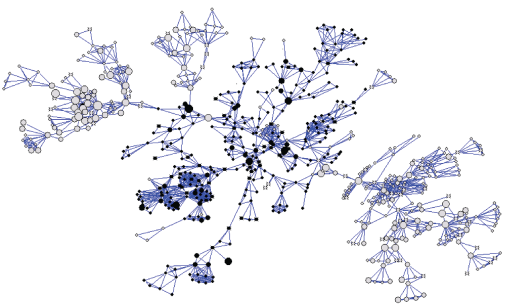
Figure 9 shows that IBM employees (past and present; the black dots) were key to enabling the inventor network (responsible for innovations in computer design and technology in Silicon Valley) to develop and expand. The lighter coloured dots are all the other companies involved or influenced in some manner. Although the local culture and regulatory context were factors, the development of the network was largely attributed to the flexibility and success of IBM’s early postgraduate programme ‘seeding’ the future inventor network with individuals who had previous links to IBM – with all the likely benefits for IBM that this would entail. Figure 9 conveys the complexity of relationships existing within and between organisations, and the contexts in which they operate. It also suggests organisations are not necessarily as ‘fixed’ and bounded as we might at first assume, and that it is sometimes hard to assign boundaries to an organisation.
When thinking about the relationships between an organisation and its natural environment, it is also important to be aware that the structures and associated processes of organisations vary widely and are also rapidly changing. Global corporate organisations are highly complex structures with myriad locations and activities. Internet and mobile technologies are also changing organisations, shifting from wholly physically based entities with offices towards distributed networks of online participants. This trend is likely to continue exponentially, with predictions of holographic offices within the next decade (see Heraghty, 2012).
This means flexibility is needed when thinking about what constitutes an organisation and the complexity of its activities. It follows that the relationships between organisations and the natural environment are equally complex.
11 Reflecting on organisations and environment
In reflecting on how an organisation might be linked to its environment, the focus is on the ‘natural’ environment (rather than environment of an organisation in a system sense). Activity 12 will help you clarify your own thinking about this.
Activity 12 Draw a spray diagram
Draw a spray diagram of the main ways in which you think organisations might be linked to the environment.
(Note: guidance on drawing spray diagrams is available in the Guide to Diagrams.)
Discussion
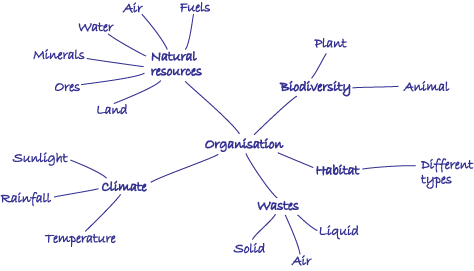
My diagram shows a range of links relating to resources, biodiversity, climate and so on. The headings are quite generic and would vary considerably according to the type of organisation, its activities and its location. After drawing it, I’m not sure that ‘wastes’ is the same type of link as the others – it seems to be in a different category to the others since it is produced by the organisation. Perhaps the next iteration would explore links relating to inputs to the organisation and links relating to the outputs of the organisation.
Unless the organisation exists in a vacuum, it is unavoidable that some kind of relationship exists between an organisation and the natural environment. Your spray diagram will probably have included items relating to energy supply, water, resources for materials, atmospheric emissions of some sort and possibly waste. Maybe you also included the physical space they occupy.
You may have noted that the links can relate to the things an organisation needs to exist as an entity and also to perform their various roles and activities – e.g. land and water for the organisation to exist, and raw materials for making some kind of product. An organisation can thus be both dependent on its environment and also have significant impacts upon it (although the dependency and impacts may not occur in the same geographic locale of natural environment). It is quite difficult to see this from a spray diagram. An alternative way of structuring and representing the range of relationships between an organisation and the environment is to use an input–output model.
11.1 Inputs and outputs
As you saw in Activity 12, an organisation’s relationship to the natural environment can be quite extensive and often complex. There are many ways to structure your thinking about the links between an organisation and the environment, but one common way is to think of them falling into two main categories: inputs into the organisation and outputs from the organisation. This can be captured in the form of a basic input–output model. Input–output models have their origins in economics.
They can be quite complicated to develop, requiring significant quantitative calculations and measurements. The purpose here is not to model or engage in complex calculations, but to use the idea of inputs and outputs to reflect upon the relationships between an environment and an organisation, as shown in Figure 11.
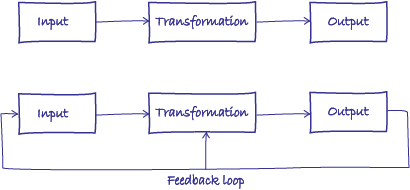
The upper part of the diagram shows a basic input–output model. The central box refers to the transformation by which inputs are converted to outputs. This is usually some kind of process and can be generalised as the organisation itself.
The input refers to something being put into the system (in this case the system is an organisation). This is transformed by the organisation (or parts of it) through an activity or function of the organisation. An output refers to whatever is produced by the system or parts of it.
A simple example would be a sheet of paper (input) used for writing on (transformation) by a member of an organisation to produce a report (output). The more complex an organisation, the more likely it is that the outputs of one part of the organisation will form the inputs to another part of the organisation, or perhaps another organisation.
In the lower part of the diagram, a feedback loop from the outputs to the transformation and inputs has been added. This is to show that:
- the organisation and its activities are linked by more than a linear dependency on inputs
- an organisation’s outputs are not ‘consequence free’ and will have impacts somewhere.
In other words, there is a ‘circular flow’ of interdependencies between an organisation’s outputs, inputs, activities, outputs and so on. It is this ‘flow’ or set of interdependent relationships in relation to the natural environment that is the focus of environmental management.
Having looked at the basic features of an input–output model, complete Activity 13.
Activity 13 Draw an input–output diagram
Drawing on your spray diagram from Activity 12, develop a basic input–output diagram based on Figure 11 to show the inputs and outputs of your selected organisation, which you think have some link to its (natural) environment. You don’t need to show inputs and outputs that occur within the organisation or the individual transformation processes within the organisation.
What does it reveal? Did it surprise you in any way? Did you find it easy to determine if something was an input or output?
Discussion
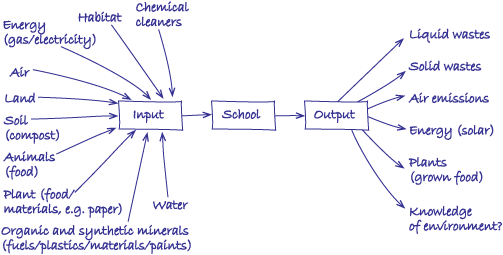
I have grouped and rearranged some inputs from my earlier spray diagram. Some items appear on both sides (e.g. energy, food) because of the solar panels on the roof of this particular school and food grown in the school by the pupils.
One item which might be a little unusual and specific to this type of organisation is ‘knowledge of environment’ as an output. I’m not sure an economist would be able to quantify this easily in a formal input–output model.
At one level it was relatively easy to decide on inputs/outputs with the more obvious elements like water, gas and electricity. But should I compile the list on an average day or over the whole life of the school? If the latter, would I have to include building materials on both sides of the model – as an input and then a waste item when the school is eventually demolished? I decided to focus on a day, but the activity did make me realise that input–output models are somewhat dependent on the time scale selected. Time frames seem to be just one more type of boundary choice.
Your diagram will depend on where your organisation is located, its purpose and your chosen time scale.
Inputs can be usefully sub-divided into two categories:
- Inputs needed to maintain the organisation infrastructure as an ongoing concern, such as building materials, water, heating, and power and computer equipment for office tasks.
- Inputs (some of which may be the same) required to achieve the purpose of the organisation – as a manufacturer or service provider, for example – such as metal ores to a steel manufacturer, crude oil to a refinery, or computers for teaching use in school classrooms.
Outputs from an organisation will vary enormously, but are likely to include waste materials, including atmospheric emissions, sewage and solid waste, and – in the case of many organisations – the end product itself (e.g. a manufactured item).
Even this very simple activity should convey some sense of the complexity of environmental management facing most organisations.
Making sense of the inputs and outputs of an organisation is often done with reference to environmental impacts. But ‘impacts’ often has a negative connotation – i.e. something hitting something with force, suddenly and often resulting in damage. While this has often been the case, it is also important to stress that impacts can also be positive. For example, a water company can clean up a polluted river system, an oil company can provide funding for wildlife conservation and a car manufacturer’s endowment can fund research into social adaptation to climate change.
Let’s take a brief look at two examples that are often associated with (respectively) inputs and outputs of organisational activities – water and waste.
11.1.1 Water use
Water use by organisations is a huge subject area, but the focus here is just as an input into organisations.
The total volume of water on Earth is estimated to be about 1.4 billion km3, of which about 2.5% is freshwater (35 million km3). Nearly all of this freshwater is in the form of ice/snow or ground water, leaving very little (less than 1%) readily available to ecosystems in lakes, rivers and other surface water bodies (UNEP, 2012a).
Human freshwater use has been growing significantly, increasing at twice the rate of population increase in the twentieth century. For example, in 60% of European cities with more than 100 000 people, groundwater is being used at a faster rate than it can be replenished (UNEP, 2012b).
Of the freshwater used by humans, about 70% is used for irrigation, about 22% for industry and about 8% for domestic use. Working on the basis that irrigation is often done by small family-type organisations, we can estimate that anything between 50 and 90% of freshwater used is used by organisations of some sort (UNEP, 2012b).
You can see some of this information more easily in Figure 13.

Collectively, UK water companies supply 17 billion litres per day of drinking water and handle 16 billion litres of wastewater per day (WaterUK, 2012). This is equivalent to approximately 8500 Olympic-sized swimming pools (where 1 billion litres = 500 Olympic swimming pools).
Drawing resources from the environment on this scale can have impacts on river systems, groundwater and species, depending on where and the type of habitats the water comes from. In recent decades, many habitats and species in the south east of England in particular have come under pressure in terms of surface and groundwater availability, as shown in Figure 15.
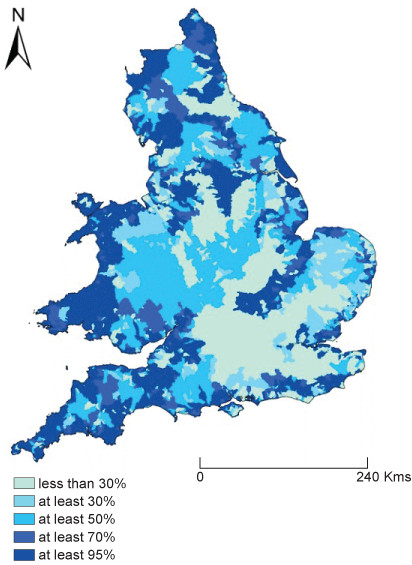
A similar picture is emerging elsewhere in Europe and globally. Figure 16 shows water stress in Europe in 2005 and projected forward to 2050 under an ‘economy first’ scenario. The stresses equate to centres of population shown in the map on the right.
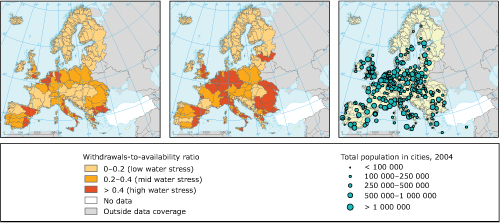
These water stress maps reveal the pressures on resources, but do not show the additional impacts arising from the energy and resources used to abstract, store, purify and supply the potable water, and then deal with the resulting waste water.
These figures and maps are high level. But the dependency of organisations and business on sustainable environmental inputs are receiving increased scrutiny, with at least one recent survey suggesting that water security (e.g. drought and flooding) was a major concern, impacting on business operations for an increasing number of the largest 500 global companies (Brown, 2012). At the level of an individual organisation this can be significant. A car manufacturer, for example, uses a significant volume of water, with estimates of 50 to 80 m3 (50 000 to 80 000 litres) of water required per car in manufacturing (Berger et al., 2012), although this estimate could easily be doubled or trebled depending on manufacturing processes and efficiencies.
11.1.2 Waste production
At the other end of the input–output model, outputs from organisations in the form of waste are also significant. It is not possible to determine global waste outputs from organisations specifically, but about 1.3 billion tonnes of municipal solid waste is produced each year – and expected to grow to 2.2 billion tonnes per year by 2025 (Hoornweg and Bhada-Tata, 2012). About 40 million tonnes of electronic waste is created each year (Schluep et al., 2009) and this is also expected to grow significantly, even with recycling initiatives.
In the UK as with many countries, waste is a significant issue. It is estimated that:
- of the 600 million tonnes of products and materials entering the UK economy each year, only 115 million tonnes is recycled (Wrap, 2012)
- 50% of local authority collected waste was sent to landfill in 2010–11, compared with an EU average of 40% (DEFRA, 2012)
- in 2009, the UK produced approximately 8.3 million tonnes of food and drink waste, 7.0 million tonnes of which was uneaten food (DEFRA, 2012)
- 52% of commercial and industrial waste was recycled or reused in England in 2009, compared with 42% in 2002–03 (DEFRA, 2012)
- between 2012 and 2020, electronic waste in the UK will total more than 12 million tonnes, of which 3 million tonnes will be IT equipment, consumer electronics and display screens – this 12 million tonnes will include precious metals with a total estimated market value of £7 billion (at 2012 prices) (Wrap, 2012)
- nearly 25% of waste electrical and electronic equipment taken to household waste recycling centres could be re-used, worth around £200 million gross a year (Wrap, 2012).
These figures are fairly high level and may be hard to picture in terms of scale or attributing waste generation directly to individual organisations or sectors. But they give a reasonable sense of the waste situation in the UK and the economic, as well as environmental, impacts.
In both the water and waste examples, the message is clear – organisations need to be active in managing their relationships with their environment not just in terms of impacts arising from their activities, but also because of their dependency on natural resources as inputs to their activities and products.
11.2 Solving impacts?
While dependencies are evident, to date much of the focus of organisations has been on managing environmental impacts upon the natural environment. Organisations are offering and claiming solutions to resolve these impacts to negate the effects of their own or other organisations’ activities. The term ‘solution’ has become increasingly commonplace among a wide range of business organisations. Environmental examples include Oran Environmental Solutions, Grounded Environmental Solutions, ESG Environmental Solutions Group, Tire International Environmental Solutions and Certified Environmental Solutions.
You may be asking why the concern about the terms ‘solving’ or ‘solution’. Surely it is harmless enough and just part of advertising claims to help an organisation gain business? At one level this is reasonable enough – particularly as ‘solution’ tends to be more prevalent in business type organisations.
At another level, it is deeply concerning. This is because solution is, in large part, the antithesis of management. As this free course is focused on management, the following example might help.
11.3 Problem solved or situation managed?
Imagine your watch is broken after ingress of water. You now have a problem. The solution to your problem is that you can buy a new watch. Then your time-telling difficulties will be over (for at least as long as the new watch works).
The point to note here is that this is a fairly well defined and bounded problem – you want to tell the time, but you don’t have a working watch. As a result of it being quite a bounded problem, everyone can more or less agree on the solution – obtain a watch or something that tells the time. You might have preferences on style, make or price, but everyone would agree more or less that a watch is a good solution. Once obtained and working, no further management will be required for the foreseeable future.

If, however, you couldn’t tell the time because you did not know how to read a watch or were visually impaired and unable to read braille, then the watch is not the solution we might have first imagined. The problem is more complex than the designers, makers and perhaps retailers of the watch had imagined. This is because the problem is suddenly less bounded and more complicated than originally envisaged.
With this awareness, the watch – labelled as the solution – is not a solution because its design and purpose does not take account of the nature of the situation into which it is being introduced. So if I were visually impaired or could not tell the time, then I would need a different way of managing the situation.
The term solution carries with it three key, related assumptions:
- The organisation claiming to offer a solution knows the entirety of the situation that it or its ‘customer’ is experiencing.
- The supplying organisation (rather than the receiver) assumes the right, expertise and capacity to judge that the solution will, in fact, be a solution.
- The solution will have no unintended consequences to its customer.
These are significant assumptions. In some cases, the assumptions will be correct. In some cases they will be incorrect. Ultimately, the term solution implies an end to the problem – whatever the problem was, it is fixed. No further intervention or management is required. This is rarely the case in terms of the natural environment. There are many examples of where a solution has been applied only to find it is has unintended consequences and made the situation worse. The example of DDT in Section 7 is a case in point.
12 Framing in environmental management
The preceding discussion raises a point about the language of management and how it frames our thinking and practice. Framing is the way something is interpreted or represented – either in ideas or language. The term ‘solution’ frames the way an organisation might think about its environment as a simple ‘problem to be fixed’. In turn, this will shape an organisation’s environmental practices. As you have already seen, many environmental situations are much more complex and our ability to understand the nature of the situation may be limited.
The importance of framing is highlighted by the following quotes from Russell Ackoff, a great systems thinker and writer, as noted in an article by Stern (2009) published shortly after Ackoff’s death.
All of our problems arise out of doing the wrong thing righter … The more efficient you are at doing the wrong thing, the wronger you become. It is much better to do the right thing wronger than the wrong thing righter. If you do the right thing wrong and correct it, you get better.
In this first quote, Ackoff was trying to draw attention to the way organisations think and structure decision making, and the limitations this can bring. The drive for efficiency and tinkering with one part of an organisation can result in doing the ‘wrong thing righter’ instead of looking at the people in the organisation as an interconnected system.
The only problems that have simple solutions are simple problems. The only managers that have simple problems have simple minds. Problems that arise in organisations are almost always the product of interactions of parts, never the action of a single part. Complex problems do not have simple solutions.
This second quote captures the concern about how we frame our understanding and actions relating to management through particular forms of language, and the importance of realising that the interconnected aspects of an organisation (as a system) means that organisations rarely face ‘simple’ problems.
Ackoff’s work suggests environmental management in organisations is a complex process from which clarity arises out of an understanding of systemic relationships. Using the term situation rather than problem can convey the idea of complexity and thus the need for a different approach, which might require something to be managed in a completely different way. In situations, a one-off solution is not going to work. The situation requires some kind of management.
(If you’re interested, you can find out more about Russell Ackoff and some of his publications at http://www.triarchypress.net/ russ-ackoff.html.)
Drawing on the notion of ecological literacy, Table 3 suggests the key capability for an environmental manager and an organisation as a whole is to be able to recognise and differentiate between a problem and a situation.
| Framing | Nature | Response | Outcome |
|---|---|---|---|
| Problem | Simple | Solution | Fixed or solved |
| Situation | Complex or systemic | Managing | Ongoing |
The skill is then to be able to choose environmental management intervention or strategies appropriately. In the next section, we look briefly at how framing has shaped the history of environmental management responses by organisations.
12.1 Health and safety
Environmental management covers a diverse historical tradition of management types and responses by organisations – each with a particular framing. There can be few organisations in history that, at some time or another, have not had to address aspects of environmental management, although it is unlikely to have been framed or described in that way until very recently.
It is only since the industrial revolution that pollution outputs from economic activity have begun to outstrip the natural absorption capacity of the local environment and affect human health on a national and international scale. In the UK, release of greenhouse gases from fossil fuel combustion started to increase from about the 1750s.
One response to the growing industrialisation in the UK was the Factories Act 1833, which was intended to create better conditions for working children by stipulating working time and provision of education. In doing so, the Act concretised the earliest formal ideas relating to health and safety and improving the working (if not the wider living) environment within organisations. This limited framing of environmental management as health and safety was a start, but for mill and factory owners (with notable exceptions of social reformers), the environmental aspect of their responsibilities stopped at the factory gate – a particular, if not unsurprising, boundary choice suggesting very different concepts of environment.
But not everyone accepted this limitation of responsibility easily. The divorcing of organisations from their localities was recognised by social reformers who saw little distinction between the factory mill and the wider environment. Charles Dickens’ Bleak house (first published in 1852) gives a compelling account of the wider environment of the time:
Smoke lowering down from chimney-pots, making a soft black drizzle, with flakes of soot in it as big as full-grown snow-flakes – gone into mourning, one might imagine, for the death of the sun. … Fog everywhere. Fog up the river, where it flows among green aits and meadows; fog down the river, where it rolls defiled among the tiers of shipping and the waterside pollutions of a great (and dirty) city. Fog on the Essex marshes, fog on the Kentish heights.
‘Aits’ are islands in a river. This extract describes a polluted environment irrespective of boundaries. Dickens’ famous description of Manchester as ‘Coke town’ in Hard times (first published in 1854) presents an even darker view of growing urbanisation:
It was a town of red brick or of brick that would have been red if the smoke and ashes had allowed it; but, as matters stood it was a town of unnatural red and black.
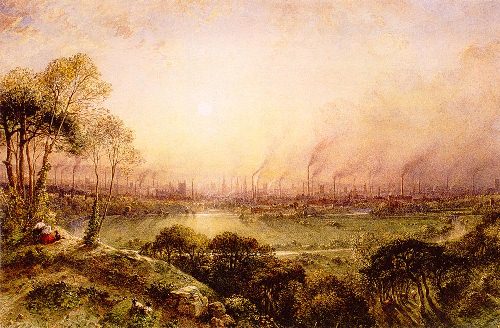
Figure 19 of Dickens’ contemporary Manchester by William Wylde presents these somewhat diverging views of industrialisation. The rural idyll is the preferred perspective of the painter. Is the industry on the horizon encroaching or in balance with the rural? While images (as any kind of diagram) are open to interpretation, it’s important to be aware that then, as now, industrialisation was seen by governments and business leaders as economic, social and cultural progress. It was part of the ongoing efforts to tame or control ‘wild’ nature, modernise towns and cities, and create wealth through production, and a natural extension of the agricultural revolution. If nothing else, the image conveys a sense in which the scale of industrialisation was changing the landscape and environment of whole cities and regions. The shift in the scale and pace of industrial activity prompted concerns about public health.
12.2 Public health
Despite the scale and speed of industrialisation, it took time to move from local responses to national legislation in terms of public health. In the UK, it was not until the Public Health Act 1848 that corporate boroughs were given responsibility for (amongst other things) drainage, water supplies and removal of ‘nuisances’.
Environmental management was mostly conceived as managing environmental resources and wastes for public health. Key milestones were the cholera epidemic of 1847, which led to water supply improvements, and the ‘Great Stink’ in London of 1858, which led to an enabling Act that raised funding for the construction of sewers to manage inflows into the Thames. Much later, London’s ‘Great Smog’ of 1952 lead to the Clean Air Act 1956 and the creation of smokeless zones.

London is still suffering ongoing public health issues concerning invisible traffic pollution, as discussed in this BBC News article, which also provides some video of the Great Smog of 1952.
In these cases, ‘public health’ rather than ‘environmental protection’ (still an unknown concept) was the focus. The environment was principally regarded as a pathway – the medium through which harmful substances and ‘waste’ could be removed – rather than an element that required protection in and of itself.
12.3 Environmental protection
With much scientific exploration and discovery about species diversity and evolution, understanding of human interactions and changing environmental relationships began to accelerate during the nineteenth and twentieth centuries. Coupled with increasing pressures from urbanisation, early twentieth century conservation efforts in the UK were spearheaded by the entomologist and banker Charles Rothschild (eventually leading to the establishment of the Wildlife Trusts). The National Trust formed to begin efforts to protect ‘wild spaces’, coupled with the social reform pressures and mass trespasses leading to the formation of the national park system. Similar sentiments were being expressed and directed to conservation in the USA with the formation of the Sierra Club.
These efforts consolidated during the 1920s and 1930s. But the technological breakthrough of synthetic chemical formulations discovered during World War II and developed for industrial scale use in the immediate post-war years, particularly in agriculture, led to a step change in the potential for substances to be released into the local, regional and global environment.
As you saw in the videos on DDT in Section 7, use of synthetic fertilisers, pesticides and fungicides became widespread in many parts of the world during the 1950s. Only slowly did counterproductive effects, including high concentration pollution incidents in surface water and fast rising resistance amongst the insect target populations, become evident.
The persistence of chemicals, such as DDT, was matched only by the persistence of the ‘dilute and disperse’ conceptual model for environmental management. This model allowed leachate from landfill to permeate into the surrounding environment and shaped UK national policy for landfill and waste management purposes until the early 1970s and the introduction of the Poisonous Waste Act 1972 and its replacement the Control of Pollution Act 1974, and later the European Groundwater Protection Directive 80/ 68/ EEC (Westlake, 1995).
This approach to environmental management held to the idea that the capacity of the environment to absorb or assimilate pollution could be established by proxy. The focus was on setting limits as to the rate of release rather than the total amount released. In a water context, under this approach, it could be viable to allow 2000 litres of untreated sewage to flow into a river per day if this was considered to be within the absorptive capacity of the river. But the habitat and species of the same hypothetical river would be significantly affected if 730 000 litres (the annual total) of untreated sewage were released all at once.
13 Environmental disasters
The years following World War II have been marked by a series of accidents that combine concerns about human health and safety and environmental protection. The litany of major events, with significant environmental consequences, have contributed to the demands for synchronous human and environmental protection, and become an important factor in shaping legislative and administrative responses. Some of these are shown below in Table 4.
Seveso, Italy (10 July 1976) | Following an accident at a chemical plant in Seveso, Italy, manufacturing pesticides and herbicides, a dense vapour cloud containing tetrachlorodibenzoparadioxin (TCDD) was released from a reactor used for the production of trichlorophenol. Within days some 3000 animals were found dead, leading to emergency slaughtering of eventually 80 000 animals to prevent TCDD entering the food chain. Almost 450 people were found to have skin lesions. The accident led to the European Seveso directives 82/ 501/ EEC, 96/ 82/ EC and 2012/ 18/ EU (termed Seveso I, II and III, respectively). These apply to around 10 000 industrial establishments where dangerous substances are used or stored in large quantities. Organisations must now have safety management systems in place to avoid major accidents. |
|---|---|
Three Mile Island, Pennsylvania, USA (28 March 1979) | The partial meltdown at the Three Mile Island nuclear power station in Pennsylvania led to a release of radioactive gases and iodine. Although the human and environmental impacts are disputed, the event led to changes in US Nuclear Regulatory Commission policing and requirements. Some observers quote this accident as being responsible for the decline in building new nuclear reactors and subsequent changes in global energy policy. Others dispute this and point instead to Chernobyl several years later. |
Bhopal, India (2‑3 December 1984) | A gas leak from the Union Carbide India Ltd plant on the night of 2–3 December 1984, killed some 3500 people in the vicinity. Later calculations indicate that up to 16 000 died from related illnesses over the next years. The case became a protracted legal battle and raised doubts about global corporations and responsibilities. The incident led to the US Emergency Planning and Community Right-to-Know Act 1986, and thus indirectly to the EU Convention on Access to Information, Public Participation in Decision Making and Access to Justice in Environmental Matters (the Aarhus Convention). |
Chernobyl, Ukraine (26 April 1986) | The meltdown and subsequent explosion at the Chernobyl nuclear power plant in Ukraine led to radioactive fallout across Western Europe. Thirty-one deaths are directly attributed to the accident, all among the reactor staff and emergency workers. An UNSCEAR (2008) report places the total confirmed deaths from radiation at 64 as of 2008. The Chernobyl Forum (2006) estimates that the eventual death toll could reach 4000 among those exposed to the highest levels of radiation (200 000 emergency workers, 116 000 evacuees and 270 000 residents of the most contaminated areas). This figure includes some 50 emergency workers who died of acute radiation syndrome, nine children who died of thyroid cancer and an estimated total of 3940 deaths from radiation-induced cancer and leukaemia. The event boosted the Soviet policy of Glasnost and led directly to the breakup of the USSR. It also led to the International Atomic Energy Authority’s Convention on the Early Notification of a Nuclear Accident (1986) and Convention on Assistance in the Case of a Nuclear Accident or Radiological Emergency (1987). |
Exxon Valdez, Alaska, USA (24 March 1989) | Between 260 000 and 750 000 barrels of crude oil were spilt following the grounding of the oil tanker Exxon Valdez off Prince William Sound, Alaska. This raised concerns about single-skinned tankers and US energy policy, and prompted the formation of CERES (Coalition for Environmentally Responsible Economies). Further investor-led action campaigned for a more corporately responsible approach to environmental and social risk. This eventually led to the US Oil Pollution Act 1990. |
Brent Spar, North Sea (30 April 1995) | Greenpeace activists boarded and occupied Brent Spar oil storage and tanker buoy to highlight concerns over planned marine disposal for the defunct vessel. The subsequent furore lead to the industry tacitly agreeing to dismantle such vessels onshore rather than pursue deep sea disposal. It is widely accepted that Greenpeace damaged their own credibility (and by extension the credibility of the environmental movement) by making inflated claims about pollution levels. This event strongly influenced the legislative framework for decommissioning offshore oil and gas facilities provided by Part 4 of the UK Petroleum Act 1998 – as amended by the Energy Act 2008. |
Deepwater Horizon, Gulf of Mexico (20 April 2010) | The explosion of the platform killed eleven workers and created an oil spill that continued to flow for three months. Estimates indicate some 5 million barrels of crude oil were released into the Gulf, which was considered the largest oil spill in history. Impacts range from damage to marine ecology including mutations, closure of fishing grounds, health impacts on local populations and loss of tourism. The platform owner, BP, has been fined $4.5 billion (the largest corporate fine in US history), faces thousands of further claims from groups and businesses and is potentially facing a further fine of $21 billion for pollution. The aftermath of the spill is still not known, but has led to changes in Government departments, new regulation and licensing of oil drilling, tighter environmental control, reviews of corporate liabilities, and establishment of a new National Ocean Council (see Simon and Owen, 2010). |
Fukushima, Japan (11 March 2011) | A major earthquake and resulting tsunami damaged the reactors at the Fukushima Daiichi nuclear power plant, resulting in the reactor melting and widespread radioactive releases equivalent in scale to Chernobyl. This has led to global reviews of nuclear station design and safety and at least a temporary stall in investment in new nuclear reactors. Germany has committed to phasing out nuclear power by 2020, but Japan’s new government may re-commit to nuclear power generation. |
These are well known international examples of where environmental management practices have been found wanting, even in ‘modern’, highly regulated installations. There are at least two implications for thinking about organisations and environmental management:
- Even though they are ‘global events’ it may be that many of these are not really that meaningful to you, and perhaps most people, unless you were directly affected in some way. For example, it is hard to know if the Exxon Valdez tanker accident in Alaska has had a direct impact on life in the UK, whereas concerns about radiation fallout from Chernobyl or Japan are perhaps more widespread.
- The events are largely attributable to a sequence of human errors and misjudgements by individuals and organisations – whether in terms of design, operation or maintenance of the facilities. The most recent event, the nuclear meltdown in Fukushima in 2011, is particularly interesting from a management point of view and is the focus of Activity 14.
Reading 1 Japan panel: Fukushima nuclear disaster ‘man-made’
Read this BBC News article about the official report into the Fukushima event. Read the article and watch the video.
Activity 14 Fukushima news article
In your own words, summarise the main points of the BBC News article and the key findings of the report.
Discussion
The article is about the official Japanese Parliament report into the events at the Fukushima plant. Although triggered by an earthquake and tsunami, the report concluded the accident was very definitely ‘man-made’ rather than an unavoidable ‘natural disaster’. The official report concluded that governance arrangements were poor, knowledge and training were insufficient, there was a lack of preparation by all organisations involved, evacuation was ineffective, and that existing ‘stopgap’ laws and regulations needed major review. In summary, the event was not a natural disaster that was ‘unavoidable’.
Far from being natural disasters, reports on the events described above tend to agree on the major causes – poor design, failure of management structures, poor operating standards, poor maintenance, and poor decision making in the lead up, duration and aftermath of many of these disasters. In other words, these are organisational failures, often arising from commercial and financial pressures, to manage known risks.
14 Risk management
Risk is one of those terms that you hear very often. Sometimes it is relished as part of the ‘fun’ of the event, experience or activity, and sometimes it is very much intended to be avoided. In many organisations, especially profit-orientated organisations, risk and risk taking are part of their rationale in the competitive market and a means to generate revenue. Of course, things do sometimes go wrong and then the results of the risk taking can be catastrophic as you have seen in the earlier listings of environmental disasters.
But what is risk? Before exploring some definitions, the next activity explores some of the risks you might experience everyday.
Activity 15 Risks and their management
Note down the risks you might have taken in the last day or so. These can be small or major risks. Did you think about or do anything to ameliorate the risks?
Discussion
Just getting up in the morning involves all sorts of risk – I might slip, stumble, fall, burn, drown and electrocute myself in all sorts of ways before I even get out of my house. A car journey adds to the risk quotient significantly – all those cars travelling at speed. And air pollution? At work I take risks relating to the work environment of cables, chairs, doors, stairs and so on. The return car journey is more risky still as it is dark (at the time of writing at least). Back to my ‘house of risk’, and then out on my bicycle to play badminton at a local sports centre – the risk of personal injury increasing significantly from both activities. And finally back home to the safety of bed.
The risks are ameliorated by keeping domestic and workplace floors clear of obstacles – as anyone who has stood on a piece of Lego in bare feet will appreciate! When driving, I try to drive defensively and to avoid manoeuvres that will increase risk. I often drive with headlights on in the belief that I will be seen more easily. This belief fails when out on my bicycle. Despite reflective jacket, reflectors, several lights, helmet and defensive riding, I am always amazed by the number of close encounters with car drivers who seem not to notice me and/or treat me as some kind of irritation to be swatted away.
Your account of risks may have some overlaps with my answer. Clearly, risks exist in just about everything we do or places we go – living is a risk-judging and risk-taking activity. But whenever we take a risk we are actually making (or have made) a judgement about a hazard and the probability of the hazard being realised.
14.1 Identifying risk
It might be surprising to learn that there are many varied definitions of risk. A common interpretation is that risk is the likelihood (or probability) that harm will actually be done by the realisation of the hazard. A hazard is the inherent potential for something to cause harm to humans or their environment. A short-hand way of writing this is:
Risk = Hazard × Exposure
Risk is thus the probability or likelihood of being exposed to a hazard. For humans, radiation is a hazard, carbon monoxide is a hazard, mercury pollution in rivers or air is a hazard. Table 5 identifies how these might be registered in general terms.
| Risk | Hazard | Exposure |
|---|---|---|
| Poisoning | Carbon monoxide | Car journeys, domestic fire/boiler |
| Poisoning | Radiation (various types) | Mobile phones, aircraft journeys |
| Poisoning (humans, soils, water, species) | Mercury | Breakage of energy saving light bulbs, improper dumping of computing equipment, gold mining |
A more detailed risk assessment and analysis would develop Table 5 with qualitative and quantitative scores to indicate the level of risk, scale of the hazard and possibility of exposure. However, it is not easy to quantify the probability of risks occurring because of the complexity of many situations, never mind the difficulties of communicating probabilities mathematically (as outlined in this BBC News Magazine article).
Just as with systems being ‘observer dependent’, risks are not understood by all or interpreted equally. Risk awareness varies because of different interpretations of hazard and the probability of the hazard occurring. Jumping off a high diving board at a swimming pool may be fun and ‘not risky’ for person A, but person B might be terrified at the thought of so doing. Their perceptions of the risk (the probability of the hazard occurring) are very different.
14.2 Organisations and risk
In an organisational setting, the risks could be more extensive, particularly in manufacturing situations when a range of engineering, mechanical and chemical hazards might exist that could impact human and environmental systems. For an organisation, risk can be expressed in all sorts of ways, but is often linked to financial damage arising from a hazard event, which forces interruption, closure of the organisation or exposure to large financial liabilities. As you saw in the listing of environmental disasters, the oil company BP was fined very substantially for its liabilities linked to the Deep Water Horizon rig explosion and subsequent oil pollution in the Gulf of Mexico.
The litany of environmental accidents and pollution incidents suggest this diversity in interpreting risks is also the same for organisations.
One organisation may not see their activities, such as disposing of waste water used for car washing into drains, as being particularly environmentally impactful or risky (i.e. likely to cause environmental damage to aquatic ecosystems). But another organisation (perhaps a regulator or more ‘responsible’ car wash operator) might be very concerned to avoid the likelihood of the pollution (the hazard) occurring.
Activity 16 Organisations and risk
Navigate to your preferred news portal. If you don’t have one, you could try BBC News. If you prefer, you can use a newspaper or television news stream or radio. Identify a news story that is linked to organisations and risk. It does not have to be environmentally based, but it is helpful if it is. Now answer the following questions:
- What risks are being described and how is it linked to the organisation?
- Compile a ‘risk register’ using the same format as Table 5 to identify the hazard and possible source of exposure.
- What are the expected consequences for the organisation?
- What steps, if any, are being taken to reduce or manage the risks?
Discussion
My news story is taken from the ‘Science & Environment’ section of the BBC News website in late July 2013 and is about drilling for oil in the Arctic. There are several organisations involved – governments, a government committee, drilling companies and an environmental NGO. A UK Government committee – the Environmental Audit Committee – has called for a halt to drilling.
- The risks being described refer to the risk of pollution spills arising from drilling operations in such a remote and harsh environment, and the risks of climate change arising from using the oil and gas that might be recovered in the drilling operations. There is also mention of climate change arising from methane being released from melting of permafrost.
- The risk and hazard register might look something like this:
| Risk | Hazard | Exposure |
|---|---|---|
| Pollution | Oil spill | Drilling operations |
| Climate change, biodiversity loss | CO2, other emissions | Use of fossil fuels |
| Financial costs (£39 trillion) | Methane release | Melting of permafrost |
- There are several expected consequences, but these are disputed by those involved. The UK Government is not halting the drilling because it is not within UK waters. The drilling companies are therefore not being regulated under UK law, but are encouraged to use the highest drilling standards and practices. If the drilling companies do find reserves, then they are likely to make significant profits. Greenpeace suggests the drilling will create ‘unmanageable risks’ to the pristine regional environment, and also contribute to climate change globally and in the UK – a point also made by the Chairwoman of the Environmental Audit Committee.
- The UK Government suggests its new policy on drilling in the Arctic and encouraging the good practices of the drilling companies are sufficient to manage the risks of pollution from oil spills. This is disputed by the other organisations represented in the article. There are no other obvious management measures in place (although the drilling companies may be subject to regulation from Arctic sovereign states).
At the time of writing, it is not possible to predict the news events you’ll be looking at in the future. You may be reviewing local or global issues. It is, however, likely that there will be some discussion on data (or lack of), understanding of the situation, and decision-making processes and structures within organisations. Because of the gaps and uncertainty concerning hazards and safe exposure limits, the boundaries of risks are often unclear. In addition, risks are often perceived and evaluated very differently. An article in the Harvard Business Review (Taleb et al., 2009) noted that executives often make six basic mistakes in assessing risks. Paraphrased, these are:
- We think we can manage risk by predicting extreme events.
- We are convinced that studying the past will help us manage risk.
- We don’t listen to advice about what we shouldn’t do.
- We assume that risk can be measured in numbers.
- We don’t appreciate that the way risk is framed (often mathematically) shapes our responses.
- We are taught that organisational efficiency does not tolerate spare capacity or spare ‘parts’, which can help withstand risk events when they happen.
You may well have encountered or recognise some of these mistakes. They are another dimension of how environmental concerns are framed – whether as problems or more complex situations. The article concludes with the stark warning:
Remember that the biggest risk lies within us: we overestimate our abilities and underestimate what can go wrong.
The inherent difficulties humans experience assessing complex risks and making sense of uncertainties and gaps in understanding makes it very hard for organisations to ascertain and manage risks easily or effectively. To some extent, financial risks can sometimes be more easily understood by organisations, especially business-type organisations, because many of their practices are linked to finances and accounting ‘traditions’.
Environmental considerations are, however, very different. They often require different and new skills sets and knowledge, and until recently were not part of an organisation’s remit, practices or traditions. Increasingly, however, in recognition of the relationship with and often dependency of many organisations on their environment, organisations have sought to combine or overlay financial risks with environmental risks. The BP Gulf of Mexico oil spill is a high profile example of where the financial risks to the organisation have become entwined with environmental risks.
Risks are therefore a key aspect of organisational functioning and decision making. In many cases, environmental management for organisations is about risk reduction by management of hazards and managing exposure to hazards, whether as inputs to the organisation, organisational functioning or outputs from the organisation.
15 Voluntary and compulsory approaches
So far, you have seen that industrial incidents and accidents at local, national and international scales often have some origin in organisational practices and organisational failings. As part of the attempts to avoid these, environmental management in organisations has become shaped, on the one hand, by voluntary codes of practice and self-regulation, and, on the other hand, by compulsory approaches.
Voluntary approaches – or self-regulation – are when an individual organisation or a sector voluntarily subscribes to a specification or code of practice that they or their representatives have developed and drawn up.
Compulsory approaches centre on legislation, such as Acts of Parliament, and their supporting regulations. These are usually written by a recognised legislature (e.g. elected government) or those working under their authority (e.g. government appointed regulatory bodies).
Before we look at each in turn, it is worth noting that as certain voluntary schemes have grown in popularity among organisations, national legislation has moved to incorporate (or at least recognise) aspects of self-regulation. This results in a distinct blurring of the lines between voluntary and compulsory approaches to environmental management.
One such example is the voluntary International Standard ISO 14001, which has become compulsory for organisations wishing to achieve compliance with other environmental management initiatives.
15.1 Voluntary approaches
The main feature of voluntary approaches to environmental management is self-explanatory – it is voluntary unless required by legislation or some form of regulation. You might like to think about the voluntary aspects of your own behaviour. For example, you do not have to recycle a drinks can – you could put it into general waste – but you might want to recycle it or feel a social pressure to do so. For the most part, an organisation has a similar choice – in most cases, it does not have to adopt a standard or be bound to a set of new rules governing its practices, although it may feel it is under political, economic or social pressure to do so.
Voluntary approaches are generally further divided into two categories:
- those where there are no third-party checks and are essentially industry or stakeholder consensus on how to implement a tool – e.g. the ISO 26000 standard on social responsibility
- those with third-party checks and audits, including some standards – e.g. the ISO 14001 standard on environmental management.
Voluntary initiatives cover a range of approaches:
- voluntary schemes – e.g. social accountability reporting
- technical standards – e.g. those produced by the International Organization for Standardization (ISO)
- self-certification – e.g. the Eco-Management Audit Scheme (EMAS).
Social accountability reporting has developed in response to concerns about, for example, worker rights and child labour involved in outsourced manufacturing and production processes, particularly in countries where such rights are much less developed. Social concerns are often joined with environmental reporting as part of a ‘corporate social responsibility’ report. The international non-governmental body Social Accounting International has established standard SA8000 as a comprehensive corporate social responsibility registration system.
Technical standardisation is usually carried out by national, regional and international standardisation bodies that facilitate the writing and publication of agreed standards produced by technical experts and industry representatives. The original goal of technical standardisation was (and remains) the removal of needless technical diversity. However, over time this has evolved into also capturing best practice (codes of practice) as well as providing technical support for legislation. Examples of technical standardisation include the standards developed and set by the British Standards Institute and the International Organization for Standardization.
The development of self-certification standards has reflected the desire to capture best practice amongst organisations. The original intent was to define processes within an organisation that would help ensure consistent delivery of services and products. However, with the development of British Standard BS 7750 Specification for environmental management systems in 1992, the emphasis has shifted to improving and extending organisational practices in advance of establishing best practice.
Let us now look at one aspect of voluntary approaches, which has gained prominence in many organisations: corporate sustainability reporting.
15.1.1 Corporate sustainability reporting
Corporate sustainability reporting is when an organisation gives an external account of itself in relation to a range of sustainability themes.
There are many thousands of such reporting initiatives by all manner of organisations under various headings including ‘corporate social responsibility’, ‘corporate responsibility’ and ‘corporate sustainability’.
Depending on the particular focus of the organisation and its reasons for reporting, each attempts to set out for external readers the organisation’s aim, purpose, range of policies, activities and practices, and provide an assessment of these with reference to a range of environmental and sometimes social concerns as well as their impacts (remembering these can be positive and negative).
The pressures leading to the development and uptake of sustainability reporting by organisations have arisen out of ethical and financial pressures from a range of individuals, shareholders, consumers and other organisations, including:
- the Coalition for Socially Responsible Economies (CERES) – a non-profit coalition of over 80 investor, environmental, religious, labour and social justice groups
- the International Labour Organization (ILO) – a UN agency addressing international labour standards
- the Global Reporting Initiative (GRI) – established in 1997 with a mission to elevate sustainability reporting to equivalence with financial reporting.
Activity 17 Sustainability reporting in your chosen organisation
Thinking back to the organisation you selected in Activity 9, does the organisation have a sustainability report of some kind? Are you aware of its environmental management strategies and performance? Would a sustainability report influence your engagement with the organisation?
If your chosen organisation does not have any form of sustainability reporting, then you can choose a similar organisation that does to answer this activity.
Discussion
I’m not aware of any formal corporate sustainability report for the school, but there is statement in the school’s documents that refers to minimising environmental impacts by reducing energy use and water use. The emphasis on ensuring the pupils grow-up with an understanding of environmental issues and the importance of wildlife is one form of enacting corporate responsibility.
Environmental strategies are fairly ad hoc, but are improving following the introduction of recycling initiatives throughout the school and an emphasis on energy saving. I have no way of assessing performance because of a lack of reporting structures.
I am not sure if the existence of a report would greatly influence my engagement with the school, although it would be a good way of holding the school to its environmental commitments.
Voluntary sustainability reporting has now become almost mandatory for all major organisations in order to demonstrate their ethics and value system, and to demonstrate to interested parties (e.g. a consumer or shareholder) that the organisation is a responsible body. Specific examples of corporate sustainability reporting are presented in this BBC News article. But this is just part of a much larger global picture. Reading 2 and Activity 18 gives a global perspective of corporate sustainability reporting.
Reading 2 KPMG international survey of corporate responsibility reporting 2011
Read the ‘Executive summary’ and ‘KPMG corporate reporting quadrants’ on pages 2–5 of the KPMG international survey of corporate responsibility reporting 2011 (KPMG, 2011).
Activity 18 KPMG sustainability report
Summarise the main advantages of sustainability reporting as set out in the KPMG reading. What does the report tell you about the importance of internal reporting systems and external communications? Are there certain types of businesses (e.g. electronics) that are leading on sustainability reporting?
Discussion
The report claims that corporate sustainability reporting is advantageous because it demonstrates being a good corporate citizen, drives innovation and learning within the organisation, grows the business, and increases its value. Financial advantages in particular arise from direct cost savings and improved reputation.
The report suggests that credibility and trust of corporate sustainability reporting is dependent on data systems and integrity, particularly with increased scrutiny of organisations by a range of external stakeholders. Professional and ‘multi-channel’ external communication to a range of stakeholders is an essential part of corporate sustainability reporting.
The business organisations leading on corporate sustainability reporting are mostly extractive – raw material- and resource-using organisations, such as energy and mining companies. The electronics sector performs well according to the KPMG report. It is not clear from the summary if this is part of market differentiation as much as environmental concerns. It is interesting to note that metals, engineering and manufacturing organisations are considered to be ‘behind’ in adopting corporate sustainability reporting – although this does not mean they are not engaging in environmental management issues and concerns within the organisations.
Corporate sustainability reporting is clearly a major activity for large organisations, but it is time consuming and resource intensive to establish and run, particularly for smaller organisations and those without a ‘public’ shareholder and consumer base to report to. And while the KPMG report suggests it has become the ‘de facto law for business’ (KPMG, 2011, p. 2), it still remains a voluntary approach.
15.1.2 Drivers
Whilst organisations usually have a choice, adopting and maintaining a voluntary code or similar standard may be in an organisation’s interest – perhaps to demonstrate good and responsible practices. In the case of businesses, it is often to win customers or demonstrate to shareholders due diligence in managing risks and competitiveness. The KPMG report noted that ‘close to half of the G250 companies reported gaining financial value from their [corporate responsibility] initiatives’ (KPMG, 2011, p. 19).
Corporate sustainability reporting has become a key part of marketing, gaining competitive advantage, image and brand management as much as a fundamental concern with management practice and environmental performance. Supporters argue that organisations engaging in voluntary approaches and self-regulation may go further than compulsory regulation with the added benefit of paying for compliance costs and helping to strengthen corporate legitimacy and public trust (Nash and Ehrenfeld, 1996). Critics see some voluntary approaches, particularly self-regulation, as a way for commercial organisations in particular to forestall or avoid detailed regulation, inspections and increased costs (Gunningham, 1994).
The centre view is that all voluntary approaches and self-regulation must function within the context of applicable law. In other words, voluntary action undertaken by an organisation is not a direct replacement or substitute for adhering to legal and social norms and expectations of acceptable practices.
At the centre of determining the value and ongoing support of voluntary approaches to environmental management are concerns about:
- data quality and collection – what is or isn’t collected, and how is it processed/interpreted and by whom?
- reporting standards – is there an independent body that is able check the data and analysis?
- boundary setting – who decides the boundary of the organisation and the analysis, particularly relating to environmental impacts, scale and time issues?
Now let us look at compulsory approaches to environmental management.
15.2 Compulsory approaches
As noted with earlier reference to the roots of environmental management and more modern environmental disasters, the recent history of environmental and human relations has been defined by increasing legal obligations on individuals and organisations to improve their practices.
Compulsory approaches to environmental management are essentially determined by legislation (laws) and regulations. Regulations set out how a law should be observed and complied with, and are thus part of the enforcement of the law. However, while one governmental body (or series of bodies) may write the law and regulations, it is often through the judiciary and the attendant court system that the law is interpreted in its application. Both laws and regulations can be legally enforceable, but laws generally take precedence over regulations.
Historical examples of environmental management legislation in the UK include the Factories Act 1833 to improve working conditions, the Public Health Act 1848 and the Clean Air Act 1956 in response to the Great Smog of 1952. The principle of legal obligations in environmental management can be traced back in English law to the 1868 case of Rylands v Fletcher. Following construction of a reservoir on private land, which then flooded a nearby coal mine, the judicial ruling noted that:
The person who for his own purpose brings on his lands and collects and keeps there anything likely to do mischief, if it escapes, must keep it in at his peril, and if he does not do so, is primâ facie answerable for all the damage which is the natural consequence of its escape.
This ruling continues to inform contemporary UK legislation, although the body of legal statute is now very much more substantial and complex. To illustrate this, the following is a list from the UK Environmental Law Association of key legislation and regulations relating to air quality alone:
- the Road Traffic Regulation Act 1984 – amended by the Transport Act 2000
- the Environmental Protection Act 1990 – amended by the Pollution Prevention and Control Act 1999
- the Clean Air Act 1993
- the Environment Act 1995 – provides for the National Air Quality framework
- the Pollution Prevention and Control Act 1999 and the Pollution Prevention and Control Regulations (England and Wales) 2000 – as amended by the Environmental Permitting (England and Wales) Regulations 2007
- the Transport Act 2000
- the Finance Act 2000 – creates the Climate Change Levy, which seeks to minimise greenhouse gases
- the Waste and Emissions Trading Act 2003
- the Air Quality Standards Regulations 2007
- the Air Quality Standards (Wales) Regulations 2007
- the Air Quality Standards (Scotland) Regulations 2007
- the Air Quality Standards Regulations (Northern Ireland) 2007
- the Environmental Permitting (England and Wales) Regulations 2007.
Repeating this exercise for land, water, waste and noise, for example, would amount to a sizable list, even allowing for overlaps. You can find out more about UK environmental legislation applicable to organisations by following these hyperlinks for England and Wales and Scotland and Northern Ireland. Even a brief glance at these links will reveal that managing compliance with environmental legislation in the UK is a significant obligation for many organisations.
You are not expected to know this legislation for the purposes of this free course, but it is important that you are aware of how significant environmental law has become in recent decades. In part, this is because much of the legislation relating to the environment in the UK (and other EU member states) is defined by European legislation. Chief amongst these are European directives.
15.2.1 European directives
As part of the growing body of European legislation, there are many directives in force covering all manner of subjects and topics. Directives relating to environmental management are numerous. The following is a sample and is by no means exhaustive:
- Environmental impact assessment directive (Council Directive 85/ 337/ EEC of 27 June 1985 on the assessment of the effects of certain public and private projects on the environment).
- Urban waste water directive (Council Directive 91/ 271/ EEC of 21 May 1991 concerning urban waste-water treatment).
- Habitats directive (Council Directive 92/ 43/ EEC of 21 May 1992 on the conservation of natural habitats and of wild fauna and flora).
- Landfill directive (Council Directive 1999/ 31/ EC of 26 April 1999 on the landfill of waste).
- Water framework directive (Directive 2000/ 60/ EC of the European Parliament and of the Council of 23 October 2000 establishing a framework for Community action in the field of water policy).
- Strategic environmental assessment directive (Directive 2001/ 42/ EC of the European Parliament and of the Council of 27 June 2001 on the assessment of the effects of certain plans and programmes on the environment).
- Large combustion plant directive (Directive 2001/ 80/ EC of the European Parliament and of the Council of 23 October 2001 on the limitation of emissions of certain pollutants into the air from large combustion plants).
- Waste electrical and electronic equipment ‘WEEE’ directive (Directive 2002/ 96/ EC of the European Parliament and of the Council of 27 January 2003 on waste electrical and electronic equipment (WEEE)).
- Floods directive (Directive 2007/ 60/ EC of the European Parliament and of the Council of 23 October 2007 on the assessment and management of flood risks).
- Integrated pollution prevention and control directive (Directive 2008/ 1/ EC of the European Parliament and of the Council of 15 January 2008 concerning integrated pollution prevention and control).
- Waste framework directive (Directive 2008/ 98/ EC of the European Parliament and of the Council of 19 November 2008 on waste).
- Birds directive (Directive 2009/ 147/ EC of the European Parliament and of the Council of 30 November 2009 on the conservation of wild birds).
- Industrial emissions directive (Directive 2010/ 75/ EU of the European Parliament and of the Council of 24 November 2010 on industrial emissions (integrated pollution prevention and control)).
European directives are used to align different national laws, and are particularly common in matters relating to the operation of the single market (e.g. product safety standards). The directives specify certain end results that must be achieved in every member state within a certain timeframe. Member states are responsible for ‘transposing’ the directive into the national context by adapting their laws to meet these goals. However, national governments have considerable freedom on how they achieve that. Infraction proceedings and fines can be imposed on the member state for failing to adopt the directive.
In contrast, national governments do not have to act to implement European regulations. This is because, as the most direct form of European law, they have binding legal force throughout every member state as soon as they are passed. Regulations are on a par with national laws.
The percentage of European directed environmental law and regulations applying in the UK is hard to determine for a range of complex reasons, but is estimated to be in the region of 50% for environmental areas (Miller, 2010).
As you can see from the above listing, just the directives alone cover many aspects of environmental management, which will shape the way organisations work and manage their activities.
Conclusion
This free course began by approaching environmental management as a way of thinking about and managing changing human–environment relationships in their many different arenas and contexts, and drawing on systems ideas to explore how those relationships are understood and managed over time.
It firstly challenged the ways that you may think about environment and management and then explored different ways of thinking about organisations including as a system, why a focus on organisations is key to environmental management and some of the historical aspects of environmental management in relation to organisations. You have also had an opportunity to think about the links between an organisation and its environment, and some aspects of voluntary and compulsory approaches to environmental management.
Glossary
- anthropocene
- A term used by some scientists to emphasise that the latest geological epoch, the Holocene (recent time), has ended and has been replaced by a new epoch where the Earth’s biological and physical systems are being modified significantly by humans.
- biodiversity
- A contraction of ‘biological diversity’. In general it describes the variety of life on Earth, and specifically the total sum of the genes, species, habitats and ecosystems in a given environment.
- boundary
- The line or region which distinguishes what is within a system from the wider environment around it.
- carbon footprint
- The annual amount of greenhouse gas emissions, mainly carbon dioxide, that result from the activities of an individual or a group of people, especially their use of energy and transport and consumption of goods and services. It is measured as the mass, in kilogrammes or tonnes per year, either of carbon dioxide emissions alone, or of the carbon dioxide equivalent effect of other greenhouse gas emissions.
- climate change
- A variation in climate, usually for longer than a decade. Often now used to mean changes in climate attributed to human activity that alters the composition of the atmosphere (the greenhouse effect).
- DPSIR
- (or Drivers-Pressures-States-Impacts-Responses). A framework of indicator types. They can be used as a means to describe the interactions between society and the environment.
- ecology
- A term coined by Ernst Haeckel in 1866 to describe the study of the relations of organisms to each other and their surroundings, which includes population dynamics, feeding interactions, competition between species, the availability of nutrients and energy flows through ecosystems. Patterns of distribution and succession, and human impacts are also studied.
- ecosystem
- A community of organisms interacting with each other, as well as the environment in which they live and with which they also interact (e.g. a pond or forest).
- environmental impact assessment
- (or EIA). An assessment of the possible positive or negative impact that a proposed project may have on the environment, together consisting of the environmental, social and economic aspects.
- environmental sustainability
- The aspect of sustainable development that focuses on the stability of biological and earth systems, and on the maintenance of a healthy natural environment.
- food chain
- A series of organisms usually beginning with plants where each stage feeds on the stage below it. In general the series consists of plants – herbivores (plant-eating animals) – carnivores (animals that feed on other animals).
- fossil fuel
- Buried fuels derived from past living plant and animal materials that have been modified and buried by geological processes (e.g. coal, oil or gas).
- greenhouse gas
- Gases, including carbon dioxide, water vapour, methane and nitrous oxide, that interact with infrared radiation and when present in the atmosphere have the effect of warming the global climate. Without naturally occurring greenhouse gases, the Earth’s temperature would be several tens of degrees Celsius colder than it is now (and life would not have evolved in its current form).
- indicator
- A characteristic of a system which is used as a measure for control.
- industrialisation
- This is the shift in a nation’s economy away from smallholder agricultural production, simple extraction of primary commodities and household-based production, towards the large-scale, factory-based production of goods.
- life cycle analysis
- (or LCA or life cycle assessment). Traces environmental impacts at all stages of a product’s ‘life cycle’ stages. This starts from the impacts arising from extracting and processing raw materials, followed by those from manufacturing and delivery, through to those involved in using the product and finally what happens at the end of the product’s life – whether it is reused, recycled or disposed of.
- methane
- A hydrocarbon that is a constituent of natural gas. Also produced by decomposing organic waste (e.g. domestic refuse) and by digestion processes in animals. Methane is a potent greenhouse gas.
- model
- A model (noun) is a simplified representation of reality (e.g. a map, scale model, mental concept or mathematical equation), developed in order to understand or change the real world. To model (verb) is to use such a simplified representation of reality.
- natural resources
- The Earth’s natural resources include physical resources (e.g. fossil fuels, mineral deposits, land and water) and biological resources (e.g. plants and animals). Resources can be defined as what the Earth can provide that humans consider economically or otherwise useful. Resources may also include human knowledge and labour. Resources are often classified into renewable and non-renewable resources depending on the timescale that they are renewed or regenerated.
- outsourcing
- The process whereby a leading firm or business shifts some of its specific activities to another firm, which can do the activity more cost-effectively. In some cases this is called ‘offshoring’, depending on labour cost and location. Outsourcing can lead to issues in managing complex activities or loss of core values if the wrong types of activities are outsourced.
- pollution
- The introduction into the environment (air, water or land) of substances or energy liable to cause harm to human health, to other animals, to plants and ecosystems, damage to structure or amenity, or interfere with legitimate uses of the environment.
- rich picture
- Rich pictures are situation summaries. They are an attempt to encapsulate the real situation through a no holds barred, cartoon representation of things that you perceive in the situation.
- smog
- A term, introduced at the beginning of the twentieth century, for a mixture of smoke and fog. The London ‘pea-soup fog’ was a mixture of soot and sulphur dioxide most likely to occur in winter. Modern brown ‘photochemical smog’ is caused by nitrogen oxides from car exhausts and is most likely to occur in summer.
- spray diagram
- Type of diagram used for representing the structure of an argument, to encapsulate the relationships between ideas or for note taking.
- stakeholder
- An individual (or group of people) who has an interest in a particular issue, event, situation, etc.
- system
- An interconnected and interdependent set of components with coherent organisation, as defined by the person interested in it. Often characterised by nested subsystems, emergent properties, communication and control which is dynamic, adaptive and self-preserving. Defining a system requires the placement of a system boundary, that is, a dividing line that separates the system components from those items outside that affect it but which it cannot significantly affect.
- system of interest
- A set of components interconnected for a purpose that has been identified by someone as being of particular interest.
- systematic
- Having a sequential plan or a method. Often contrasted with systemic.
- systemic
- An agency, organisation, body or organism considered as a whole. Often contrasted with systematic.
- systems approach
- A way of thinking that considers an entity or situation within the context of a larger whole or system, rather than focusing just on one part – as in systemic (a property of the whole) rather than just systematic (linear, step-by-step) thinking.
- systems map
- A diagram consisting of words/phrases and ‘blobs’ showing the major components of a system, its boundary and possibly items outside the system boundary.
- systems thinking
- An approach for investigating complex situations that looks at the behaviour of the whole situation and the many interconnections between the component parts of the situation.
- urbanisation
- The movement of people from the countryside to the towns and cities.
- values
- A measure of the worth, desirability or utility based on individual preferences. Personal view of an issue or of the importance of taking or preventing a particular action. Values are subjective and cannot be described in terms of ‘right and wrong’.
References
Acknowledgements
This unit was written by Kevin Collins and Andy Lane.
Except for third party materials and otherwise stated (see terms and conditions), this content is made available under a Creative Commons Attribution-NonCommercial-ShareAlike 4.0 Licence.
Course image: Andrey Belenko in Flickr made available under Creative Commons Attribution 2.0 Licence.
The material acknowledged below is Proprietary and used under licence (not subject to Creative Commons Licence). Grateful acknowledgement is made to the following sources for permission to reproduce material in this unit:
dmaroscar/Istockphoto.com
Figure 1 (bottom): NASA
Figure 2(a): ‘The Cavalry Manual of Horse Management’, Frederick L. Devereux, Jr. © Unknown
Figure 2(b): Federal Aviation Administration (www.faa.gov)
Figure 2(c): www.cartoonstock.com
Figure 4(a): Cunfek/Istockphoto.com
Figure 4(b): Francisco Diez (taken from http://commons.wikimedia.org/ wiki/ File:Times_Square,_New_York_City_(HDR).jpg). This file is licensed under the Creative Commons Attribution-Share Alike Licence http://creativecommons.org/ licenses/ by-sa/ 3.0/
.jpg)
Figure 6: European Commission
Figure 7: © Copyright 2011 United Nations Foundation
Figure 9: Taken from Flemming, L. and Frenken, K. (2007) ‘The evolution of inventor networks in the Silicon Valley and Boston regions’, Advances in Complex Systems (graphed in Pajek with Kamada-Kawai/Free algorithm http://vlado.fmf.uni-lj.si/ pub/ networks/ pajek/)
Figure 13: United Nations Environmental Programme
Figure 14: Alamy Images
Figure 15: Crown copyright, reproduced with permission from the Controller HMSO
Figure 16: European Environment Agency
Figure 17: Kartika Sari Henry (taken from http://commons.wikimedia.org/ wiki/ File:Mountain_of_garbage_in_Bantar_Gebang_with_some_excavator.jpg). This file is licensed under the Creative Commons Attribution-Share Alike Licence http://creativecommons.org/ licenses/ by-sa/ 3.0/

Figure 20: Taken from http://www.bbc.co.uk/ news/ uk-england-london-20269309
Reading 2: KPMG International Survey of Corporate Responsibility Reporting 2011, KPMG
Video 1 (transcript): © The Economist Newspaper Limited, London (May 2011)
Videos 2 and 3 (transcripts): © unidentified
Every effort has been made to contact copyright owners. If any have been inadvertently overlooked, the publishers will be pleased to make the necessary arrangements at the first opportunity.
Don't miss out:
If reading this text has inspired you to learn more, you may be interested in joining the millions of people who discover our free learning resources and qualifications by visiting The Open University - www.open.edu/ openlearn/ free-courses