You can start learning at any time. By signing up and enrolling you can track your progress and earn a Statement of Participation upon completion, all for free.
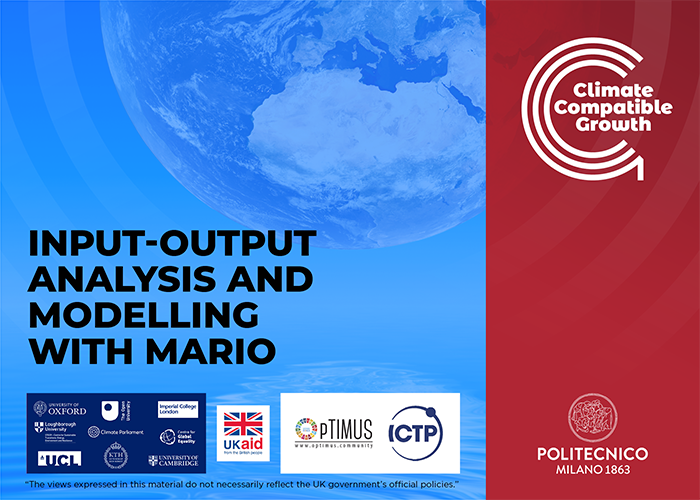
The main goal of the course is to
introduce you to the fundamentals of quantitative impact assessment methods and
models. These quantitative models are specifically designed to assess the
prospective environmental and economic impacts resulting from the application
of technological or policy interventions at meso- and macro-scale,
comprehensively including supply-chain effects in a Life Cycle perspective.
Basic principles of systems
modelling, quantitative impact assessment and industrial ecology are introduced
and discussed also based on real life examples and/or case studies. The
mathematical background of impact assessment models are then discussed,
focusing on Leontief’s Input-Output framework. Such framework allows to
describe national energy, environmental and economic accountability, mapping
the structure of national supply chains, hence it is usually adopted as
underlying database for impact assessment models.
Once the theoretical background is provided, the
course becomes more practical and will teach you how to handle input-output
tables and how to use them to quantitatively measure the impact of given
national policies, to calculate products and processes environmental
footprints, and to introduce new supply-chains using MARIO, an open-source
Python library born to make it easy to handle large databases and to build
complex Input-Output models and analyses.
This is the March 2024 presentation of the course
This course is part of a collection
This course is part of a collection of courses called Climate Compatible Growth March 2024 courses. There are 16 courses in this collection so you may find other courses here that maybe of interest to you.
Knowledge and understanding. You will learn basic concepts of Impact assessment methods, Life Cycle Assessment and Input-Output modelling. You will understand how physical and monetary flows of goods and services are produced and consumed within a generic productive system, and how they are accounted in standard accounting frameworks.
Applying knowledge and understanding. You will be able to setup an Input-Output model from scratch to perform quantitative analyses of shocks using MARIO. You will be able to properly model a policy intervention, a structural technological change or a new supply-chain within an economic system.
To enrol on this course, sign in and create your free account
If this is your first visit to this site, you need to register for a free account, then login on this site and click on the Enrol button for this course.
The course lectures are password-protected PowerPoints that will be downloaded to your computer. To view a lecture, open the file in PowerPoint and select ‘Present’ or click f5 on your keyboard. The slide notes are also available in the speaker notes section below each slide. Guidance on viewing the PowerPoints without Microsoft PowerPoint can be found here. To view on mobile devices, you can download the PowerPoint Mobile app. Free PowerPoint viewers, such as PPTX Viewer, are available. Most lectures in the course have associated hands-on exercises, which allow you to work through structured examples. There is a multiple-choice quiz to be completed after most lectures and hands-on exercises.
When you have completed the course, your certificate will appear in the course menu. Click on the 'Certificate' heading to access it. A copy will also be emailed to you.
This site provides access via hypertext links to resources in other web sites for browsing only and in so doing we are not endorsing any linked entities nor authorising any act which may be in breach of copyright or any other third party rights which are protected in law or by international treaties worldwide. Please be aware these external sites usually have their own terms and conditions.
Your course certificate will become viewable once you have completed all the criteria for the certificate. You will need to click on the certificate to view it.
To obtain a certificate, you will need to complete all the lectures and
hands-on exercises and achieve at least a 75% pass mark on the overall course
quizzes.
To enrol on this course, sign in and create your free account
If this is your first visit to this site, you need to register for a free account, then login on this site and click on the Enrol button for this course.
We invite you to discuss this subject, but remember this is a public forum.
Please be polite, and avoid your passions turning into contempt for others. We may delete posts that are rude or aggressive; or edit posts containing contact details or links to other websites.
To enrol on this course, sign in and create your free account
If this is your first visit to this site, you need to register for a free account, then login on this site and click on the Enrol button for this course.
This course is made available under CC BY-NC-SA 4.0: Climate Compatible Growth consortium
Any third-party materials featured in this course are used with permission and are not ours to give away. These materials are not subject to the Creative Commons licence. See the
terms and conditions and our FAQs. Please see the course acknowledgements for further information about copyright details.
For further information, take a look at our frequently asked questions which may give you the support you need.
You can start learning at any time. By signing up and enrolling you can track your progress and earn a Statement of Participation upon completion, all for free.
This course is made available under CC BY-NC-SA 4.0: Climate Compatible Growth consortium
Any third-party materials featured in this course are used with permission and are not ours to give away. These materials are not subject to the Creative Commons licence. See the
terms and conditions and our FAQs. Please see the course acknowledgements for further information about copyright details.
For further information, take a look at our frequently asked questions which may give you the support you need.