

1.5 So what is change?
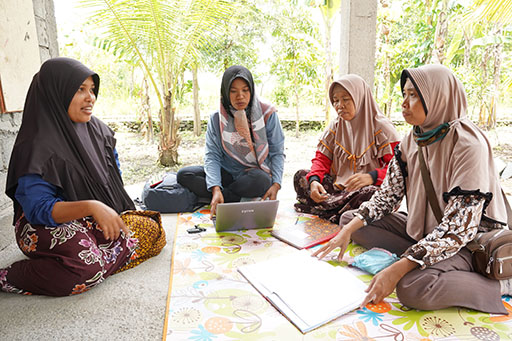
Yuli is a leader in the Indonesian Women with Disability Association and states that women with disabilities often face gender-based violence and many don’t know how to report the assault. Oxfam acknowledges the support of the Australian Government through the Australian NGO Cooperation Program (ANCP).
Here are some thoughts on what change is:
- Change comes in many guises and happens in many ways.
- Change is nearly always contested. Some people or institutions will support it, others will oppose.
- Change can be transformative when it challenges existing ways of doing things, or it can be incremental and piecemeal.
- Change can happen through strong and decisive leadership, or it can happen through shared interests and collective action.
- Change can appear to happen through luck, or a happy, or unhappy, accident.
- Change may be one small piece of a bigger picture where the long-term outcome may be unknown, and it may also involve one step forward and two steps back.
- Change can be scary. It is unpredictable and makes people feel insecure, even if those people stand to benefit from the change.
- Change does not affect all groups in the same way, and can be good for some while being less good (or bad) for others.
- Change can be highly beneficial, and it can be dangerous, putting certain groups at risk.
- Change can lead to a backlash, where individuals or institutions work to undermine a change achieved and try to restore the previous order of things.
- Change can be led from outside the community, often imposed from government or private companies, or it can come from within the community, from active people at the grassroots level.
- Change can be supported or opposed by governments or businesses, for good or for bad.
- Change can happen at different levels; at a personal level within ourselves, at a household level, community level, national level and global level.
- Change at a personal level can evoke strong feelings: fear, loss, anger, self-doubt, hope, joy, acceptance, solidarity.
- Change can be resisted by vested interests, which benefit from the status quo, but where outside interventions can loosen and overcome such resistance.
- Change can also be resisted by communities and disenfranchised groups, who consider it more of a threat than an opportunity.
- Change in some form is continuous and inevitable – even things that people consider to be immovable and fixed are always changing – culture, norms, beliefs and practices.
- Change can happen as the result of intentional action, and it can emerge in unplanned and unpredictable ways, with unintended consequences.
- Change often looks clear only in retrospect. While they’re happening, events are often confusing and contradictory.
- Change processes are seldom smooth – they often consist of long spells of stasis, punctuated by sudden spikes of good/bad change (‘windows of opportunity or threat’).
 Activity 1.3: What do you think change is?
Timing: Allow 10 minutes
What have we missed here? What else are important characteristics of social and political change? Which of these thoughts on what change is do you think are the most relevant to making change happen in your location?
Add your thoughts to the free text box, in the Make Change Happen Plan or in your own notebook about what you think is important to understand about change.
Interactive feature not available in single page view (see it in standard view).
Back to previous pagePrevious
1.4 Understanding ourselves

