

2.7 Understanding your change and defining change objectives
Having gone through your context analysis and got to know the change analysis tool, this is the opportunity for you to decide more specifically what the change you would like to see would look like in more concrete terms.
Having a clearly defined change goal will help you:
- Frame your change in a more specific way
- Identify specific objectives or key steps to achieve your goal
- Spot key stakeholders who have influence over what you want to achieve
- Determine your strategy and the tactics you will employ
- Develop your plan of action
- Monitor and evaluate your progress towards achieving your change goal and objectives
- Keep motivated throughout the highs and lows and to motivate others to join you.
We suggest you continue to use the change analysis tool we introduced earlier and apply it to your issue in order to help define the steps you and others will need to take in order to achieve change – your change objectives.
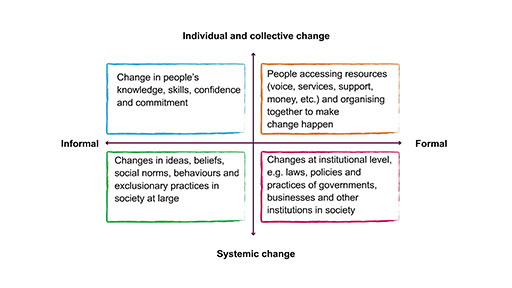
Consider the statements in each of the four quadrants and how they relate to the various challenges you need to address to achieve your vision of change – your change goal. Look at the different types of change at different levels, such as in policies, in resources, in norms and attitudes, and within individual’s awareness. What needs to change at each level to achieve your overall goal? In most cases changes will need to occur in more than one quadrant, although you might choose to focus on one area. That would be your contribution.
In order to identify your change objectives, take a look at the table below. Begin by confirming your change goal at the top. This should summarise your vision for change in a single sentence. For example, a change goal might be ‘Providing equal access to quality education for girls in my country’.
Then, for each area, write down some ideas which show how change could be achieved. These could become your change objectives. If you are struggling to identify an objective in one or more of the quadrants, don’t worry, not all change processes span across all four quadrants. The process of reflection and coming to this conclusion should be useful in itself.
So for the example change goal of girl’s education, the change objectives might be:
We can achieve more equal access to quality education for girls by:
- abolishing school fees and making education free and compulsory for all children
- shifting attitudes that create barriers for girls attending school, such as early pregnancy and child marriage
- local communities, mothers and girls themselves collectively advocating for better access
- local schools and classrooms having the commitment and resources to become more gender sensitive (e.g. sanitation and menstrual hygiene facilities).
 Activity 2:3: Defining change objectives
Now it’s your turn to fill in the table for your change goal. You will find this in the Make Change Happen Plan, or you can use the free text box or your own notebook.
| Overall change – informed by your vision, and your context analysis | Your change goal: |
| Policy or practice change at the institutional or government level | Your change objective: |
| Changes in ideas, beliefs, social norms, behaviours or attitudes | Your change objective: |
| Changes in people accessing resources and their collective capacity to organise | Your change objective: |
| Change in people’s knowledge, skills, confidence and commitment | Your change objective: |
2.6 Adapting to the context

