

4.4 How working with others achieves change
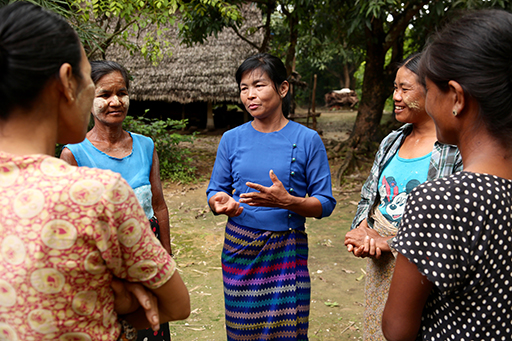
We all know of inspiring examples of national or global movements for change. Here are two case studies that illustrate the power of collective action in communities where, despite difficult local contexts, citizen activism has successfully achieved local changes in policy and practice, attitudes and behaviours.
One group increased their negotiating power by working together, the other increased their power of persuasion by campaigning together.
Anti-domestic violence little vaccine
From January 2020, many Chinese cities including Wuhan were locked down due to the Covid outbreak.
At the beginning of the lockdown, Guo Jing felt vulnerable and helpless as the infection rate rose dramatically. She began communicating regularly with her friends online, setting up a feminist activist WeChat support group after a few days. The group examined the lockdown from a feminist perspective discussing ways of engaging with the social impacts and exploring strategies to help individuals overcome a sense of vulnerability, especially for young women like themselves.
In their discussions, they realised that the epidemic was exacerbating sexual discrimination and domestic violence against women. Trapped in a confined physical space for a long period of time, many men were venting their pent-up frustrations on their family members.
Guo and her friends decided to launch an ‘Anti-Domestic Violence Little Vaccine’ campaign. The group published an open letter online, calling for an end to domestic violence and encouraged people to copy or print out the letter and post it in public spaces. The response was overwhelming: ‘In just a few hours, several thousand people volunteered to become 'little vaccines’ volunteers.’ Many people dialled the telephone number of the Women’s Rights Hotline run by the All-China Women’s Federation to make sure that the hotline was in operation. Others shared their own experience of falling victim to domestic violence. The campaign’s Weibo social media account attracted over 8 million views with many comments supporting the campaign. One participant wrote: ‘We should all become active spectators and refuse to remain silent when seeing domestic violence around us!'
Feminist activism is a politically sensitive issue in China but it is possible to tackle domestic violence with the right approach. The campaign attracted some male participants and support from parents. The ‘Anti-Domestic Violence Little Vaccine’ campaign offers a good example of activism in a time of crisis and a ‘state of emergency’. The collective spirit and emotional intensity generated can be mobilised for activist purposes, and the impacts can be greater than in more ordinary times.
Women peacebuilders in Yemen advocate for the re-opening of Al-Riyyan airport
The conflict in Yemen labelled the country as one of the worst humanitarian crises in the world. According to the UN, more than 21 million people in Yemen are in immediate need of humanitarian assistance. Yemeni citizens lack access to medical supplies and foodstuffs and lack freedom of movement throughout the country or internationally with more movement restrictions imposed on women and girls. Despite the difficulties and limited participation of women in the political arena, women peacebuilders in Yemen are working tirelessly to alleviate the suffering of their communities.
The Al-Riyyan International Airport in the coastal city of Mukalla, the capital of the Hadhramaut governorate, was closed in April 2015 after Al Qaeda in the Arabian Peninsula (AQAP) took over the city. Despite the city’s liberation from AQAP the following year, the airport remained closed. Without access to the airport, citizens in Mukalla had to travel over 200 miles on hazardous roads to the airport in Sayoun. For patients with severe medical conditions, this journey was dangerous or impossible.
A women’s group in Hadhramaut began advocating for the re-opening of the Al-Riyyan airport. Their campaign had a two-pronged approach: holding meetings with key stakeholders and decision-makers to apply pressure to re-open the airport and using creative means to raise community awareness and generate public support for the campaign’s initiative.
The women’s group used art and community gatherings for their awareness-raising and advocacy. They produced a short stop motion animation film titled ‘The Longest Way to Our Dreams’, which portrays a young girl who suffers a life-altering car crash and is unable to seek medical attention due to the airport’s closure. They held community gatherings where people affected by the closures could share their stories. The women’s group compiled ten of these personal accounts into a booklet called ‘Unforgettable’, a booklet full of stories, children’s drawings and poems depicting the suffering caused by the conflict in Yemen.
In January 2019, the governor of Hadhramaut accompanied the women’s peacebuilding team on a visit to the Al-Riyyan airport. This visit was covered by local media and television stations and broadcast widely on social media. ‘Through networking and advocacy, the women’s group was able to convey their demands to local government representatives and decision-makers in a peaceful manner... these women deserve to occupy senior leadership positions,’ said the deputy governor for youth affairs in Hadhramaut. The governor of Hadhramaut directed all airport staff and personnel to resume their positions starting in April 2021.
During the closing ceremony of the advocacy campaign a member of the Hadhramaut women’s group proclaimed, ‘We were able to prove that women can make a difference. We have successfully achieved the goals we had when we started the project and will continue to address various community priority issues.’
4.3 What do we mean by collective action?

