

5.3 What is influencing?

Influencing is the ability to get others – whether individuals, groups, organisations, or governments – to do something they wouldn’t otherwise have done. It can also be the ability to get others not to do something they would have done. Influencing means having an impact on people’s hearts and minds, but importantly also their actions. As well as influencing wider attitudes, social norms and behaviours on an issue. it can also be collective and systematic efforts to change power relationships, the terms of public debate, or the policies and practices of institutions.
As you’ll know from campaigns you’ve been involved in or seen already, changemakers need to communicate a vision of change and encourage and inspire others to align their actions with that vision. This will often mean identifying and appealing to shared values and communicating well through strong narratives around the common challenges faced, along with positive and inspiring stories of how these challenges can be overcome. We will look at storytelling and developing narratives in the next unit.
In this unit, we focus on influencing through engagement and persuasion.
To achieve change you may need to accompany persuasion with pressure, particularly with powerful decision-makers who may not be your natural allies. All depending on power analysis. Examples include the use of digital tools and social media that demonstrate the level of public concern or organising a demonstration or sit-in to highlight your issue in the media.
To be effective in your influencing, you should also think about how to build a constituency of allies and supporters. The building of support is likely to rely heavily on who you are as an individual and your own personal networks and influencing skills. This can also be described as interpersonal power, of which there are two types: personal power and positional power.
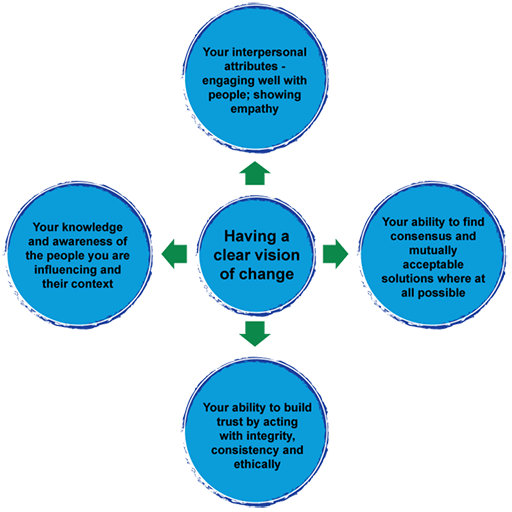
Personal power is the power you have because of your characteristics as an individual. We’ve already talked a lot about the desirable characteristics of changemakers in terms of your own curiosity and courage. Your ability to work well with people, to listen and garner trust and respect from others, as well as your credibility and ability to empathise with others, will all drive your personal power. Thinking about how you can apply some of the feminist leadership principles we outlined in Unit 4 will be important too. Developing these personal attributes are essential for building your constituency and enhancing your influence.
Positional power derives from the role you occupy or the responsibilities you have, whether from a formal or informal role. The knowledge, expertise or information you have, or can access, are also important sources of power which you can use to good effect as a changemaker. Wherever your power is derived from, it’s how you use it and for what purpose that is important, as well as how you work with others.
As changemakers, you will need the support and actions of others but you are unlikely to have direct control over them, nor is this necessarily desirable. As you saw in the last unit, your ability to build consensus is important. You may have some positional power, but you will most likely rely on personal power; the power that resides in personal relationships.
You also need to think about the influence your group or constituency has and how you engage with this collective power (power with). The bigger your constituency of supporters the more influence – or group power – it will have. But the group’s influence will also depend on other sources of power – such as your perceived authority, reputation, knowledge, credibility, legitimacy and the trust people have in the group.
5.2 Being influenced... and influential

