Rural entrepreneurship in Wales
Use 'Print preview' to check the number of pages and printer settings.
Print functionality varies between browsers.
Printable page generated Wednesday, 23 September 2026, 7:43 AM
Rural entrepreneurship in Wales
Introduction
This course considers the issues that are important when starting up or running a small business in a rural environment.
Traditional business models apply to running a business in any location. This course will introduce you to some concepts that will help you work out what you want to do with your business idea. It will also ask you to consider the impact of living in a rural location on your business and to consider what is important to you.
Here are some characters who will be with us throughout the course. Each has a different proposal for which the rural context poses particular challenges.
Euan works on his family’s farm and wants to develop more income by diversifying outside of traditional farming activities.
Gwyneth is a keen cook and has had her hours reduced at the café where she works in town. To supplement her family income, she wants to sell her homemade jams, chutneys and preserves at farmers’ markets and food fairs.
Julia, a Further Education student, lives with her family in a remote area where the Post Office and village store are threatened with closure. She needs to engage in a team enterprise activity as part of her Welsh Baccalaureate qualification and has been inspired by enterprise events and lectures attended at college. With the support of staff at the Post Office, she wants to lead local residents in a bid to take over the Post Office and store and run them as a community shop.
Dafydd is a sheep farmer who, together with his wife Ffion, works off farm to supplement the farming income. He wants to diversify into the holiday let business by turning three redundant barns into eco-friendly self-catering accommodation.
Gwenllian is a language teacher living in a fairly remote area of mid-Wales where access to learning is difficult (long distances, poor public transport and inflexible timetables). She has identified a need for language-based CPD and translation services among local businesses involved in exporting their products to mainland Europe.
Whatever your motivation for tackling this course of study, it will take you on a journey looking at the challenges posed when you live in a rural environment and start you thinking about how you can use this knowledge to run a successful business of your choice.
This OpenLearn course is an adapted extract from the Open University course Q91 Business Management.
Learning outcomes
After studying this course, you should be able to:
understand the importance of how living rurally influences your business or social enterprise objectives
explore the feasibility of a business idea
plan a strategy for the development of your company
state the likely resources and capabilities required for your new business and understand where the gaps are likely to occur.
Unit structure
This course should take approximately 30 hours to study, but it has been carefully designed so you can choose your own pace of learning. The materials are designed for study at your computer screen (but sections can be printed out to read elsewhere) in short periods – half-an-hour now and then wherever you are.
While it has been designed so that you can study it on your own, as an Open Educational Resource (OER), you can also download content and reuse, revise, or remix it for use in other contexts. We have tried to ensure that the content is as flexible and adaptable as possible. This means it should be easy to use in face-to-face contexts with, for example, a group of other entrepreneurs or community members (community enterprise) as well as by yourself, alone, online. The Resources section at the end of the course contains templates used in the course to download.
We have set up a Twitter account, @RuralEntWales. You can use this to find up to date information about the changes in the rural entrepreneurial landscape.
The course map below indicates the sections of the course together with guidance on how long each section might take, enabling you to plan your study time. The learning outcomes describe what you can expect to have learned at the end of your study.
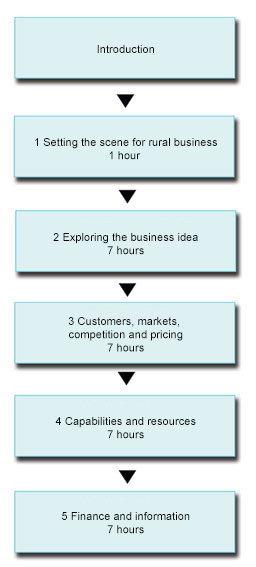
As you progress through this course you will start to complete a plan, by filling in the Business Plan Progress Review (BPPR). Although the BPPR is too brief to be considered a full business plan, it will help you review the key elements of your business idea and will be extremely helpful as a summary document. The BPPR is available to download in the Resources section.
As you launch your new business idea – and if you intend to secure finance for your business – you will need a business plan with more detail than this course provides, so it is a good idea to work on two versions of the plan as you progress through the course.
1 Setting the scene for rural business
Learning outcomes
At the end of this section you will be able to:
- understand how living rurally influences your business or social enterprise objectives
- set business goals within a framework for living rurally
- articulate the importance of personal values in setting up and running a business.
1.1 What does rural mean?
How do we define what is rural? Before we move on to any official definitions or statistics, it might be worth looking at what we think is meant by the term ‘rurality’. Often when we think of ‘rural’ we tend to perhaps equate it with ‘the countryside’, or ‘landscape’, or ‘nature’, or other similar general terms. Perhaps we might think about ‘quality of life’, a slower pace, stronger communities. We might think about some things that relate to descriptions of the physical world around us and some that relate to social or cultural aspects. Sometimes they might be positive (as above), but others might be negative: everybody knowing your business; difficult to access services like education or health care; poor roads and transport links, and lack of employment opportunities. Defining ‘rurality’ is by no means straightforward, but it is important to understand and recognise the benefits and costs of living in a rural area.
It is worth recognising that not all rural areas are the same, and that the rural context and rural challenges within each of the four nations in the United Kingdom (Wales, Scotland, Northern Ireland and England), and regionally within these nations, will be very different. Within Wales, the rural challenges of Pembrokeshire, for example, will be very different to those experienced in Conwy, andeven within Pembrokeshire, between Narberth and St. Dogmaels.
New findings, released by the ONS, show that Wales continues to have many of the most empty areas in the United Kingdom. Powys, with only 26 people per square km, is the second most empty part of the UK. For comparison Cardiff has 2,482 people per square km. The average weekly earnings of those living in rural areas such as Powys is lower than the Welsh national average. Anglesey and Conwy have the highest number of economically inactive, retired residents in Wales.
The Rural Development Plan (RDP) for Wales 2009–2013 outlines four axes that provide strategic direction to regional and local rural development initiatives:
- Axis 1: Making rural Wales more competitive
- Axis 2: Protecting our countryside
- Axis 3: Improving people’s lives and encouraging diversification
- Axis 4: Supporting local projects and initiatives
Each region in Wales, as part of the Wales Rural Network, has its own Local Action Group which then applies the RDP strategy according to its own situational needs.
This kind of information is useful as background when thinking about your business and your community.
Note: A link to the 2014–2020 version of the RDP for Wales will be made available via the Twitter hashtag #RDPWalesRuralEnt.
The affordability of housing in rural areas has long been an issue across the UK, and particularly in Welsh communities, where the price of local houses is out of step with the level of local incomes. This situation is exacerbated by the extent of second home ownership in many rural areas, as well as the influx of city dwellers looking for ‘a mixture of clean air, friendly people and community spirit’, according to the NFU Mutual study (2010). The study claims that nearly seven in ten of rural residents have exchanged towns and cities for the Welsh countryside, and that around 45 per cent have moved from urban areas in the last five years. While this has helped local services to survive, it has also pushed up house prices according to The Campaign for the Protection of Rural Wales (CPRW).
Research conducted by The Wales Rural Observatory (2009) for the ‘One Wales’ coalition government in 2010, found that other challenging issues for those living in rural areas include the relatively high cost of goods (including fuel), transport difficulties and poor access to broadband. Nevertheless, more than 90 per cent of those surveyed said they were satisfied with their local area as a place to live, and 94 per cent rated their quality of life as either ‘very good’ or ‘fairly quiet’.
The public sector is a major employer in Wales, and in rural Wales it accounts for 28 per cent of the workforce. There is considerable regional variation, however. Therefore, almost a third of the workforce in Gwynedd and Carmarthenshire work in the public sector whereas less than a quarter of the working population do so in Pembrokeshire, Powys, Conwy and Monmouthshire. As the size of the public sector shrinks, its impact will be felt keenly in rural Wales.
In 2006, small and medium-sized enterprises made up over 99 per cent of the 190,000 businesses in Wales but accounted for less than 60 per cent of employment (Stats Wales, 2009).
Rural areas have the highest density (per head of population) of private business small employers (Powys, Ceredigion and Pembrokeshire ranking 1st, 2nd and 3rd, Wales.gov, 2011), 17 per cent of whose employees are aged under 25. In addition, under 40 per cent of those who work in the private sector speak Welsh with under a half using the language ‘mostly’ or ‘sometimes’ at work (Wales Rural Observatory, 2006).
CO2 emissions are higher in rural areas, transport use tends to be higher, and rural properties tend to be less well insulated. However, rural communities have the greatest potential to benefit from renewable energy.
What these kinds of ‘facts’ tell us is that rural areas experience different sets of issues. Knowing those issues, and reflecting on and understanding how they might affect your business and your choices will help you to develop your business, and give potential funders confidence that you have done your research. For the latest information look for #RDPWalesRuralEnt on Twitter.
Local Authorities (LA) also gather data about your area; it is worth exploring these either by going directly to your Local Authority’s website or by going to the Business Wales website where you will find links to all of the 22 LAs as well as additional information and support.
At the end of this section we suggest some possible sources of information and support.
Task 1: Personal objectives
Write down your personal objectives for studying this course. (You can modify this as you progress.)
- What do you enjoy about living in a rural location? What do you not enjoy?
- Write down what ‘rurality’ means to you i.e., what are its characteristics (this might help you think about what it is it that being rural brings to your business).
Share your thoughts with other entrepreneurs in your local networks.
At the end of each section you will be asked to review the activities you have completed and summarise your work in the Business Plan Progress Review (BPPR).
Take a look at the template now so you are clear about what you will need to do in each section.
1.2 Why start a business?
For some, living rurally has special benefits, and for others it is about making a difficult life more manageable.
Before you examine the feasibility of your business idea, take some time to think through who your stakeholders are and what your strategies are for taking the business forward. This is useful to understand the basis on which you are building the business. This is about you, what is important to you and how this will be reflected in your business.
Task 2: Visioning – life and business
Write down your personal goals for 12 months’ time and for five years’ time. What would you like to have achieved? Include personal and business objectives. Use the table template as below or, if you prefer, create your own mind map (Buzan, 2002) or list.
| Area of my life | 12 months | Five years | Comments and links |
|---|---|---|---|
| Home – living rurally | a. b. c. | a. b. c. | |
| Family | a. b. c. | a. b. c. | |
| Work | a. b. c. | a. b. c. | |
| Values | a. b. c. | a. b. c. |
Look at your table, mind map or list. Does anything strike you? Are your goals compatible?
It is important to understand what it is about where you live, how you live, your desires and your fundamental values that you will take with you into the new venture.
Every organisation, large or small, has a ‘pyramid of purpose’.
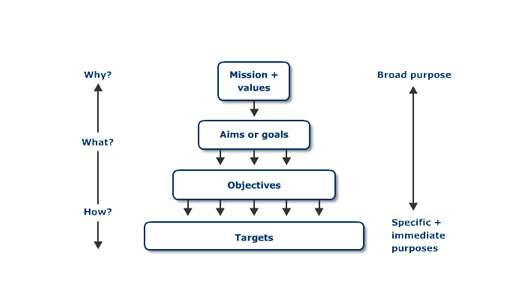
As we progress through the course, your aims, objectives and so on will become clearer. This diagram shows how they all need to align, to build upon and support each other.
Task 3: Mission statement
One of the things that can help us understand our own business idea is to reflect on our previous work experiences. Think about an organisation in which you have worked.
- Can you state its general mission and values?
- Do you know its aims or goals?
- Were its objectives (or those of the department you worked in) clear?
- Did you have formal (or informal) targets?
Discussion
If you have worked in a large organisation you may have seen the company ‘mission’, vision and values on posters, etc. These things are seen as important in creating a culture or ‘way of doing things’ within the company.
In smaller companies not so much time is usually given to communicating them in such a formal way. Nevertheless, when you go into a small shop or company you sense what is important by the way business is conducted (how staff behave towards customers, the lighting and lay out of the premises and how this makes you feel, and so on).
It will be the same for your business: the values you work to will be your own. How do they transfer to the business world given that you need to make a profit in some way, even if it is to be reinvested in the business?
It is common for large companies to have a ‘corporate social responsibility’ policy, and for some smaller organisations it is part of their very being (e.g. community shops and cafés). Wherever such a policy fits in your business, it can provide a helpful point to reflect your personal values formally within your business.
1.3 Values
All businesses have values, which are influenced by the world around them. The acronym SOGI helps us to think about them.
- Society: Every organisation operates within societal norms: they might relate to faith, environmental aspects, historical traditions, geographic or cultural practices. These will vary. Earlier, we explored our own perceptions of rurality, and discovered that rural areas vary and that our position in rural society (young/old/less able/employed) changes how we experience rural life.
- Organisational: A founder of an organisation imparts their own beliefs and values into the way the company is run. Some of these will relate to the aspects above and be unconscious, others may be a wish to resist or move away from established ways of doing things. These are then taken on by the staff and become embedded into the way they are expected to behave. We may do the same ourselves.
- Group: Within an organisation a group can develop their own set of values, ways of communicating and behaving with each other.
- Individual: Our personal values and beliefs will ‘fit’ or not with those of society, the organisation and the groups in which we find ourselves. People usually give their best when the ‘fit’ is good.
Task 4: Values
Think about the values you bring to your new enterprise.
If you are planning a partnership, think about the values of each person involved. (You could ask them to complete the previous activity too!)
- Are you and your partner’s values compatible?
- How will your values be evident in your organisation?
- If you are extending an existing business: what are the existing values of the business?
- Are you happy to build on them?
Make notes of your thoughts.
Share your thoughts with other entrepreneurs in your local networks.
1.4 The rural entrepreneur
Originally, the term ‘entrepreneur’, which derives from the French words entre (between) and prendre (to take), referred to someone who acted as an intermediary in undertaking to do something. The term was first used to describe the activities of what today we might call an impresario, a promoter or a deal-developing, entrepreneurial ideas maker.
Ask people to name an entrepreneur and many will say Richard Branson. He is indeed an entrepreneur, but to think that his high-profile celebrity status is necessary to entrepreneurship does a great disservice to all those who work creating new products or services or delivering them to market in a different or more efficient way.
It is also worth noting that entrepreneurship is not something that is confined to the ‘for profit’ sector. We also find social entrepreneurs, and in many rural locales policy entrepreneurs (people in public office like a local authority) can be just as important in laying the foundations for entrepreneurship.
Within a 20 mile range of any rural location there will be many examples of entrepreneurial businesses.
Task 5: Rural businesses
Make a list the businesses local to you that might be deemed entrepreneurial.
A sample of small businesses identified within a very small radius of one another were:
- A chocolate importer, originally from mainland Europe, who noted that people loved the chocolate he brought back as presents and set up a business.
- A farming family who have built a cafe and a bunkhouse to supplement their income.
- A consultancy that conducts ecological monitoring, usually for new developments. They are very busy with impact assessments on hydro schemes and wind farms.
- A range of local traders who work as sole traders but come together to take on larger projects.
- A community company that owns and manages the local fishery and is branching out into hydro.
- A self-employed machine operator with his own plant who is diversifying into the pipe business.
- A smallholder who moved into the area, set up a mushroom business selling direct to wholesalers and who has recently branched out into selling mushroom kits.
- Two guitar makers, independent of each other but living less than a mile apart. Each makes handmade bespoke instruments.
- A sole trader who develops and designs the computer systems that run climate controls in high rise buildings and most of whose clients are in SE Asia.
Discussion
Each one of these business owners started with a small idea and developed it into a sustainable business or social enterprise. It is often assumed entrepreneurs share with all other business owners and senior managers the goal of maximising the ‘profits’ of their business. Even if you are working towards a social enterprise, the long-term financial viability is still a fundamental necessity. In reality, however, many other motives and objectives also influence business and managerial behaviour, particularly among small organisations of less than 20 employees (which would include almost all new start ups).
Austrian economist Joseph Schumpeter (1934) defined the entrepreneur simply as someone who acts as an agent of change by bringing into existence a ‘new combination of the means of production’. The essence of Schumpeter’s approach is that entrepreneurs are competitive and always strive to gain an edge over their competitors, or the best facility for their clients in the case of a social enterprise. In general, he suggests entrepreneurs are also adept at getting investors and providers of capital (such as banks, relatives or grant schemes) to bear the main part of the financial risk.
When entrepreneurs begin to consolidate and slow down they revert to being ordinary managers and, in Schumpeter’s terms, are no longer entrepreneurial. Thus, a certain set of skills, approaches and attitude may be required to set up a business and a different set required to run and maintain it.
McClelland (1968) takes a more psychological perspective. His preferred entrepreneurial motivator is the ‘need for achievement’ (‘nAch’, as it is usually abbreviated) – ‘a desire to do well, not so much for the sake of social recognition or prestige, but to attain an inner feeling of personal accomplishment’. McClelland was quite critical of the profit motive as the mainspring of entrepreneurial activity.
Slee (2008) purports that once a relatively low level of wealth is achieved, further increases do not mirror increases in happiness. Thus, the desire for constant growth in a small company may not enhance the ‘well being’ noted as being a key motivation for many rural businesses.
He argues that many things should happen locally, be it work, energy or food production or, indeed, leisure time. Curry (2008) suggests:
It is the pursuit of a number of these ‘non-growth’ characteristics that is enjoying increasing popularity amongst rural communities themselves … ‘bottom up’ initiatives such as land trusts, community finance solutions, alternative foods, local foods, farmers markets, etc. are all naturally adopting Slee’s notions of relocalisation on the ground.
1.5 Behavioural characteristics of entrepreneurs
Many, but not all, rural businesses are driven by the desire to provide a local service, to succeed and build the community around them. Some of those are private ‘for profit’ and some exist in the ‘not-for-profit’ sector – voluntary organisations, community interest companies, charities, or social enterprises. Of course the ‘not-for-profit’ organisations still need to make money, but that is not their principal goal and any excess profits are typically invested back into the organisation.
One idea of entrepreneurship may sit more comfortably with you than others, and indeed, you may never (until now) have considered yourself to be an entrepreneur at all. Whatever your motivation there are some key characteristics that support entrepreneurial success that were identified by Jeffrey Timmons from Massachusetts Institute of Technology. These are:
- drive and energy
- self-confidence
- high initiative and personal responsibility
- internal locus of control
- high tolerance for ambiguity
- low fear of failure
- moderate risk taking
- long-term involvement
- money as a measure not merely an end
- use of feedback
- continuous pragmatic problem solving
- use of resources
- self-imposed standards.
Task 6: Qualities of and entrepreneur
Which of these qualities do you recognise in yourself? You don’t have to have them all! For more information see What makes an entrepreneur?.
Share your thoughts with other entrepreneurs in your local networks.
1.5.1 Further information
Listen to Why study entrepreneurship? This is part of a series of recordings tracking entrepreneurs’ journeys that we will visit throughout the module.
If you have found this section useful you may also want to explore this resource on Entrepreneurial impressions. It includes a video from young Scottish entrepreneur Fraser Docherty about his SuperJam business. Or try the OpenLearn unit Entrepreneurial behaviour.
1.6 Summary
In this section you have:
- examined the definition of ‘rural’
- written your personal objectives for starting a business
- considered the pyramid of purpose, looking at the alignment of your life and business values.
Now open the BPPR and reflect on the activities completed in this section. Review the output from each activity and complete the two questions raised in the introductory section of the BPPR. This requires you to pull out the most important aspects of your thinking to date.
A wise word of experience…
Remember that as you develop your enterprise you are not on your own. Family, friends and existing networks all provide valuable support. However, there are lots of other sources of support as well, such as from public bodies. Many organisations also provide useful signposting to resources and information, advice and guidance. These will vary depending on where you live. Here is a starter list of organisations you might consider contacting or exploring (if you have not done so already):
2 Exploring the business idea
Learning outcomes
At the end of this section you will be able to:
- explore the feasibility of a business idea
- identify the stages to business success
- state the different company structures possible
- assess the impact of living in a rural environment
- understand stakeholders, identify them and their expectations
- plan a strategy for the development of your company.
2.1 The business idea
In this section you will begin to look at your idea in detail, to consider its feasibility and the perspectives of some of the others who will be interested in the viability of your idea, including any rural perspectives.
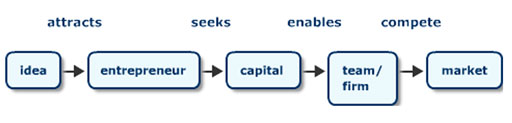
To have the power to attract, convince and motivate people with wildly divergent interests – such as customers, consumers, investors, employees, suppliers, distributors and so on – the idea must be innovative, legitimate and viable. It must offer something new, something of value to some or all of these interested parties (often called stakeholders), and its first essential step is that it must attract someone, or some team, committed to making it happen. The person who is committed to undertaking the idea we can call the entrepreneur.
However, commitment is not enough. To become reality, ideas need resources – physical, financial and intangible (such as experience, knowledge and, sometimes, legal rights to use processes and products). A key part of the entrepreneur’s job is to obtain the capital to acquire those resources.
When developing a business we draw on a range of complex capital inputs. For example, our own skills and those of anyone we employ is called ‘human capital’, our networks and connections are ‘social capital’, and the effect on the community in which we operate will be around ‘cultural capital’. Social and cultural capital might be particularly important when considering a social enterprise such as promoting inclusion for vulnerable adults, or promoting the local culture.
Many small rural businesses start with just one person, the business owner, perhaps working part-time alongside another job at the beginning. It is certainly possible (although hard work) to continue like this, even when your enterprise becomes ‘full time’. However, even if it’s just you in your business, it does not exist in isolation, it is still part of a network, where often businesses depend on each other.
Most businesses grow sufficiently so that they need to employ another person or even a group of people. It is the actions of these people that will translate the idea into a product or service. However, they do not all need to work for you. You might make a product, but you do not have to market it, or distribute it: you can employ others to do this for you. In the end you might not even end up making it yourself either but instead decide to outsource the production to someone else.
Finally, the products developed from the idea need customers and consumers who want them and are prepared to exchange their hard earned cash for them. Often you can make an enterprise succeed by meeting a local need or you may be targeting a wider market. Whatever your scale, it is likely that your business idea will have to be strong enough to secure the finance, skills and other business support to help your idea develop through to fruition. That does sound daunting, but often what is distinctive about your product or idea might be the values that lie behind it or even the location. Thus, a community owned or local shop might be expensive or stock a small range of products, but for rural residents that cost may be set against travel costs they might incur by having to travel elsewhere to shop, and they might also place a social value on supporting their local shop.
Task 7: The business idea
To be confident that your idea is strong enough to succeed in its competitive market, you will need to provide robust answers to the following questions (which, at this stage, you may find difficult – but you should have a much clearer idea by the end of the course):
- In one sentence, what is your business idea?
- What unique or distinctive features characterise it?
- What types of customers are likely to be attracted to its benefits?
- Potentially, how many customers are there?
- Are enough of them willing to pay the prices or fees to cover all your costs and provide you with a reasonable living?
Write down your answers (even if they are just initial thoughts) so that you can refer to them later.
Share your thoughts with other entrepreneurs in your local networks.
2.1.1 Case studies – business ideas
Having met our case studies in the introduction, we will now find out more about their individual business ideas.
Euan

‘I want to make my family’s farming business more resilient and bring in more income by making use of the unused sheds and land we have. There are lots of microbreweries setting up and I think having one on the farm would be unusual and a great way to modernise what we do. It’d be unique and we could use lots of the resources we already have but it could take a long time to set up, purchase equipment and learn the ropes – that is something I am more than willing to do.’
Gwyneth

‘I love cooking and I’ve worked for others in hospitality and catering for ten years. I currently work part-time in a café but I don’t feel I could go back to full-time hours as I need some flexibility around my family. I want to make products at home that I can sell to delis and cafés in the area and at weekends at farmers’ markets and food fairs a little further afield.’
Julia

‘I live with my parents in an area where our local shop and Post Office are threatened with closure. This would mean my family and other local residents having to make a long and difficult journey to reach the next nearest Post Office branch or to buy daily supplies as public transport is so infrequent. I think that local residents could come together and run them as a community shop and I would like to be the person to lead on seeing if it is possible.’
Dafydd
‘My wife, Ffion, and I live on our family-run 140 acre sheep farm with our two children. We have three lovely traditional stone buildings on the farm which are surplus to requirements within our modern farming business. I would like to bring additional income into the business by restoring them to their former glory and letting them out as holiday lets.’
Gwenllian

‘I teach part-time. I have recently established a link with a local international corporation and realise that instead of the traditional type of language course, what they really seem to need is very tailored, ‘quick fix’. Basic language skill training and cultural briefings to prepare them for their business trips abroad. There is a lack of this kind of linguistic service in mid-Wales so my business idea is to develop a bespoke language service offering a range of different types of language support – from industry-based updateable, multi-platform, on-site translation and interpretation services.’
David

‘My business idea is to use my previous experience of making staircases for property developers and use it to establish my own company, designing and building bespoke staircases. I would use locally sourced, sustainably produced timber and work from a workshop located away from my home. I’ve worked self-employed before but this time it’ll be through choice, not necessity.’
If you are still a bit unclear about your business idea, it may help you to consider the seven sources of innovation identified by Peter Drucker (1985), whose writings have influenced the theory and practice of business, entrepreneurship, innovation and management for more than half a century.
2.2 Sources of innovative business ideas
Innovative ideas grow out of ordinary experiences and situations. Consider the suggestions below. Perhaps your business idea has developed from such a situation:
- past and present work and experience
- hobbies and leisure interests
- qualifications and studies
- new markets/uses for existing products
- solving a persistent problem
- research and development (R&D)
- patents, licences and research institutes
- invention
- opportunities from new technologies
- opportunities from economic/market changes
- changes in consumer behaviour
- complaints and irritations expressed by potential customers
- changes in rules and regulations
- imitating an idea from a different locality
- imitating an idea from a different industry
- improving an existing product
- films, TV and radio
- books, magazines and the press
- trade shows, exhibitions and conferences
- business and social networks
- family and friends.
Case study: Sources of innovation
David was pondering the list above and he concluded that while many of them could be included, his idea had been significantly influenced by the following:
- past and present work and experience – many years of practical experience as a joiner, making and fitting staircases. Taking on additional work to make staircases when the employer’s alternative was to source from further afield, at a greater cost to them.
- hobbies and leisure interests – creative work such as making bespoke items using his carpentry skills, which have been given as gifts to family and friends.
- research and development (R&D) – there have been a number of residential properties in the area that have been renovated in recent years, either for resale or to add aesthetic or monetary value during the property sales downturn. This has provided him with good, hands on research and development. He has provided stairs for commercial properties, and through this has become familiar with the specifications and with the necessary regulations and requirements.
- improving an existing product – staircases are something that homes and commercial properties of more than one story will always need. The basic design is the same. However, he can add and improve other qualities. Wood has not always been sustainably sourced, and local timber from sustainable sources is not being used. He could also look at using reclaimed wood whenever possible which means he could also add this as a selling point.
To have any chance of making it as a successful product or service in its chosen market, an entrepreneurial business idea has to find the right balance between two potentially conflicting forces:
- the need to be innovative (have something sufficiently new about it so that it is both attractive and competitive)
- the need to be viable (have sufficient resources, capabilities and potential customers to bring the product to market and achieve your financial objectives).
2.2.1 Generating innovation
Task 8: Generating innovation
The following table suggests situations that might generate innovation. Match the rural examples in this drag and drop exercise.
Two lists follow, match one item from the first with one item from the second. Each item can only be matched once. There are 7 items in each list.
Foot and mouth
Closure of village shop
Processing wool for insulating material for packaging
Opening of a local farmers market
An increase in the number of people over 65 living rurally
Desire for more local food
Increased use of internet in rural communities
Match each of the previous list items with an item from the following list:
a.Situation 7: New knowledge
b.Situation 3: A need for process improvements
c.Situation 6: Changes in perception, mood and meaning
d.Situation 5: Demographics
e.Situation 1: Unexpected happenings
f.Situation 2: Incongruous happenings
g.Situation 4: Changes in industry structure or market structure
- 1 = e,
- 2 = f,
- 3 = b,
- 4 = g,
- 5 = d,
- 6 = c,
- 7 = a
2.2.2 Further information
If you found this useful you might also want to:
- read Have you got a good idea?
- read Managing innovation
- or listen to Developing a new idea
2.3 Steps to success
The entrepreneur or business owner needs to have a defining belief that the idea will work and sufficient energy to drive it to be ready to launch on the defined market. Sometimes the finance required comes from personal funds, sometimes from grants and sometimes from banks, venture capitalists or other sources of funding.
Wherever the capital is coming from it is important to be clear what the goals are in the short and longer term. If the funds are coming from personal or family sources you may not require a formal business plan, more a convincing conversation. However, it is best practice, wherever the finance comes from, to have some form of business plan – a plan that has clear goals that map out your route to success.
Your goals need to be SMART to be helpful.
- Specific
- Measurable
- Achievable
- Resource-related
- Timed.
For example, ‘I want to have a business that provides me with a good source of income’ sounds fine initially, but what is ‘good’? For some, an income of £10,000 would be fine, while others may require £50,000 or £100,000.
A SMART goal might be: ‘In two years time (timed) I will have a turnover of £500,000 (measurable and specific) with a 20 per cent profit margin (measurable)’.
It can be a matter of judgement whether the goal is achievable, which will depend on your market and starting position. Ensuring that the goal is ‘achievable’ does not mean it has to be soft or easy to achieve; it needs to be challenging, too.
When you work for someone else, the goal needs to be agreed with your manager; when you are the company owner the resources required need to be specified and need to be agreed with your board of directors, the bank manager, your family, and your staff where appropriate.
Task 9: Defining the business goals
- Think about where would you like your business to be in 12 months’ time. You will refine these goals as you work through the course and you gather more information to inform them. These short-term goals will inevitably be described in greater detail than those covering a longer time period.
- Now write down your goals for your business in three to five years’ time.
- Check that they are SMART
- Share your goals with other entrepreneurs in your local networks.
Along with the clear statement of your business idea, this is the first step to building your plan. This information will be required in your BPPR. It defines the strategic direction you will be following – but more about that to follow.
2.4 Company structure
One of the decisions you will be faced with is how to structure your business. This means the legal structure not the organisation structure.
If you are planning a commercial company, there are the following legal forms to choose from:
- sole trader
- partnership
- limited liability partnership
- limited company
- franchise
- social enterprise.
An overview of legal structures is available at Business Wales. It clearly explains the different legal forms. For further advice on this please contact your accountant or adviser.
The Welsh Government agenda has focused on ‘communities’ in recent times, with funding to support the establishment of a range of ‘non profit’ enterprises, community companies, social enterprises, charities, or community interest companies. We alluded to the growing importance of these organisations at the start of the course and also pointed you towards a range of support and advice services.
In setting up one of these you (and your community) will need to consider exactly the same things as any private or for profit enterprise; demand, financial viability, skills and capacity, and how to secure funding. However, as these are often publicly regulated bodies they have complex legal structure and you should contact one of the organisations listed in Links to get appropriate advice.
2.5 Environmental scan
The environment around you and how it is changing will influence the chances of your business succeeding. It is important to consider what factors are important and to understand how they influence your chances of success. The period since World War Two has seen unprecedented change and advances throughout the world in five key areas – societies, technologies, economic development, the environment and political systems and regulations. We refer to these areas as STEEP factors, and the pace of change in them has intensified in most parts of the world in recent years. Find out how an entrepreneur used STEEP in an audio track, Entrepreneurial Opportunities. This draws on a suite of resources exploring entrepreneurial opportunities which are featured throughout the course.
Sources of major change arising from STEEP factors
Social
- Ageing populations in most of the industrialised world
- Growth in mass migration and refugee populations
- Challenges to welfare provision and educational systems
- Changing consumer needs and wants.
Technological
- Speed and capacity of communication
- Moore’s Law (data capacity of computer chips doubles every 18 months)
- Increased consumer sophistication due to widespread use of computers and the internet
- New mobile and wireless communications applications
- Biological and genetic discoveries and applications.
Economic
- Integration of world financial markets
- Rise of BRIC (Brazil, Russia, India and China) as new world economic powers
- Relations between Euro and US dollar
- Dominance of ‘free-market, free-trade’ model
- Fast and increasingly transparent access to information
- Reduction in transaction costs.
Environmental
- Climatic change
- Genetically modified crops and produce
- Increased risk of epidemics and disease (AIDS, BSE, SARS and so on) through more mobile human and animal populations
- Ecological damage; reliance on energy sources that are effectively non-renewable.
Political
- European Union
- World Trade Organisation
- Increased regulation
- Regional resurgence
- Ethnic conflict, nationalism and militant fundamentalism
- The changing position of the US as the only superpower and the increasing importance of China on the world stage.
These changes are far reaching and affect us all. Some of these will have given rise to the opportunity you now have.
Some of the most spectacular changes have been in the introduction of new technologies and applications based on them. For instance, the rapid and almost universal spread of information and communications technologies (ICT) in the form of computers, broadband, the internet, mobile telephony and the many other applications that derive from them has cut communications times and increased access to information to such an extent that global competition reaches into the most local and rural of economies. However, there are still issues around broadband access for some rural areas.
Overall, globalisation (the integration of worldwide financial, product, resource and services markets) has encouraged the growth of transnational businesses and world brands and also, paradoxically, of localisation (promotion of distinctive community, local and regional activities and identities).
Both of these opposing tendencies are reflected in consumers increasing identification with global brands but also by the resurgence of consumer interest in local products and locally sourced foods. Rural areas are increasingly woven into the national and global economy via the internet. While it may be that the internet allows rural enterprises to access wider markets, it also works the other way around; national and global brands are able to sell more easily into rural areas.
Consequently, even quite minor changes in any of the STEEP factors can influence local economies and open up significant business challenges and opportunities. Looking again at the common sources of new business ideas in Section 2.1, you can see that many of them result from changes in one or more of the STEEP factors.
These changes can also close down options and adversely affect existing businesses and future plans. In general terms, STEEP factor effects will vary according to how industries and markets are structured in different regions.
2.5.1 Case study: STEEP factors
Case study: STEEP factors
Which of the STEEP factors predominantly impact Gwenllian’s business idea?
All of the STEEP factors will influence Gwenllian, and the most influential draw from the economic, social, technological and environmental.
The social factor of changing customer demographic profiles (increasing migration of people across Europe’s porous boundaries), means that the business community has to constantly adapt and adjust the way that it operates locally, regionally and globally. This means that the language skills needed to respond will also be constantly changing. A bespoke, flexible language service to meet the needs of the different business sectors is therefore likely to be an increasingly attractive commercial offer.
This is reinforced by the economic factor of globalisation meaning that products are sourced and traded internationally and within ever tighter timeframes. A language service that can offer quick, efficient, university-standard tuition, designed around the particular commercial needs of the client, may mean the difference between securing and losing overseas contracts. The economic factor is therefore key for Gwenllian. It will open up a significant business opportunity for her.
Technological factors have both up and downsides in relation to increased consumer sophistication, due to the widespread use of computers, the internet and new mobile and wireless communications applications. Fortunately, for Gwenllian, she has experience of delivering supported distance learning through her University work and of using Skype and telephone to support her students. She also has experience of using materials on CD and is able to design and deliver tailored learning programmes on multi-platforms.
Nevertheless, she will need to keep up with the latest pedagogical developments in online and supported distance learning if she is to remain competitive. However, a very real challenge to the future expansion of Gwenllian’s business may be the highly variable access to (reasonable speed) broadband which continues to be a particular challenge in rural Wales.
An increasing awareness of environmental issues means that Gwenllian’s ability to deliver learning through a variety of means (face-to-face tuition, via Skype and telephone contact, and by multi-platform programmes) makes her business offer particularly attractive as it offers a very flexible environmental footprint. This flexibility is especially impressive in a rural context where public transport is inadequate and travel-to-study times uneconomical for businesses to support.
From a political perspective, Gwenllian’s business benefits from its low environmental footprint, its support of the Welsh Government’s aspirations for the knowledge economy, and its contribution to the development of a stronger global reach for the Welsh economy.
Task 10: STEEP factors
- Review the list of STEEP factors and consider which are most significant for your business idea.
- Conduct your own ‘mini-STEEP’ by looking at each of the five specified areas in your locality. Use the STEEP template.
- Share your STEEP list with other entrepreneurs in your local networks.
Discussion
David had some thoughts about his business.
| STEEP factor | Significance | |
|---|---|---|
| Social | The ageing population means more lifestyle migrants moving to the country who want to renovate old buildings or build from new. There is potential for business increase from that group. Young people have fewer opportunities available in the area and might want work experience. I might be able to take on an apprentice as a cost effective way to grow the business. | links to ageing population and changes to customers’ needs and wants, changes to education systems |
| Technology | I could have a website to show my staircases and advertise my joinery workshops. Clients now often expect to see 3D ‘mock ups’ on computer. I could learn how to use design software (the local college may have a course). | speed and capacity of communications, increased consumer sophistication due to internet and ICT penetration |
| Economic | As the economic climate improves the potential for my products could grow. There are fewer local timber merchants and joiners working from scratch, which means similar businesses have centralised to the cities. People looking locally has led to more high end opportunities from those looking for something different. | |
| Environmental | Using sustainable products is always an issue, as well as using things made locally. My timber will come from the local area where there is a re-plantation programme. I could also look at using reclaimed materials. I would ensure that my production methods and workshop run on an eco-friendly basis. | loose link to global warming |
| Political | I am not sure if there are any political influences, although there is a growing identification with our region within the UK. |
David has considered the global STEEP and taken a local perspective. He has seen how some of these factors have influenced his local environment. He knows a lot of the local trades people, and has a ‘best guess’ at the market based on his experiences. The nature of David’s business means that he is unlikely to export his product. Selling to locals may work in David’s favour, as he is offering a local product and service that nobody else is. If you are considering retailing a product you may choose only to sell locally. However, living locally does not mean you have to sell your product or service locally, although you may choose to use your area as a trial market, at least while establishing your product.
2.5.2 Further information
Something that might help you think things through as you explore those wider factors and their influences is this series of audio resources on Understanding Social Change.
2.6 Stakeholders
There are many different stakeholders in a business. The first people who often spring to mind are the financial stakeholders and they are indeed important, but ‘stakeholders’ can be defined much more broadly as the range of people who have an interest in the company.
Freeman (1984) defines stakeholders as ‘any group or individual who can affect or is affected by the achievement of the firm’s objectives’; Hill and Jones (1992) prefer to define stakeholders as ‘constituents who have a legitimate claim on the firm’.
Stakeholders are not just external agents. Your family can be key stakeholders, they might rely on the business, and you may want to ask them how the time you spend on your business affects them.
In the case of Gwenllian, her husband – who is a music producer – will help her in the production of her language materials. Using the home as the cooking premises means that Gwyneth’s family life will have to accommodate manufacturing processes. Without the backing of his family who own the farm buildings he wants to use and the farm he currently works on, Euan will not be able to get his microbrewery up and running.
Stakeholders could include banks, funding agencies (like grant awarding authorities), employees, customers, suppliers, shareholders (if appropriate), the local community, the state and those who share the environment.
Identifying stakeholders
Historically, stakeholders were individuals or organisations (including law courts sometimes) that held the money or stakes of a bet, wager or other contest. They were independent of the gamblers or contestants but very important to the outcomes. More recently, stakeholders are seen as ‘interest groups’ or ‘interested parties’ who may not be directly involved in a transaction but whose fortunes are influenced or even strongly bound to the activities of your organisation.
Some of the more common stakeholders of significance to small firms include:
- owners
- shareholders
- managers
- employees
- suppliers
- customers
- consumers
- creditors
- retirees/pensioners
- distributors
- landlords
- business services (legal, accounting and so on)
- local community
- customers’ local communities
- suppliers’ local communities
- fellow small firm owners
- network members
- national economy/society
- international economy/society.
Each company will have different stakeholders, and the strength of their power and influence will differ from situation to situation and over time.
Task 11: Stakeholders
Identify the stakeholders in your proposed business. You may choose to use the stakeholder template but do not be constrained by it.
If factors such as the environment or family are important stakeholders in your business then add them and/or delete one of the stakeholders designated in the template. Consider the list above for additional possible stakeholders. You can have as many as you feel appropriate.
Use the stakeholder demands template to record the demands or expectations of each of the stakeholders.
Share your thoughts about stakeholders with other entrepreneurs in your local networks.
2.6.1 Case study: Stakeholder analysis
Let’s see how Gwyneth approached her stakeholder analysis:
Case study: Gwyneth
I used the basic diagram and tweaked it to fit my situation. I changed ‘shareholders’, which I won’t have initially as I plan to start up as a sole trader, to ‘family’, as they will have a big influence on the business and also their needs are my priority.
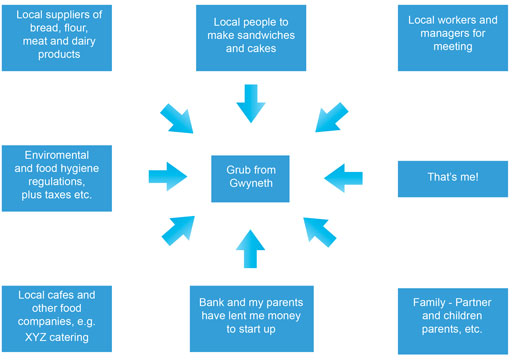
I could have included many more boxes, but I decided to concentrate on the stakeholders I felt were most important to me as I start up. I am sure the influence of each stakeholder will be different in 12 months’ time.
I found it quite daunting at first to think that all these people had an interest in and an influence on my new company. I started to work out what each stakeholder wanted from me and this meant that it became clearer what the impact of each stakeholder might be.
I decided to include myself as a stakeholder so that I could look at my needs alongside everyone else’s, to see if they were compatible.
| Stakeholder | Demands/needs | Power/influence – strong/weak? |
|---|---|---|
| Family | Children need to be dropped off and picked up from school Monday to Friday. They need my time in the evenings and weekends. Need to make up the drop in income from reducing my hours in the café – approx £250 per month. | Very strong |
| Me | To make a success of the company, earn some money and gain a sense of satisfaction while being close to my family, with the potential of giving up my café job completely. | Strong |
| Local companies | Good quality products that offer good value for money for them and for customers leading to return custom. Need to present my region well as a producer of high quality local products. | Strong |
| Suppliers | If my business works, I will start to place regular orders, and I will need to ensure I have the right amounts and have cash flow to make prompt payment. | Medium |
| Environmental health/food hygiene and government | Food is produced in clean and hygienic surroundings that are safe for me to work in, my family to be around and for customers. I need to keep accurate records of sales and turnover. | Strong |
| XYZ condiments | I will have competition – from major retailers but also from other local producers – we can help each other out sometimes maybe? | Medium |
| Bank | I will need to borrow money to cover the cost of industrial catering supplies and a stall for the markets and fairs. The bank expects a reasonable rate of return on their investment and for me to make regular payments. | Medium |
| My parents | They have given me some money towards my first set of jars and labels. While there is no current pressure, I would like to give them their money back at some stage – they want me to succeed. They also provide childcare at weekends and during school holidays. | Medium |
I marked how strong the demands of each stakeholder are on me, which helped me see which to prioritise.
I wasn’t sure about the power of my parents as they are very reasonable, but should they stop helping with the kids they would be very powerful indeed! I will need to think about how my business and family life can adapt to each other over time, should my business become successful. I can’t always guarantee my parents will have the good health or time to help with childcare – while it is a little stronger than ‘goodwill,’ I don’t think relying on goodwill is a way to operate a professional business!
That made me realise that demands change and the power of each stakeholder can change over time. I guess I need to keep an eye on that as my business develops…
Your business plan must recognise the needs of each of these stakeholders. You can see that often their needs are conflicting, for example, the needs of workers to have a good rate of pay and the needs of local firms to have sandwiches at as low a price as possible. Running a business is about balancing these conflicting interests to achieve a compromise that is acceptable to as many stakeholders as possible.
2.7 Competitive advantage
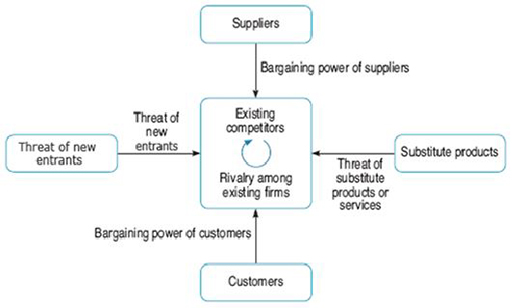
Michael Porter (1998) has an international reputation for his work around creating competitive advantage. His analysis of the impact of external competitive pressures or forces provides a useful framework to consider the types of forces and relationships between companies that influence local competition (and the sort of pressures that a new entrant company can face).
Porter sees the competitive pressures on a given industry in terms of ‘five forces’ – in addition to the central struggle with existing competitors, there are new competitors entering the market, arguments with suppliers over the costs of inputs and persistent downward pressures on selling prices from customers. All these, except sometimes new entrant competitors from outside, are visible. Less obvious are the competitive forces that come directly and indirectly from consumers and customers when they turn to alternative or substitute ways of meeting their needs, for example internet-based travel services versus high street travel agents.
The five forces also represent areas where entrepreneurs can spot opportunities for innovation that offer a decisive competitive advantage. Looking at the competitive environment in this way can help us understand how the STEEP factors are affecting our customers.
Task 12: Competitive advantage analysis
Complete a five force analysis for your proposed business using the Five force analysis template.
Indicate if you think the bargaining power is low, medium or high in each case.
Discussion
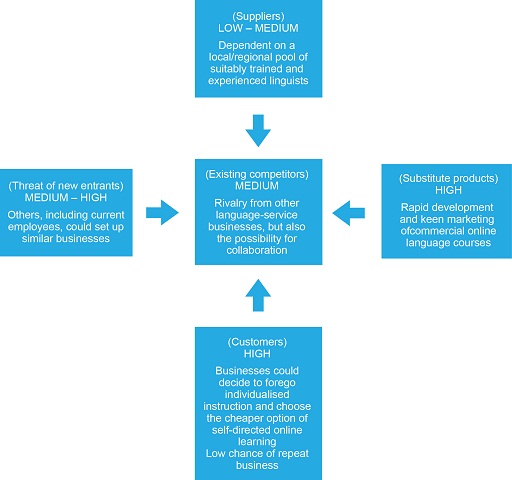
From this analysis it is clear that while Gwenllian’s business idea is reasonably unique, she is entering a potentially competitive area. She will need to pay particular attention to how her company builds a niche and customer base in order to protect her business idea and succeed.
2.8 What is a strategy?
There are many definitions of strategy:
- Chandler (1962) ‘The determination of the basic long-term goals and objectives of an enterprise, and the adoption of courses of action and the allocation of resources necessary for those goals.’
- Andrews (1971) ‘Every business organisation, every sub-unit of an organisation and even every individual (ought to) have a clearly defined set of purposes or goals that keep it moving in a deliberately chosen direction and prevent it drifting in an undesired direction.’
- Porter (1985) ‘A process of analysis that is designed to achieve the competitive advantage of one organisation over another in the long term.’
- Henderson (1984) ‘To enable an organisation to identify, build and deploy resources most effectively towards the attainment of its objectives.’
Whichever definition strikes a chord with you, they all emphasise that strategy is about the long term:
- clear vision through goals
- understanding your external environment to ensure the goals are realistic
- appropriate allocation of resources to the tasks that will most likely help the company achieve its strategy implementation.
As the owner of a small business, it is inevitable that you will get involved in all aspects of the business, particularly at start up.
It is important to distinguish between operational and strategic thinking. Operational thinking relates to those tasks or activities that characterise the day-to-day working of the company. This could be anything from making practical, stylish staircases (David), producing some delicious and unique sandwich relish (Gwyneth), drafting a marketing email (Dafydd), designing a language course (Gwenllian), or monitoring the purity of the water obtained from the farm well (Euan). The more efficiently these are completed the better it is, as the costs will be kept to a minimum and output of the company will be enhanced.
Strategic thinking looks at the business more holistically. It connects all the activities and considers how they relate to each other in achieving the overall objectives of the company. Strategic thinking questions how the tasks can be aligned, combined or performed differently to deliver something better. For a not-for-profit organisation ‘the fit’ between these aspects also needs to account for the ethos or wider goals of the organisation. Find more information about creating an ethical organisation.
Many small business owners are guilty of ‘working in the business not working on it’. It is easy to become so engrossed with meeting operational day-to-day requirements that there is no time left for any strategic, longer term thinking.
2.8.1 Case study: Operational versus strategic thinking
Read this short case study and think about the main issues facing Fiona.
Case study: Managing everything – and nothing
Fiona was excited when her father announced that he was going to retire and that she was to take over as general manager of the small chain of off-licences (retail outlets for alcoholic drinks) that he had founded. She had lots of ideas about expanding the business, the most important of which was the establishment of a wholesale business supplying clubs and restaurants.
The new business was successful – she had identified a useful market niche – and after a year its sales were better than forecast. But it was not yet making money, largely because the operating costs were above budget. It was essential to introduce an efficient stock control system, and she set about finding a suitable software package. There were a number of teething problems – it was constantly crashing and she was the only one able to operate it, so it took a lot of her time. The company needed to recruit a new driver and a new order clerk: it was important to get the right people, but interviewing and agreeing terms seemed to go on forever.
One of her ideas had been to provide an own-label service for restaurants, so that they could serve wine with their name on it, and this had proved very popular. She enjoyed designing the labels with her software package, which she tended to do in the evenings. It was also necessary to remove all the original labels and apply new ones – and they simply did not have the labour to do this, so she found herself spending most of her weekends labelling wine bottles.
The wholesale business had introduced a number of new customers, several of whom proved to be bad payers, so she was spending an increasing amount of time chasing debts.
Their price list had not changed for three years, and she knew that a number of their products were now significantly underpriced, but she simply had no time to update the list. And the new business was still not delivering a profit.
You can see that Fiona is focused on operational tasks. She is busy operating and sorting the stock control software and designing, removing and sticking labels. She is thinking operationally and not strategically. She is working ‘in’ the business rather than ‘on’ it. Strategic thinking would enable her to look at the complete picture and decide which activities lead to delivery of the company’s strategy. She would be able to see which processes could be combined or even abandoned. She would be able to allocate resources more effectively (more about resources in 4 Capabilities and resources), which would improve the chances of success for the company.
Setting some regular time aside to take a step back and reflect on your business will be very difficult at times but also very important to ensure you allow yourself time for some strategic thinking. Working with a mentor or advisor can help you do this. Often it is the business owners who feel they have the least time and the least need to have a mentor, who most need time and a mentor!
There are many times when there are just not enough hours in the day, particularly at the start of a new business when you seem to be doing everything yourself. Time spent with an external experienced advisor or mentor can be likened to having a non-executive director for a larger company. They can see issues with fresh eyes and can help you consider the longer term view to get through the short-term operational pressures. They can also be a listening ear, a support and trusted friend.
2.9 Formulating strategy
You have now examined the external environment and looked more deeply into how the STEEP factors have an impact upon your local market and how you can expect to relate to your suppliers and customers with knowledge of substitute products and new entrants. You have also completed some analysis.
You now need to think about your longer term options and select the best way to work in order to meet your objectives. You have to determine your strategy and then implement it.
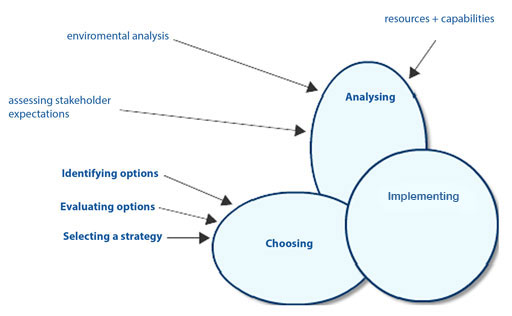
Many strategies are decided as the result of a thorough analysis, perhaps some research, and clear decision making. Many others emerge as a company grows or gets started. Neither route is wrong.
It is important to keep reviewing your strategy against results to check if it is working. Many things can change in the STEEP factors, which may give rise to the need to review the strategy, but it is important to give it time to work. Remember, a strategy is a long term plan – you cannot change it every week!
Developing and reviewing your strategy is an area where a mentor can be especially valuable. They can help you see the wood for the trees and ask the questions that can sometimes be hard to see when you are immersed in the day-to-day grind.
Task 13: Identifying your strategic options
- What options do you have that could deliver your objectives?
- List the pros and cons of each.
- What additional information do you require before you can decide?
You will need to use the outcome of this activity in your BPPR.
Share your thoughts with other entrepreneurs in your local networks.
Discussion
Case study: Euan
Euan’s business idea is to establish a microbrewery on his family’s farm.
He sees his options as:
- obtain permission to convert the existing unused farm buildings into brewing sheds (this may require a planning application)
- invest in machinery for the barley and hops preparation and brewing processes
- invest time and money in training to learn the skills of brewing
- concentrate on the unique selling points to market the beer
- use farm resources to provide ingredients, such as winter barley
- consider retail outlets, the possibility of off- sales on the farm via a shop, and mail order sales
- explore options for food tourism via brewery tours on-site.
In this example, not all the options are mutually exclusive. Euan needs some detailed information to help him decide. He needs to gather information about the extent of his investment in terms of the time it will take to purchase machinery and establish the microbrewery.
In assessing which route to market to take, he will need to take into account the resource constraints at the farm and the existing expertise within his family. As farmers, he and his parents are used to running a business, but there will be some key differences between farming and brewing.
Euan may have to negotiate reallocation of space on the farm, but this is probably not a strategic driver. By carefully reviewing his results against his chosen strategy, he will see if there is a need for more space (i.e. he will not know the answers to these questions until his business has started operating). If his business objective was to supply winter barley to other brewers, then changing the use of fields from grazing to growing areas may be a strategic decision.
Keep these strategic options in mind as you work through the rest of the course. You will add more information to your analysis as you progress. This will help you decide which strategic option is the best fit for your new company.
2.10 Summary
In this section you have:
- articulated your business idea and how it fits with your rural lifestyle
- set your SMART business goals for the next three to five years
- considered the most suitable company structure
- completed a mini-STEEP
- identified the stakeholders for your business and their strength of influence
- gained an understanding of your competitive environment through Porter’s five forces model
- reviewed the process of strategy formation and outlined the strategic options for your business.
Now open your BPPR (or download the template) and reflect on the activities completed in this section. Review the output from each activity and complete the three questions raised in Section 1 of the BPPR, which require you to pull out the most important aspects of your thinking to date.
3 Customers, markets, competition and pricing
Learning outcomes
At the end of this section you will be able to:
- identify the customer decision-making process
- state the difference between types of customer and consumer
- recognise the market research process and the importance of different types of information
- identify the four Ps – four Cs marketing mix model
- know how ‘place’ can affect a rural business
- identify factors affecting pricing decisions
- identify some low-cost ideas for promotion.
3.1 What is a customer?
Whatever your business, product or service, you will need customers. It can feel like there are so many things to do when you start a company. Very often a great deal of time is spent perfecting the product, be it a beer or a pot of jam, and no time is left really to understand your customers and potential customers.
There are a number of different types of customers:
- customers who are also consumers – for example, a restaurant or café
- customers who buy for others (consumers) – for example, local government buying-in services from a social enterprise
- customers who buy for others (businesses) – for example, utility warehouses that buy energy for other companies
- other businesses – for example, a company that develops a service for other companies to use.
Task 14: Identifying your customers
Think about the groups of people who will be your customers.
- Will you be selling mainly to consumers, other businesses or government bodies?
- Will you be selling mainly to consumers, intermediate customers or to buyers or purchasing units of larger organisations?
- Do you have ways of classifying the key purchasing decision makers you will have to influence in your industry (or more particularly, in your business)?
Share your thoughts with other entrepreneurs in your local networks.
Discussion
It is not always a case of there being just one type of customer or another.
Case study: Gwyneth
Gwyneth may sell to customers who are consumers. This means they would buy pots of jam, chutney or preserve and eat them themselves.
She may also sell to a retail manager who buys to sell in their shop to their customers. The manager will not consume the food at all.
Gwyneth may at some point in the future expand her business and also sell to a purchasing manager or buyer for online sales.
It is important to think one or two steps beyond the immediate customer/consumer.
Gwyneth needs not only to think about her immediate buyers but also who will have a key influence in enabling her to supply to a wider customer base.
3.1.1 Customer needs
The basic process that a buyer travels through is the same, irrespective of the product or service being purchased. However, it may be prolonged and completed more rigorously if the product is of high value. There is a basic exchange process between customer and organisation.
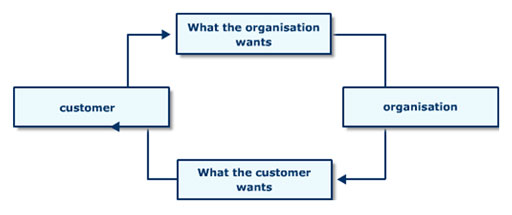
Task 15: Customer needs
Consider a product or service that your company will provide.
Describe the exchange relationship with a customer by filling in the boxes in the Customer needs template.
You might like to consider a number of different customers – you may find that their needs are quite different.
Share your thoughts with other entrepreneurs in your local networks.
Discussion
Case study: Gwyneth
Gwyneth might first consider the customer who buys her jams, preserves and chutneys at farmers’ markets and food fairs or when she visits their business premises. They buy and take the product home to eat. This customer wants unique, fresh food. Gwyneth wants this customer to buy on a monthly basis and tell their friends how good the product is.
The needs of this customer are primarily about the nature and quality of the food. To meet the needs of this customer, Gwyneth must have a consistent service. The full range of her products must be available each time she attends a market, where she will be at a regular time slot. The product itself must be of a reliable quality.
When Gwyneth considers the retail manager who buys for their deli she has to take into account their needs as a business too. The manager wants to have an easy and reliable order procedure, with variations in order quantities if required. The manager wants to be able to offer samples to customers to be able to demonstrate the quality of the product and market it so there must be some surplus stock. Invoices will need to be delivered with accuracy and on time. The manager also wants to have good food with no complaints from customers!
The needs of this customer are not just about the food. They also have needs arising from the systems and processes of Gwyneth’s company. To meet the needs of this customer, Gwyneth must also have a reliable delivery service, good order and invoicing processes and be able to finance a day delay in receiving payment.
3.2 The purchasing pathway
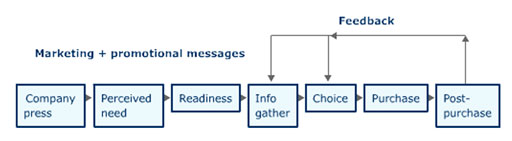
This diagram shows the pathway purchasers travel when making a decision about what to buy.
When making a purchase there are competitive pressures that influence us all. They may be overt, like advertising or direct promotion, or less obvious, like comments from friends and family. A ‘need’ is thus perceived and grows until the customer is ready to consider a purchase more seriously. Information is collected before a choice can be made and eventually a purchase completed. The diagram shows that the process is not complete until feedback is processed as information that can affect future choice of purchase. This feedback loop will happen each time a purchase is made.
The pathway allows for all sorts of influences – like colleagues, friends, family, previous experience and so on. Some businesses may be more susceptible to the competitive pressures and social influences than others. All of these are external to the company selling the goods or services and illustrate the need for a good up-to-date environmental scan (see Environmental scan) so that you can understand which influences are likely to affect your customers.
Larger-value buying decisions follow the same path but typically more time is spent in researching the competition and gathering data than for a low-value purchase.
Selling to a large organisation
If you are selling your products or services to a large organisation, whether it be public sector or private sector, the customer will want information about the qualities of you and your company and the product or service you offer. This process can take quite a long time and involve a number of people, even if the final decision rests with just one person. You will need to establish who the influencers are, as well as who the decision-maker is.
Though time consuming, it may be worth the investment. For example, if you are a social enterprise working on reducing waste, a service level agreement with the local authority to deliver waste reduction advice or even divert waste from landfill is likely to provide more security than continual grant applications. Note, if you want to sell into the public sector then start by looking at the Sell2Wales website.
The purchasing pathway diagram also shows that the process continues after the sale has been made, as the customer evaluates their purchase. This evaluation will influence the chances of repeat purchase either positively or negatively. Do not underestimate the importance of word-of-mouth recommendations as an important aspect of launching and building the business.
3.2.1 Stages of adopting innovation
Some potential customers will be cautious and stay with their current supplier for as long as possible. Others are excited by the chance to try something new. Everett Rogers (1962) illustrates that there is a five-stage process of innovation adoption.
- Awareness: the customer (either a consumer or another organisation) becomes aware of the existence of the innovation and has a general perception of what it entails
- Persuasion: the owner becomes progressively interested by the innovation (usually through peer or social networks but also through advertising and promotion)
- Trial: the firm, consumer or trade associations, or local networks test the innovation on a small scale
- Adoption: actual decision to adopt – OU Business School research indicates that this is related to a clear business or personal use for the application (Zappala and Gray, 2006)
- Consolidation: the agent seeks reinforcement on the decision or rejects it (in most cases, this will relate to market feedback in the form of increased sales).
Case study: Gwyneth
How would this work for Gwyneth?
- Awareness: Gwyneth could put up posters and leave flyers to let people know that she will be bringing her products to a location at certain times
- Persuasion: Marketing flyers could invite potential customers to purchase at a discount at a certain time
- Trial: Gwyneth could take along a selection of her products and give out samples so potential customers can try her jams, preserves and chutneys
- Adoption: Next time she attends a market or visits a fair, if the trial has worked there will be a queue of customers waiting to buy
- Consolidation: If the products are enjoyed they will become regular customers and tell their friends about ‘Cottage Condiments.’
Task 16: Adopting innovation
Consider how you might plan to take your potential customers through each of these five stages.
3.3 Market research – segmentation
We can divide customers into market ‘segments’ in order to understand their needs and wants and allow us to target them. The aim of segmentation is to identify a group of people who have similar needs that can be met by a single product or service. This process will enable a new venture to concentrate its marketing efforts in an efficient and cost-effective manner. Segmentation also helps to channel feedback into the product or service design process.
Targeting is concerned with choosing which segments to aim for in order to achieve success. By implication, targeted segments are the focus of your resource spending at the expense of non-target segments. Thus, the two concepts of segmenting and targeting are almost inextricably linked.
This raises the question of how new enterprises might go about identifying which groups or market sectors will buy their products or services and what improvements, replacements or new related products may be desirable. This requires some research into the markets.
Sometimes it is hard to justify this kind of investment when faced with the challenge of conducting market research, especially if you lack technical knowledge and skills and/or a lack of resources – namely, time and money. The time taken to conduct research must be viewed positively as a resource investment since it is critical to the successful launch of a new product or service.
Task 17: Segmentation and targeting
Think through these questions and note down your answers.
- How would you define your current market segment?
- What are the current or future needs and wants of your prospective customers?
- What common characteristics (if any) do your current prospective customers share?
- What existing data do you have of your chosen customers (e.g. geographic, demographic and socio-economic)?
- What plans do you have to fill any knowledge gaps?
Share your thoughts with other entrepreneurs in your local networks.
As you consider the questions in Task 17 it is likely that you will discover that you do not have enough detailed information to answer fully.
Having identified a need for more information you now need to consider what that information is, and how to access it. Some may be publicly available through web searches, business or trade directories, and libraries. A local business advisor will also be able to help. However, identifying your future customers’ common needs and characteristics to group them as segments may well depend on you conducting specific research and often comes down to personal judgement. It will be hard to be confident and precise in your responses until you deal with real customers. The benefit in starting the questioning process right now, however, is that you will get a clearer idea about what customer information is going to be relevant and helpful in your decision making.
Also, you can begin to work out whether and how a potential segment is measurable and how easy it is to define members of the segment. This will enable you to decide how substantial the segment is and whether there are likely to be enough potential customers to enable you to achieve your proposed objectives. You can begin to see to what extent the target customers will be accessible and how you might be able to communicate with them. You may even begin to have an informed opinion on whether certain groups of customers have similar product service requirements and whether the segment is likely to be stable or to disappear in the face of changing fads or fashion trends.
3.3.1 Stages in the market research process
The stages in the market research process are:
- Describe the target customer segment: the description of the customer group under investigation needs to be as precise as possible to avoid wasting resources due to the gathering of unnecessary data (e.g. geographic, demographic and socio-economic).
- Define the research objectives: what will the information be used for? What questions need to be asked in order to meet the aims of the research?
- Check the existing knowledge and data: what do you already know about the target customer segment?
- Define the information required: what segments are most attractive? What customer needs and wants are currently not well satisfied? How likely is it that the customers will buy the proposed product or service on offer? How much will they be willing to pay?
- Decide on the methods to be used to gather the data: there are two critical questions that a researcher must ask at this stage – should data be gathered from primary or secondary sources, and is qualitative or quantitative research needed to meet the research objectives, or both?
- Collect the data: the most important consideration at this stage is avoiding errors and therefore creating inaccurate or corrupt data.
- Analyse the data: this usually involves raw information that needs collating and turning into intelligent information that has been interpreted and summarised.
- Evaluate and review: this may involve a rethink of the customer segment under investigation. For example, does the information support the targeting of the original segment and, if so, how can this be pursued? Should the entrepreneur’s efforts be concentrated on a different segment and what research needs to be undertaken to determine which one?
Primary research is conducted yourself. It is often expensive and thus beyond the means of small start ups. Sometimes the major cost can be time, so collecting your own information should be carefully considered. For example, if you were planning to set up a community shop, then asking the local inhabitants if they want a shop and what they might use it for is likely to be a condition of any funding – just like any business. There are some free or cheap survey tools available, for example SurveyMonkey. This enables you to conduct your own online research very economically.
Secondary research is data that has been gathered by someone else. Your job is to find relevant data and search through it and draw conclusions that are relevant to your business. The internet has made this easier in that lots of information is available online. In other ways it has made the task more difficult – there is so much information there it can be difficult to see which is the most relevant or which has integrity. We alluded to the value of secondary sources earlier when we talked about broader data that might be available from organisations like Business Wales or from your local authority, see 1 Setting the scene for rural business.
3.3.2 Secondary sources of research data
Let’s look at the secondary sources of research data in more detail.
- Internal sources: the entrepreneur’s or the firm’s existing internal records are an obvious place to start. The data is low cost, readily available and usually reliable.
- Personal contact networks: these consist of the personal contacts, relationships and alliances that entrepreneurs develop over time, and they can provide a rich source of informal information. Networks include suppliers, customers, local businesses, contacts in the trade, professional advisors (bank managers, accountants and solicitors), former colleagues, friends and acquaintances.
- Trade associations: these can be specific to a particular industry (e.g. the National Federation of Builders).
- Chambers of commerce: these are organised locally but often have links and services that extend beyond the local economy.
- Competitor sources: most businesses publish information that is actually intended for customers. However, this can also be obtained by small firms wishing to investigate a competitor’s activities. For example, accessible published information includes websites, product and service information leaflets, reports and accounts.
- Trade shows and exhibitions: these can also be good sources of competitive information – the exhibitors catalogue will provide a good summary of the existing companies in the field and the literature can be easily collected from one place. Franchisors will also give information to prospective franchisees on the prospects for their particular market, which can be obtained by new entrants who are not actually interested in taking up a franchise.
- External secondary sources: external information sources are available quickly and easily online. Entrepreneurs and small businesses can research the macro and micro-environments in considerable depth before making strategic decisions. However, do not underestimate the time and effort it takes to source secondary data that is relevant to your business.
- Other external sources: this includes central and local government, directories, published statistics and reports, and national trade and press articles. Government statistics and those published by other official bodies can have the disadvantage of being out of date and not meeting specific requirements.
Most sources of data can be accessed free of charge on the internet (or in a library) or purchased at a relatively low cost (e.g. through a subscription).
Trade associations, chambers of commerce, banks, universities and research institutions are also good sources of information for specific fields. Newspapers and periodicals, however, tend to provide more general data but can be useful for background information.
3.3.3 Case study: Market research
Case study: Dafydd
Dafydd decided to embark on some market research before launching his business, which his wife Ffion helped him with.
- Their first thoughts were to target the domestic holiday market. With the growing focus on carbon footprint awareness, the increasing emphasis given to localism, and the established attraction of Welsh activity holidays for young families, Dafydd and Ffion wanted to target the domestic holiday maker.
- They wanted to find out whether Welsh family holiday-makers would consider an eco-friendly destination as a priority when choosing a self-catering holiday, and whether a rural farm setting would be of added value as an attraction.
- Both Dafydd and Ffion knew quite a lot about the tourism market as their respective part-time jobs were linked with it in different ways. Dafydd was also very technologically aware and familiar with online marketing strategies. However, neither he nor Ffion knew very much about the area of green tourism or felt confident in how to approach this market..
- Ffion suggested that paying a marketing company to help them work out the right questions and where to go to ask the right people might be a worthwhile investment. They both felt that they were too close to the potential business to be able to take a sufficiently impartial view and that a fresh pair of expert eyes would be able to see things that neither she nor Dafydd could.
- Dafydd did most of the desk research while Ffion undertook email and telephone research.
- Dafydd looked for existing data through organisations like BusinessWales and Visit Wales to find business who were working closely with the tourism sector.
- Dafydd spent time researching funding opportunities that could be available to them as a new start up in the tourism industry, based in their location. In doing so, he discovered the Tourism Investment Support Scheme (TISS) which is open for both existing and new tourism businesses in Wales. This can be used to support upgrading the quality of facilities and increasing capacity where there is a gap in the market, especially energy efficiency and/or environmental improvements.
- Ffion’s questions related to the nature of the accommodation and what the requirements of residents would be.
- At the end of the process:
- Dafydd had learned that there were very few holiday lettings businesses in Wales that offered an eco-friendly footprint, and none at all in West Wales. Some businesses combined farm activities with accommodation and a few others promoted the environmentally friendly activities in the area but none packaged or promoted all three elements together.
- Ffion, with the help of the market research company, established that there was a definite interest in eco-packaged holiday lets that promote the green credentials of the accommodation, the farm location and the countryside surroundings.
- As a result of their market research, Dafydd and Ffion felt confident that there was a market for their eco-friendly holiday lettings business.
- They decided that their next step would be to undertake further market research into ways in which they might market their unique holiday letting business but rather than restrict themselves just to Wales, that they would look to market to a global audience. Having discovered that they might be able to get support to help them set up within the tourism industry, they decided to apply to Tourism Wales for a Tourism Investment Support Scheme grant.
Conducting market research does not have to be a huge exercise. It is basically asking the right people the right questions so that you can deliver the best product or service. How much you invest in market research will often be based on the investment or risk associated with the business. Dafydd and Ffion recognised that their business required external market research investment in order to give them a fuller and professional perspective and so they decided on getting professional help. This will not apply to all enterprises.
3.3.4 Further information
You may find this audio track Competitor and market research helpful. It starts with Porter's five forces and then looks at market research. This is part of a series of podcasts that we have linked to throughout the course.
3.4 Marketing mix
There are many definitions of marketing. The one we shall use works for not-for-profit and commercial organisations, puts customer satisfaction at the heart of marketing and gives appropriate emphasis to distribution – that is, making sure the customer actually receives what you provide.
Marketing is the creation and distribution of customer satisfaction for an appropriate return on resources and effort.
The ‘marketing mix’ was one of the key concepts born in the post-war boom in the 1950s and 1960s. Early marketer Philip Kotler (2003) defines it as ‘the set of tools that the firm uses to pursue its marketing objectives in its target market’.
There are four aspects to the original marketing mix (McCarthy, 1987):
- product
- price
- place
- promotion
The model has been criticised as being rather outdated and difficult to use in industrial and service companies. As western markets have become more service-orientated, the ‘product’ variable has been adapted to incorporate products and services. The ‘place’ variable is also difficult to apply to a service environment where sales are often made directly to the consumer without any intermediary involvement (e.g. the digital downloading of music and films).
Booms and Bitner noticed the move from product to service marketing and introduced the seven Ps concept. This recognised the importance of three additional variables in marketing, namely: people, process and physical evidence (Booms and Bitner, 1981). We will return to this extended model later in the section.
However, the four Ps model is still a useful and simple tool to use when embarking on the early stages of planning a marketing strategy, and we will work primarily with the four Ps. These four tools (product, price, place and promotion) are interdependent and the trick is to find the right ‘mix’ to satisfy customers.
3.4.1 Product (or service)
The product or service relates to what is being marketed, including range, sizes, colours and functions. This is now taken to cover services as well and is referred to as the product or service package.
To attract customers from existing products, and to develop completely new consumers and customers, the product or service should be innovative in some way. It should be distinctive in having its own unique selling proposition (USP). In addition, if the product or service is to sell successfully in reasonable volumes it must also provide tangible and intangible customer benefits. Traditionally, marketers have always defined a product as being a bundle of benefits. According to Dibb et al. (1998), the customer is obtaining three levels of benefit from the product:
- the core product benefits
- the actual product benefits
- the augmented product benefits.
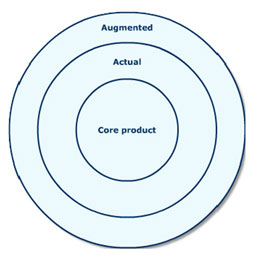
The core product benefits are the same for all competitors. The actual and augmented benefits include those additional benefits associated with the innovative product or service you are bringing to market. This may be customer service, product design, etc.
It is important to recognise the difference between a product, which can be returned if faulty, and a service, which is usually consumed as it is produced and cannot be stored.
Case study: Dafydd and Ffion
Dafydd and Ffion thought this idea through with regard to their new business. They looked at the core, actual and augmented benefits for their eco-friendly holiday lettings business and came up with the following:
- Core: the opportunity to holiday in a beautiful, unspoilt rural location close to nature
- Actual: provision of high quality and sustainable self-catering holiday accommodation designed to specifically meet the needs of people who are environmentally conscious and who care about their eco-footprint
- Augmented: small environmental and carbon footprint.
Task 18: Establishing levels of benefit from the product
Consider what comprises your core, actual and augmented product or service.
Does being rurally located play a part?
Can you use location to enhance your offering in some way?
Share your thoughts with other entrepreneurs in your local networks.
3.4.2 Price
This is the only part of the marketing mix that generates any money! In the commercial sector the price for the product or service has to be high enough for the supplier to make money but low enough for the customers to believe they are getting value for their money in exchange. In non-commercial organisations the relevance of price is less clear, although there is clearly an exchange going on and there is an expectation of the service or product that is provided.
Providing good value does not always mean being the cheapest. As a small business, never consider competing on price with larger organisations that have more resources. In fact, most customers are prepared to pay a little more for a product that is of a high enough quality, provided it is not prohibitively expensive.
In a typical transaction, a potential customer will assess the product or service and then measure this against the price asked. In rural areas they may also have to account for other costs like time, travel expenses and delivery costs. This leaves the business owner with the problem of trying to determine what price potential customers will regard as good value for money while still allowing the firm a sufficient margin to cover its costs and make a profit.
The main methods of pricing that are used by firms are:
- cost-based
- customer-based
- competition-based.
3.4.3 Cost-based pricing
Cost-based pricing is the least customer-orientated and includes cost-plus and mark-up pricing methods.
Cost-plus pricing is commonly advocated by accountants and engineers because it is simple to use and guarantees that the company meets a predetermined profit target. The method works by calculating the total production costs and then adding on a fixed percentage profit in order to arrive at the price.
Unfortunately, this approach does not take account of how the customers will react to the quoted price. If, in the eyes of the customer, the price does not represent value for money this will have a negative impact on sales.
Conversely, if the customers see the price as representing very good value for money then the company may not have sufficient stocks to meet demand, therefore allowing new competitors to enter the market.
Mark-up pricing is similar to cost-plus pricing and is the method used by most service retailers. For example, a retailer will buy in stock and add on a fixed percentage to the bought-in price (a mark-up) in order to arrive at the shelf price.
This method is identical to the cost-plus method except for two factors. First, the entrepreneurial retailer will be in close contact with the customers and can therefore develop an intuitive idea of what they are prepared to pay and, second, they can dispose of unsold stock by discounting it back to cost and selling it in the sales.
3.4.4 Customer-based pricing
Customer-based pricing methods do not mean that products and services are offered at the lowest possible price, although they do take into account customer needs and wants.
Demand pricing is the most market-orientated method of pricing. The entrepreneur who uses this method needs to start by assessing what the demand will be for the product at different price levels.
This can be done by asking potential customers what they might expect to pay for the product or service and then calculating how many choose each price level. As the price rises, fewer customers are prepared to buy the product since fewer will still see the product as being good value for money.
It is also worth mentioning that, because of the nature of the market or their own skill and capability constraints, many entrepreneurs will not be able to do formal market research to ascertain this information. Instead, they will rely on judgement, intuition and experience – either their own or of people they trust. This is a key reason for choosing to start a business in a sector that you already know and understand.
In any case, this kind of calculation can be used to determine the stages of a skimming policy (where you start high as a first entrant to the market and then reduce over time as others enter the market) or it can be used to calculate the appropriate launch price of the product.
The next stage is to calculate the costs of producing the product in different quantities. Usually, the cost of producing each item falls as more units are made (e.g. if we make 25,000 units, each unit will cost less than if we produce 5,000 units). The table below demonstrates this.
| No. of units | Unit cost | Tooling up* + fixed costs | Net cost per unit |
| 25,000 | £1.10 | £3,500 | £1.24 |
| 20,000 | £1.22 | £3,500 | £1.39 |
| 10,000 | £1.44 | £3,500 | £1.79 |
| 5,000 | £1.87 | £3,500 | £2.57 |
Footnotes
*The tooling-up cost is the amount it will cost the company to prepare for producing the item. This will be the same if 25,000 or 5,000 units are made. Tooling-up costs for David would include his woodworking tools and equipment, for Gwyneth her stall and commercial standard catering equipment.The next table illustrates the importance of economies of scale and the impact of price on demand. The price that would generate the highest profit per unit would be £6.50, but at this price they would only sell 5,000 units and make a total profit of £19,650. On the other hand, the price that would generate the highest sales would be £3.50 although this would mean a lower profit per unit.
The price at which the product is sold will therefore depend on the entrepreneur’s overall strategic objectives – in this case whether to maximise profit per unit or to increase sales and market share.
| No of units | Price per unit | Total profit | Profit per unit |
| 25,000 | £3.50 | £56,500 | £2.26 |
| 20,000 | £4.50 | £42,200 | £2.11 |
| 10,000 | £5.42 | £36,399 | £3.63 |
| 5,000 | £6.50 | £19,650 | £3.93 |
3.4.5 Competition-based pricing
Competitor-based pricing acknowledges the influence of competition in the marketplace. The entrepreneur must decide how close the competition is in meeting consumers’ needs. If they are close then the entrepreneur will need to set prices similar to the competition. This is known as a meet-the-competition strategy, which avoids damaging price wars (which an SME can ill-afford), thus maintaining profitability.
On the other hand, an undercut-the-competition strategy has become very common among retailers who have little control over product features and benefits or the promotion of products. However, there is a risk of starting price wars when using an undercutting strategy, which is not a recommended approach for a small firm with limited market share and financial resources. For more information see Pricing strategies.
Whichever pricing strategy is best for you, it is important to understand your cost base and ensure that you cover the basic costs of producing the product or delivering the service. Attention should also be given to the impact pricing has on the image of the product or service and the importance of complementing competitor offerings rather than trying to compete head-on (e.g. competing upon the basis of personalised service and superior delivery might be more effective than reducing prices).
Finally, if the new venture competes solely on price it may never be able to grow because the margin will be too small to allow for re-investment in the firm’s infrastructure.
Task 19: Pricing
Taking in to consideration what you have read, what approach to pricing is most appropriate for your product or service?
Note down your thoughts and the reasons why.
3.4.6 Place
Where you are located may be a key factor in developing a rural business. For example, Wales is renowned for its high quality artisan ingredients. Getting the products physically to market can be very challenging though, and expensive, hence the premium we often find on these types of Welsh products.
For a tourism business, location is fundamental and is often central to any marketing message. Place matters. For example many tourism businesses do not just rely on natural beauty but create a local package emphasising their localness through the use of local ingredients or traditional products. That place-based value can also be used to sell those local products into global markets, for example, Welsh hillside lamb.
For a knowledge-based business, like Gwenllian’s, place may be less relevant. If you are dependent on infrastructure, like digital connectivity, you may feel that location is immaterial. However, knowledge businesses can also emphasise location. For example, if you were a web designer you might emphasise to local customers that you are nearby, and emphasise to potential customers in other rural areas that you understand the needs of rural businesses.
3.4.7 Distribution
Place, in general, refers to the distribution system that supplies goods or services to customers. This includes shops and mail order. The concept of place also covers types of transport employed, storage and warehousing, and the use of wholesalers.
The number of middle men will vary from industry to industry, but the more intermediaries there are, the higher the final price to the customer. This can result in added cost to the rural business as frequently there is more work and there may be more people involved before the product reaches its customer destination.
Very often the problem for new small firms is gaining access to the distribution channels (think back to Porter’s five forces model). Their lack of economies of scale and related bargaining power, plus the absence of a recognisable brand, are factors that seriously limit their supply chain power.
3.4.8 Local
Consider the renewed interest in ‘local’ food we have experienced in recent years. This has not happened spontaneously. The re-connection of people, products and places was a key recommendation of the Policy Commission on the Future of Farming and Food in 2002 (see Hein, Ilbery and Kneafsey, 2006).
Not every place is going to develop a vibrant local food economy. Hein et al. looked at various factors that might influence the strength of the local food market in any area, such as the number of food directories and the number of local food producers advertising in them. They also examined the number of licenced organic farmers and growers, number of farm shops and farmers’ markets.
They highlight the difference between having good local food products and access to markets. Is there a strong local market, or does it need to be exported? If the latter, is the ‘value’ of that product dependent on freshness which may not translate well to an export led approach, or is it unique to a particular locale and a ‘value’ that people outside the locale might want to buy into. For a discussion on this in relation to Wales, read the Guardian article Local food: have you had your fill?
Wales, for example, has both a strong local food market, based on local raw ingredients, and a strong brand awareness through its erstwhile Taste of Wales, and its newer VisitWales brand. Essential to this is the trust that comes from the quality-assured branding of a product from a range of producers – from meat to cheese, and beers to whisky. Of course, this is dependent on having good quality ingredients, a level of existing brand awareness, and a set of images and values associated with that brand awareness that complements the products you wish to sell. Famous for its food festivals celebrating all that is good and local, none is better known as a brand than the annual Abergavenny food festival. Started in 1999 by two local farmers in the aftermath of the BSE crisis, it has now spread its reach, celebrating good produce from Wales, the Marches and further afield.
3.4.9 Supply chain
Marsden, Banks and Bristow (2000) look more specifically at the changing nature of the supply chain, which they credit with the increasing interest in local, high quality food. They see the development of quality associated with a specific locality creating new associational networks that involve very different types of supply chains. They argue:
... short supply chains seek to redefine the producer-consumer relation by giving clear signals as to the origin of the food product. Short supply chains are also expressions of attempts by producers and consumers alike to match new types of supply and demand
… A common characteristic is the emphasis upon the type of relationship between the producer and the consumer in these supply chains, and the role of this relationship in constructing value and meaning, rather than solely the type of product itself.
Thus the supply chain becomes much shorter. Marsden et al. define three different types of ‘short food supply chains’ (SFSC). The defining characteristic of an SFSC is that the product reaches the consumer accompanied by information about the product’s origin, be it in person or on the packaging. It is this information that enables the connection between producer and consumer – it can go as far as forming an association with the values of the producer and the methods used.
Producers use one, two or all three of these SFSCs:
- Face-to-face: the consumer makes a purchase directly from the producer (perhaps at a farmers’ market). This personal interaction facilitates authenticity and trust. Online trading may be seen as a variation on this through highly personal web pages.
- Special proximity: products are produced and retailed in the specific region of production. Information at the point of sale makes consumers aware of the provenance.
- Spatially extended: the product is sold in all locations but value-laden information about the place of production and the people involved is given to consumers, who may have no connection with the region itself.
Engaging with these organisations or groups can help your business develop and manage its SFCSs. The Llyn Beef producer cooperative in North Wales is an excellent example of a response to new demands for quality assured, fully traceable, mature, lean beef of consistent quality. It recognises and responds to wider society needs around animal welfare and the maintenance of biodiversity on the land. The co-op was established believing that the promotion of branded Welsh beef would be successful in achieving retailer and customer loyalty and a price premium. It illustrates how new networks and supply chains have developed to support rurally-based businesses.
3.4.10 Effects of the internet
The internet has changed the way marketers view the marketing mix since the promotional and place functions can now be carried out at the same time through a company website (e.g. the internet portal acting as a promotional and distribution channel). Digital downloading of music and films is also a good example of extreme disintermediation, i.e. the conjoining of promotion and distribution channels.
It is true that use of the internet and advances in access to broadband have made a difference to rural businesses (although difficulties with broadband are by no means totally solved). Larger markets have been opened up to all businesses: just as you can use the internet to reach beyond your local market, so rural customers may now purchase easily from any location in the UK and internationally. It is a double-edged sword.
So, some aspects of ‘place’ have become easier when living in a rural environment. You can run a website from just about anywhere. The growth of home delivery couriers is considerable. However, the cost of accessing these services can still be greater when living far from urban centres, and it is important to account for these costs fully.
There are many products – for example food products – that do require physical movement around the country. Small companies are frequently challenged by needing to send small quantities to customers when the cost of shipping can be prohibitive. Many ‘piggyback’ on large organisations but have to fit in around their delivery schedules and demands. Some combine to work together cooperatively to move their goods around the country – whatever solution is found, distribution can be a significant challenge to many rural businesses.
3.4.11 Promotion
Promotion is about communicating with actual or potential customers. This covers the whole area of how customers know what is available and the benefits and value of the product or service.
Promotion includes advertising in the electronic and print media, together with other activities such as customer and sales promotion and public relations.
Many business owners also act as their own sales representatives, developing important network contacts with key stakeholders. The use of social networking sites cannot be ignored.
We highlighted the role of Llyn Beef as a support network but there are looser, even more regionally specific, networks emerging, for example the Taste of Powys network in mid-Wales, or the Wales-wide ‘Fforch-i-Fforc/Fork2Fork’ which has its own Facebook page.
For some service companies, sites such as LinkedIn form a key part of their promotion strategy.
Small companies, particularly at start up, are often unable to finance large promotional budgets, which means that some promotion tools are not available to them. Advertising is usually prohibitively expensive other than on a small and local scale. Therefore, advertising may be through word of mouth, via existing networks, or through local groups and networks.
Task 20: Identifying promotional activities
List promotional activities that will work well for your product or service. Be mindful of the resource implications.
Share your thoughts with other entrepreneurs in your local networks.
Discussion
Case study: David
David thought he had some very good networks, and that perhaps the business ‘would come to him’. However, he realised that part of promotion was ensuring that they knew he was aiming to do this full time – so worth phoning. He also made up some business cards, and has started to think about getting a sign and perhaps some lettering on his vehicle.
He noted that the local paper was often looking for stories and wondered if that might be a way to reach outside his network. With the agreement of the property developers he had worked with, he decided to invite the editors to a new eco-friendly holiday cottage he had worked on to see his work, at the same time as sending out his press release.
Case study: Gwyneth
Gwyneth was struggling with how to afford to promote her jams and chutneys. Her budget was very small and time was tight; she had to factor in manufacturing, alongside her part-time job and family commitments. She decided to concentrate on her presence at the local farmer’s market first.
While she knew she couldn’t afford to pay for advertising in local papers, she felt she needed some kind of promotional literature and used an online template to create some business cards and colour postcards promoting her products which she started to distribute in local shops and businesses.
Gwyneth also thought about how people might be interested in her story. Exposure is everything, so she set up a Facebook page where she began to record her development of Cottage Condiments from scratch. It also helped her to record her ideas as the business began to grow.
Gwyneth knew she would have to keep a careful eye on what was working and what wasn’t, so she made a habit of asking customers and enquirers where they had heard of Cottage Condiments. She kept a note of this and planned to review her marketing activity in six months.
3.4.12 Networking
Networking can be a hugely important element of promotion for a small business. There are many networking groups operating all over the country – some meet for breakfast, some have restrictive membership, some are lunch clubs, and others meet socially in the evening. The networks people prefer will be different depending on where they are coming from in relation to their work background.
Many small business owners invest a huge amount of time in ‘networking’, for example on Facebook and Twitter. Some of this is essential, but it is important that you are clear about what you hope to gain from networking and what each network you attend delivers for you.
Many rural businesses involve meeting with people, virtually or in person, which can alleviate feelings of isolation. Some, particularly those based at home, can increase feelings of rural isolation. It is important to recognise that connecting with other people, either formally or informally, is important.
Networking does not have to be stuffy and entirely business-focused. Great friendships are frequently formed through networking. Recognise your need and plan your networks to meet it. You may need to go to a few networking meetings to discover what style suits you best.
So while networking has been included as an element of promotion, it serves much broader needs than that. This is illustrated with an example from South West England, The Cheese Gig.
3.4.13 Network audit model
The network audit model is very practical. It starts from where you are. It is designed to help business owners look at the networks they use and how they fulfil the needs of their business. This analysis can result in more focused networking with a clear purpose in mind and/or looking for new networks that meet your needs more effectively. You can enter the model at any point.
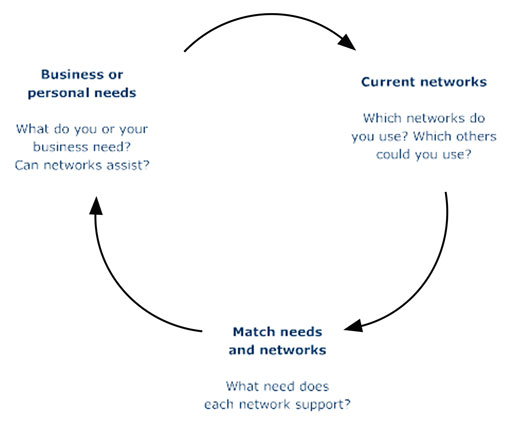
The outcome of this analysis is recorded in a network audit table. This enables you to see where there are gaps in the business or personal needs that can be met through networks. It enables you to identify whether you attend several networks all with the same purpose. You can then prioritise them in order to improve the effective and efficient use of your time.
| Blackdown Hills Food Producers Group | SWIRE /WIRE | Every-woman | Exeter Women in Business | ‘Taste of the West’ | Somerset Chamber of Commerce | |
| Food –regional or national | X | X | ||||
| Training and info | X | X | X | X | X | |
| Shared experience | X | X | ||||
| Mutual support | X | X | ||||
| Inspiration | X | X | ||||
| Fun and friendship | X | X | ||||
| Sales | X | X |
Footnotes
A network audit is an iterative process – networking needs change as a business and business owner develop. This model gives the basis for review in a systematic way. (© KmG Management Consultants, 2007.)Task 21: Networking analysis
Work through these steps to make the most of your networking:
- List all the things you hope to achieve by networking. This can include gaining business, gaining confidence, accessing training and information, friendship and support. There are no wrong answers.
- List your current networks. Include your social networks too – friends and family – as well as any business meetings you attend. Some networks can be virtual, especially with blogs and online chat rooms and online social networks you may be part of.
- Enter this information in the Network audit template. Review it to ensure that your networks are in line with your business objectives. For example, there is no point in going to a mother and baby group if you are selling walking sticks!
- Review the completed table to see if there are lots of duplications and if there are any gaps.
Are you getting all the things you want from networking? Are you spending time and money on networks that duplicate each other?
You may have to seek new networks to meet needs that are not matched at present. You may have to decide to cancel membership of some other networks if they are duplicating each other.
3.4.14 Seven Ps
The four Ps model has been extended to seven Ps in recent years. If you feel they add value to your analysis then use the seven P model.
The additional three Ps are:
- people
- physical evidence, and
- process.
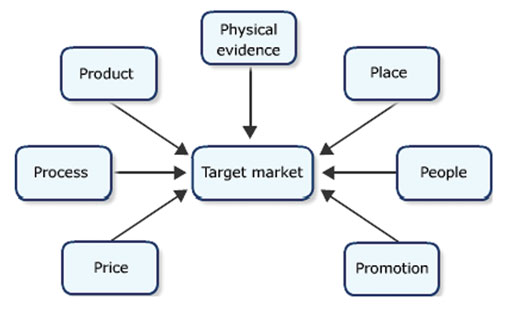
The people element acknowledges that service delivery (unlike manufacturing) involves a personal interaction between the supplier and the customer. Careful attention must therefore be given to the attitudes, demeanour and personality of those responsible for the service delivery. This characteristic is particularly relevant to small businesses that are predominantly service companies and are in regular contact with their customers (usually at an owner-manager/entrepreneur level).
Most offerings to customers now consist of a combination of product and service. This means that there are both tangible and intangible characteristics involved. Although most services are based on an intangible, emotional experience (e.g. the atmosphere and ambience in a restaurant) there are also important physical aspects (e.g. the appearance of the food, the quality of the decor and the appearance of the waiters). The area in which the restaurant is located will also provide physical evidence of the level of quality being offered.
Since services are usually carried out with the consumer present, the process by which the service is delivered is also an integral part of what the customer is paying for. For example, there is a significant difference between a silver-service meal in an upmarket restaurant and a hamburger bought from a fast-food outlet. A consumer seeking a fast process will prefer the fast-food outlet, whereas the consumer seeking an evening out might prefer the slower process of the restaurant.
Task 22: Match the Cs with the Ps
There is an alternative version of the four Ps that takes a more ‘customer-orientated’ view.
Two lists follow, match one item from the first with one item from the second. Each item can only be matched once. There are 4 items in each list.
Customer needs and want
Cost to the customer
Convenience
Communication
Match each of the previous list items with an item from the following list:
a.Promotion
b.Price
c.Place
d.Product
- 1 = d,
- 2 = b,
- 3 = c,
- 4 = a
Task 23: Marketing for your business
Select the four Ps , the seven Ps or the four Cs.
Consider the product or service you are hoping to launch.
For each tool of the marketing mix consider what will work for your new business. Be mindful of potential resource constraints but do not limit yourself in the achievement of your goals.
3.5 Social marketing
These kinds of marketing techniques and approaches noted above are just as applicable for social enterprises. We can see this clearly in relation to a community, but they also apply to enterprises whose principle aim is to influence or change peoples’ behaviour. Read more about Social marketing.
3.6 Summary
In this section you have:
- looked at who your customers might be
- examined the path customers take on their way to purchasing a product or service
- considered the importance of market research and the stages involved
- unpacked the marketing mix for your new business in a rural environment.
Now open your BPPR (or download the template) and reflect on the activities completed in this section. Review the output from each activity and complete the two questions raised in Section 2 of the BPPR, which require you to summarise the most important aspects of your thinking to date.
4 Capabilities and resources
Learning outcomes
At the end of this section you will be able to:
- state the inputs – outputs transformation model
- compare and contrast capabilities and resources that a firm can easily buy and those it must develop over time, and are thus difficult to imitate
- state the likely resources and capabilities required for your new business and understand where the gaps are likely to occur
- complete a strengths, weaknesses, opportunities and threats (SWOT) analysis.
4.1 Transformation model
Any organisation takes inputs and applies some sort of transformation process that results in a significantly different output.
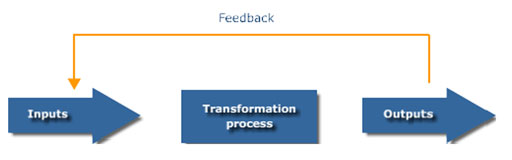
Inputs
Three types of input that might be transformed are:
- materials – the physical inputs to the process
- information that is being processed or used in the process
- customers – the people who are transformed in some way.
It is not just physical goods that are subject to this process of transformation. All organisations that produce goods or services transform resources. Many are concerned with the transformation of information (e.g. accountants, consultancy firms) or the transformation of customers (e.g. hairdressers, hospitals).
There are two types of resources that are used to perform the transformation process:
- staff – the people involved directly in the transformation process or supporting it
- facilities – land, buildings, machines and equipment.
Outputs
Many transformation processes involve both goods and services. Some outputs are not desirable, e.g. waste products, the environmental impact of which must be considered.
The social impact of the transformation process must also be considered, locally as well as globally.
4.2 Transformation process
It is easy to see the transformation when a physical product is involved, but when it concerns information or people it can be more difficult.
Transformation processes include:
- changes in physical characteristics of materials or customers (e.g. fruit into jam)
- changes in the location of materials, information or customers (e.g. taxi, distribution services)
- changes in the ownership of materials or information (e.g. retailing)
- storage or accommodation of materials, information or customers (e.g. warehousing services)
- changes in the purpose or form of information (e.g. offering an online timetable)
- changes in the physiological or psychological state of customers (e.g. a beautician, hairdresser, hospital or doctor).
Frequently, all three types of input (materials, information and customers) are transformed by one organisation. For example, withdrawing money from a bank involves information about the customer’s account, materials such as cheques and currency, and the customer.
The type of transformation may be categorised as follows:
- manufacture – the physical creation of products
- transport – the movement of materials or customers
- supply – change in ownership of goods
- service – the treatment of customers or the storage of materials.
Several different transformation processes are usually required to produce a good or service. The overall transformation process can be described as the macro operation, and the detailed transformations within it as micro operations.
Task 24: Transformation process
Identify the principal resources (inputs), the type of transformation and the principal outputs (goods or services) for each of our case study characters. Fill in the Transformation process table.
Discussion
Here are the answers:
| Character | Inputs | Type of transformation | Outputs |
|---|---|---|---|
| Euan | Malted barley, hops, water Family labour (and potential additional labour) on farm Relationship with third party, on building customer list via website, etc. | Manufacture Transport/Supply: Mail order delivery, retail off-sales Service: If he sells locally. | Beer Customer list Organic waste for recycling? |
| Gwyneth | Fruit, vegetables sugar, preservatives, delivery vehicle, stall Relationship with business/office managers. | Manufacture Supply: direct sales and sales to retailers Service: at local food events. | Jams, preserves, chutneys Customer and stockist lists. |
| Julia | Products stocked in the shop, fresh and store cupboard food, hardware, newspapers Volunteer labour. | Supply Service | Sales with sufficient profit. |
| Gwenllian | Linguistic knowledge (Welsh, French, Spanish, German and English) Knowledge of designing bespoke language courses Company HR contacts Specialist translators. | Supply: learning programmes, translation services Service: to local and regional businesses. | Bespoke language courses Customised translation episodes Language materials Team of language specialists List of local and regional companies. |
| Dafydd | Knowledge of enewables (energy) and recycling (water) Partnership working with leisure and tourism sector. | Manufacture of eco-friendly accommodation Service delivery to customers on location. | Holiday lets. |
| David | Wood, tools, equipment, transportation facilities. | Manufacture Transport Supply Service. | Staircases Recycled waste product? |
4.3 Resources
We will take a resource-based perspective and look at the interaction between a company’s resources and its environment.
Resources refer to company-specific assets that are difficult to imitate (e.g. because of tacit or unspoken knowledge that exists but is not always paramount) unlike undifferentiated inputs such as unskilled labour and capital. How management sees the interaction between the resource and the environment shapes the strategies that the company chooses. Thus, sustainable competitive advantage is built by the company as a whole, learning about processes that translate into knowledge and skills that are difficult to imitate and that can be applied to various types of markets and products.
The resources of a firm are the tangible and intangible assets it owns or has access to, e.g. plant and equipment, workers, machines, the amount of money tied up in fixed capital, stocks and savings accounts.
A tangible asset is something you can touch, like a building or a machine. An intangible asset is something that is less physical, like staff knowledge and expertise (human capital). However, these assets or resources on their own do not give the complete picture. It is how they are used that makes the difference, and this is known as the capability of the company.
So, if resources are the physical, financial and human inputs that are required for your idea to be realised, then your capabilities are the skills, knowledge and ability to coordinate and make effective use of your resources. Analysing your idea in terms of operations, tasks, capabilities and resources not only provides more clarity but is also an essential step in its transformation into a real product.
This is not to say that all the necessary resources must be within your organisation. You may prefer to operate by yourself from home, or with a loosely organised team of colleagues, or as a virtual organisation linked by the internet, or, indeed, you may wish to start your own firm that employs others or even to sell the idea of your innovation to an existing firm.
Whatever form you think is right for the implementation of your idea, business is a social activity and you will need resources in addition to your own knowledge and skills.
It is common for rural businesses to support one another in this way. Indeed, many operate a bartering system where they exchange goods or services in a cost-effective way. These companies find one another through local networks; they build trust and do business together (social capital).
Let us start by looking at the crucial resources you already have – yourself and the people you know.
4.3.1 People skills
Clearly, it is important for your future success to work with the right people, who have the right capabilities and skills. The focus here, however, moves out from the central role of the new business owner to the needs of the company as a whole. People, and the skills they develop, are essential to the success of any organisation (no matter how small).
As well as understanding the skills and capabilities required for producing, launching and sustaining your product profitably, you may need to develop your understanding of your own strengths and weaknesses further in relation to technical skills, organisational ability, management style and business acumen.
If and when you create a new company you will need to address your own development needs – by studying this course you have recognised that you need to do this. You will also need to review the skills of your staff/volunteers, or the network of people/businesses you rely on, against the goals you set for them to achieve in your plans. However, for now, we will just focus on your skills and associated needs that relate to your idea as it now stands.
To turn a business idea into a reality you will need to deploy a range of skills and resources. Some of the skills you need you will have already, in your knowledge of the world and of your field. Others can be acquired or further developed, either by your own learning or by hiring the right people, temporarily or permanently.
The combination of the knowledge, skills and often ‘personality’ of you and your staff/volunteers or network is unique and can form part of your competitive advantage.
The key considerations that have to be taken into account when analysing your human resource needs are:
Job needs analysis
Job role
- What tasks are required to produce the product or service?
- What tasks are required to sell the product or service?
- What tasks are required to support the production and sales staff?
- Which of these tasks need to be done in-house?
Purpose of job
- How does it contribute to the successful production of the product?
- How does it contribute to the successful sale of the product?
- How does it contribute to achieving the aims of the firm?
Essential functions
- What key tasks actually form the job?
- Are they all essential?
- How are the key tasks related to each other?
- Is there a sequence in which the tasks have to be done?
- What physical activities need to be performed?
- Can the activities be shared among a number of people?
- How much time is spent on each task?
- Are the tasks equally important to the successful completion of the job?
- What happens if a task is not completed?
Job qualifications
- Are formal qualifications required?
- Is specialist knowledge required?
- What are the skills required?
- What training is required?
- What previous experience is required?
Job context
- Where are the essential tasks done?
- How is the work organised?
- What are the physical conditions?
- What are the social conditions?
- How is the job supervised?
Do not fall into the trap of failing to analyse all the work you expect to do yourself. Firstly, you could quickly be in a situation where if the job you actually do was advertised by another company you would reject it out of hand! There are inevitable trade-offs required in the short term but be clear what they are and how long you are prepared to let them continue.
Secondly, if you fail to account for all the work that you and your family do in the business, you risk missing out essential components of your business.
4.3.2 Job analysis
Task 25: Job analysis
- Review the information above with a view to your own job, if you are planning to be a sole trader, or for a key member of your staff.
- Identify any gaps in skill or knowledge that need to be filled.
For example, Euan needs to learn more about brewing, and David is considering learning 3D design software skills.
- Start to identify how/where these gaps can be filled.
Euan has found a brewery that runs classes, and David is going to try his local college.
In firms based on physical production and distribution, it is often easier to identify key resources (people, equipment, premises and so on). However, most services have a physical aspect to them too, and many have a basic production process (processing of orders, client’s specifications; allocating staff to client’s jobs, appointments; producing reports, invoices and so on).
If you are at a more advanced stage where you are beginning to plan, bear in mind that an increasing number of small firms are doing away with support employees, turning instead to more creative uses of technology internally or making more use of outsourcing.
For example, one successful small firm comprising an architect and a surveyor used to employ three support staff. They now employ none and believe that they work more effectively for it. Good employees were hard to find and retain, so they invested heavily in ICT. Letters and reports are dictated using voice-recognition software, design drawings are done using a computer-aided design (CAD) package and jobs are costed and controlled through a complex spreadsheet and database suite that they set up themselves. They now feel far more in control, with everything at their fingertips.
Outsourcing might be as simple as relying on a particular courier firm to collect and deliver goods. However, not all industries offer the same scope for outsourcing or using ICT in precisely this way (and not all localities have the same access to outsourced services or ICT services such as broadband, after-sales service, help lines and so on). You need to take into account the presence or absence of such services and your own capabilities for making effective use of them.
Even if you feel your idea does not lend itself to support from clusters and networking, there is clearly a trend towards these more collaborative forms of work, particularly in innovation, and therefore it needs to be reflected in most STEEP analyses. You should seriously consider outsourcing as a source of capabilities not just during the launch phase of your business cycle, but longer term through the growth phase.
Outsourcing firms often possess specialist knowledge and provide services to clients on a local or global basis. They are able to employ economies of scale and use of new technologies that as a result, will keep prices low without affecting quality. In other words, if you identify skills or gaps within your business you might be prudent to look outside the business for those skills rather than develop them in-house.
4.3.3 Your capital base
The people you work with are essential, but they have to have somewhere to work, equipment to work with, material to use and a system to manage the flow of work and its sale and delivery to customers in the market.
The physical assets and the contracts for services, as well as the human resource of the firm, are the sum of resources that enable the firm to carry on its business – the capital of the business. It consists of elements that can be valued in money terms, but actual money accounts and cash form only a part of it (albeit, in the case of cash, an incredibly vital part of it).
You will need a clear idea of not only the people you need but also a good understanding of your capital requirements. You need to make sure that your revenues more than cover your running costs, contribute to your capital costs, pay reasonable returns to any investors and afford you a reasonable living. Indeed, in considering these issues you test the viability of your idea.
Resource requirements
Here are some of the important resources a new business is likely to require:
- people and skills – doing the job itself, managing customers and suppliers, organising, motivation and attitude, upskilling and training, Welsh language skills
- equipment and furniture – something for the people to work on, computers/laptops as well as desks
- premises – somewhere for the people to work in
- communications – the means of exchanging ideas and market intelligence, visiting, talking, writing, delivering; the internet, broadband,Welsh language skills
- suppliers – to provide inputs you cannot make or produce for yourself
- distributors – to provide sales and delivery to customers that you cannot do yourself
- time – most people get much the same ration, yet some use it better than others
- money – to fund salaries, wages, premises, equipment and so on.
Depending on the type of organisation that is most suitable for implementing your idea, you are likely to need tangible, physical assets such as premises (even if just a desk somewhere), machines (even if just a single PC or telephone) and, maybe, vehicles.
These assets represent the necessary resources for launching your idea but may also limit your capacity for expansion or development, if you are successful. They also influence the potential your business has to attract certain target market segments.
After you launch, or if you are already in business, you should also look at the age of the assets, and their life expectancy, to estimate when they need replacing.
You need to start thinking about your idea in terms of the operations and tasks needed for transforming it into a product to be offered to customers and the consequent physical and organisational resources it is likely to need. In other words, you need to start developing your strategy for taking your product to market (we referred to this as operating ‘on’ your business in 2.8 What is a strategy?).
Despite the fact that space might appear not to be at a premium in rural areas, finding a suitable place to work can often be difficult. Many new firms start up small, perhaps without fixed premises, some work from home, or perhaps it’s a mobile service, it might be run from a vehicle. When starting up it probably makes sense not to invest too much in premises, or at least carefully consider what you might need a premise for.
4.3.4 What resources?
External resources are much the same: you may have accumulated some money and acquired some of the necessary equipment already.
The first step lies in identifying what you need. The second step is to identify the gaps between what you need and what you have, and to understand why it is important that they are covered.
Obviously, if you are still clarifying your idea and have not yet begun to plan or take concrete steps towards implementing your idea, it will be difficult to be precise about this. However, trying to identify the tasks needed and gaining some idea of the skills needed for your idea to become a successful, innovative product or service is an excellent way of achieving the clarity you are seeking.
Include the things that you need because of where you live as well. Do you need people who can complement your need to look after your family? Are there concerns about travel safety, etc.? Make a note of any issues like this, not necessarily in the table but just to ensure you deal with them as you develop your plan.
Task 26: Resource requirements
Make a list of your resource requirements as far as you can at this stage using the Resource requirements table. Don’t worry if it is quite rough – you can always revisit it later.
If you can estimate the financial requirements of each resource need then so much the better.
4.4 Capabilities
Capabilities refer to the particular ways that your resources are used, that is, how production and distribution are organised. Resources are not productive on their own, but in the way they are utilised and in their interaction with other resources.
Capabilities define how this interaction or coordination takes place. Hence, firms can differ both in terms of the resources they own as well as in the way they make use of them. Competitive advantage comes from both.
Capabilities refer to the ability of organisations to manage specific types of general processes, such as distribution or manufacturing processes.
Core competences
Core competences are a company’s most important strategic capabilities. They are a set of differentiated skills, complimentary assets and routines that give a business its competitive edge and therefore its commercial advantage over its competitors. An example would be the collective knowledge and skills that employees of the business have, i.e. information about processes, for example, that are understood throughout the company.
Prahalad and Hamel (1990) differentiate strategies based on products and those based around their core competences. The former focus on end products, with a protective view of internal labour. The latter focus instead on a company’s ability to develop the core capabilities and knowledge that can be used across products.
Prahalad and Hamel suggest that the first view will only operate in the short term, where competitiveness depends on price and performance of current products. In the long run, success will depend on the ability to invent new products and adapt to a changing market.
To illustrate this, if we look at Gwenllian’s business we can see that her knowledge-based strategy, based on core competencies, concerns her language and subject-specific specialisms, as well as her skills in using the latest communication technologies to deliver learning. These are knowledge and skills that are difficult to replicate and which will give her business its competitive edge. However, she will need to ensure these are regularly updated if she is to maintain this edge.
Physical resources can be bought, capabilities take time to develop. Support is available to help you develop your core competencies, or fill any gaps you identified earlier. Organisations like Business Wales and Wales.com, as well as the Wales Co-operative Centre have a number of support programmes and may also be a source of further information about training. You may find other support locally perhaps at a local college, university or agency which run regular training events.
Task 27: Identifying competency
Identify the core competences of your new company. What is essential to the very being of the organisation?
Make a note of these.
Discussion
Case study: Euan
Euan might consider that a core competence is familiarity with the workings of a biodiverse farm. Alongside this, he has a rural location, access to a suitable production location and raw materials for his supplies. While he needs to learn the skills of brewing, his ability to seek, find and build relationships with similar companies is also essential to the success of the business.
Case study: Gwyneth
Gwyneth understands that a core competence for her is to produce high quality, local jams, preserves and chutneys. She also has to build good relationships with her customers to make them want to revisit her at her stall or look forward to her site visit as a highlight of their working day!
Case study: Julia
Julia needs to ensure that she and her team of volunteers have the core competences of retail practice and customer service skills that will be needed to run a community shop.
Case study: Gwenllian
Gwenllian recognises that her core competencies lie in her language skills and her ability to use the latest communication technology in order to keep costs down and maintain flexibile delivery of a high quality product.
Case study: Dafydd
Dafydd knows that his core skills are in sheep farming, his knowledge of renewables, and his ability to provide a unique holiday rental experience on a working farm. His core competency is being able to combine his knowledge and skills for the benefit of others.
Case study: David
David has a core skill in joinery, and his core competence is in producing unique, bespoke pieces of furniture.
4.4.1 Extended enterprise value cycle
We began with a simple box with a transformation written in it (in Figure 19). Now we can start to bring some components we have explored so far together into an extended value enterprise cycle.
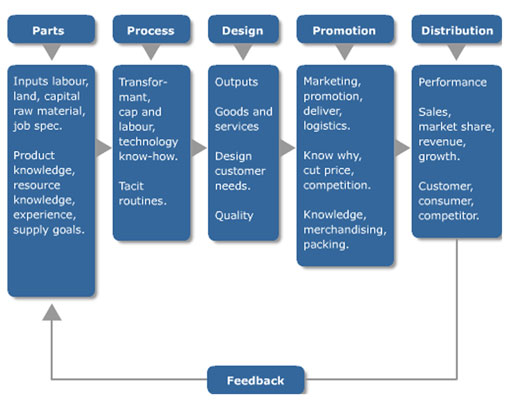
The parts or inputs that start the enterprise value cycle can be tangible, e.g. raw materials, buildings, etc., or intangible, e.g. knowledge or experience about something physical, like a product, or of a process.
The process uses specified or planned, and unspecified or tacit routines in changing the form of the inputs. Tacit routines can be particularly relevant and important in a small family business where each family member has their own job, that they do without thinking about it and certainly not writing it down.
The design element of the process is concerned with the goods and services that form the outputs of the transformation. They reflect the needs of the customer, the quality required and so on.
Promotion includes the presentation of the output. This could be the packaging of a product or the presentation of a service. It includes an awareness of competitor activity, including price and distribution channels.
The physical distribution is the last piece in the chain and results in the sale of the product or service. That is not all, though; it also includes an awareness of market position, growth trends and an understanding of both customers and consumers in their approach to purchase. This model builds on the inputs–outputs transformation model we looked at earlier in this section.
Value is added at each stage of this cycle but is only realised at the end. It is dependent on having the appropriate resources for your business and the capabilities that turn them into a product or service that can be delivered to the market in a sustainably competitive way.
The way in which you acquire your capabilities and skills – whether full-time, part-time, temporary or freelance staff or outsourcing to another firm – are determined by when and for how long you need particular capabilities and skills.
For example, if you were to decide that skills in financial planning and raising finance are needed for the launch period, but only for a few hours a week, it would be pointless to employ a full-time accountant. Equally, one with the range of skills required is unlikely to be in the market for a part-time job. In such a case, you would almost certainly be better off using an accountant in professional practice. It is also important to review the timing, quantity, level and frequency of need for each of the skills you have identified, and determine how each is to be introduced.
As you determine what you need, keep in mind the value that is added to your product or service at each stage of this process. This will serve to keep you focused on the costs associated with each step and also on the overall value of the knowledge you acquire, as well as the product or service you produce.
4.5 SWOT analysis
Now that you have spent some time analysing your potential business, it is a good time to pull together your strengths, weaknesses, opportunities and threats (SWOT).
You will find that strengths and weaknesses come predominantly from the internal environment, i.e. things to do with the internal workings of the company. Opportunities and threats frequently arise from what is happening outside the company. Pulling together everything you know about your company both internally and externally is very useful. It informs strategy and guides day-to-day operations too.
A SWOT analysis usually comprises a series of points under each heading and behind each point you write will be a great deal of analysis that has informed your view. Include only the most important points – that is, those that will have the greatest impact on strategies and programmes of activities that are developed. Clearly the internal points, the strengths and weaknesses, are easier to influence and control as they occur within the business.
Consider the value cycle in the last subsection as you complete your analysis. Examine the process for strengths and weaknesses. Look at opportunities and threats in the context of such a process as well.
Opportunities and threats generally occur outside the business. They cannot necessarily be changed or influenced by the business or the business owner – certainly not in the short term.
It is better to have a few well-informed and pertinent points than a long, superficial list in your SWOT analysis. It is also important to consider all the points together, as they may be interlinked and interactive.
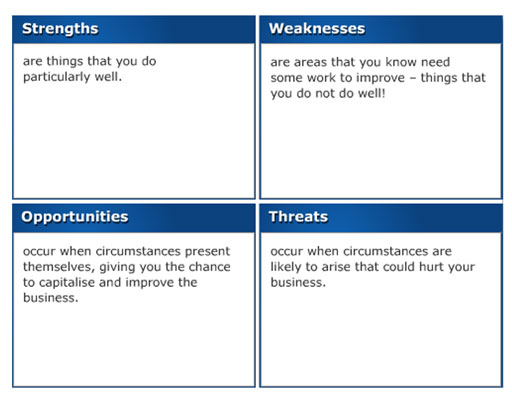
4.5.1 Completing SWOT analysis
Task 28: SWOT analysis
Conduct a SWOT analysis for your new business. You could use the SWOT template but don’t feel constrained by it.
Try to rank your statements in each quadrant. Which are the most important? Avoid saying ‘they all are’. Really understand them and work out which ones are the most important – which ones put you ahead of competitors.
Discussion
Euan’s SWOT analysis looked like this…
Case study: Euan
Strengths
- His family owns the farm, so no mortgage or rental costs for the premises, therefore starting from a stable financial position
- The family already has a steady income from cattle
- Strong and supportive networks socially
- Access to good quality raw ingredients (water/barley).
Weaknesses
- Other microbreweries are spread across the country (not necessarily a weakness after set up as it means the brewery will be unique, but limits mentoring possibilities)
- Highly skilled staff (mostly family) skilled in one area may need to diversify.
- Need to undergo some form of training
- Planning permission needs to be obtained to change the use of the existing property
- Lack skills in distribution
- Poor or inconsistent weather could ruin crops on the farm and from other suppliers which could increase supply costs
- The farm is busy, there may be a need to recruit staff.
Opportunities
- Increased interest from consumers in microbrewed beers
- Increase in mail order shopping online reduces disadvantages of rural existence
- Potential, if successful, to work with other artisan drinks makers including breweries and a small local distillery to develop a local trail, or even a regional ‘real ale trail’ to bring tourists to the area.
Threats
- Increasing number of microbreweries in rural locations
- Consumers (especially tourists) are fickle
- Ongoing competitive activity by larger manufacturers.
Anyone reading your SWOT analysis will be able to gather a good picture of the position of your company at a particular point in time.
If we go one step further and look at how all the statements work together, we can see that Euan has identified one of his major strengths (family owning the farm buildings) with a weakness (need to change the official use of some of the buildings). Similarly he has a family who are supportive but who may need training to work on the new income strand, in addition to their current workload. He will also be looking at the lifestyle he and his family want to live as well as the business. (Remember how we saw in the introduction that rural companies have a healthy outlook on work/life balance!) This is frequently an issue for family firms, and the business owner has to balance the economics of hiring staff against the risk of heavy dependence on the family. This is, however, a risk for any company with small numbers of staff. The business owner might consider writing down the processes followed in the business such that:
- they can be examined and improved
- it is easier for someone new to follow the processes and thus do the job.
It is vital to keep referring to the SWOT analysis when you develop your strategies and plans. When completed thoroughly it will help inform you of resource constraints (and surpluses) and help you to see issues that must be dealt with before embarking on the next part of your strategy.
Case study: Gwyneth
Gwyneth might have noted that her car was coming towards the end of its useful life (weakness). Therefore she needs to sort that out before embarking on a plan to expand by taking on delivery rounds further afield (opportunity) alongside using the bigger family estate car (which her partner uses for work on weekdays) for weekend farmers markets.
She might be concerned about a new company that is expanding into the area (threat). She knows her feedback from customers on her service and products is great (strength) so she can start to look at how to build up loyalty around that in order to protect her against the competition.
Broadly speaking look to your strengths to defend you against a threat.
Use your strengths to capitalise on the opportunities as they give you a real advantage.
Your weaknesses must be dealt with swiftly to protect you from any specific threats, as otherwise you will have a serious disadvantage.
Avoid being tempted to go for opportunities when you are exposed by weaknesses. Sort them out first.
Remember, the purpose is to seek a competitive advantage for your company that will be sustainable over time.
Bruce Henderson (founder of the Boston Consulting Group) has said. ‘Your most dangerous competitors are those that are most like you. The differences between you and your competitors are the basis for your advantage.’ In reality, most successful competitive advantages come from a mix of things. How they all work together makes the total unique and very hard for a competitor to copy.
Task 29: Revisiting strategy
Revisit your strategy you devised in Task 13 now that you have completed your SWOT. Is there anything you want to revise? Does this confirm your earlier thoughts?
4.5.2 Further information
You might find it useful to listen to an audio track on SWOT analysis.
4.6 Summary
In this section you have:
- examined the transformation model of inputs into outputs and the extended enterprise value cycle
- considered the resources required in your new business
- understood that a capability is about how you use resources
- started to think about the core competence of your new venture
- conducted your own SWOT analysis
- looked beyond the SWOT to see advantages, disadvantages, temptations and defences.
Now open the BPPR (or download the template) and reflect on the activities completed in this section. Review the output from each activity and complete the questions raised in Section 3 of the BPPR, which require you to synthesise your activity and thinking to date.
5 Finance and information
Learning outcomes
At the end of this section you will be able to:
- understand the need for finance and identify possible sources
- state essential management accounts and understand how they fit together
- know how to use management information in the new company and understand its role in continuous improvement.
5.1 Financing your business
Every business needs financial resources to operate. However, entrepreneurs also need more than money; their business models depend on access to networks, knowledge and people.
HSBC research ‘The business of recovery’ (2009) indicated that the entrepreneurial and small business sectors had found new flexible ways of working and will not return to more rigid, arguably more expensive, forms of business in the future. These sectors are using technology and advisers to build social networks and human capital, as well as finance.
At the time of writing (Summer 2013) there is a pressure on the private sector and in particular the entrepreneurial and small business sector – as the ‘backbone’ of UK industry – to lead the economy out of recession. Alongside this we also see the ‘shrinking of the state’, often a significant part of the rural economy, and the emergence of alternative enterprise models such as third sector and social enterprises.
However, funding is tight. The recession and a credit crunch mean that these are potentially difficult times to secure finance from the private sector. Government cuts mean there is increasing competition for public sector funding or contracts. If you are to realise expectations then you need the right support, finance and advice.
Access to finance is often a barrier for business. For example the Scottish Federation of Small Businesses’ figures for the first quarter of 2013 show that while credit became cheaper at the start of 2013 the 12 month trend for the number of successful credit application was down.
The Bank of England’s regular credit conditions survey covers household and small business lending. A visit to your local bank, or asking other local business people where they have sourced finance may be just as useful.
5.1.1 Types of finance
Small companies obtain finance from a wide variety of different sources.
Task 30: Sources of finance
Match each source with its description and the percentage of businesses using each source. The percentages relate to respondents.
Were you surprised at how many businesses access money from each different source?
Two lists follow, match one item from the first with one item from the second. Each item can only be matched once. There are 11 items in each list.
Asset financing
Family and friends
Business mortgage
Venture capital
Involving financing
Informal investor
Enterprise finance
Grants
Leasing or hire-purchase (HP)
Loan
Bank overdraft
Match each of the previous list items with an item from the following list:
a.Funds found without a formal agreement 12%
b.A long-term loan similar to a domestic mortgage 4.9%
c.Funds provided by investors, frequently seen as high risk and therefore high return expected 12.4%
d.Like a domestic HP agreement 3.1%
e.Money available for specific purposes, often with key requirements 15.7%
f.Gifts or loans from family members or friends 2.5%
g.Agreed sum over an agreed period at an agreed rate of interest 50.8%
h.Delaying payment of invoices to increase availability of cash 1.8%
i.Part of the small firms scheme 3.4%
j.Using the value of assets to release funds 1.9%
k.Ability to exceed balance of account usually to a defined limit at a prescribed interest rate 21.5%
- 1 = j,
- 2 = f,
- 3 = b,
- 4 = c,
- 5 = h,
- 6 = a,
- 7 = i,
- 8 = e,
- 9 = d,
- 10 = g,
- 11 = k
The per cent of respondents seeking finance through these alternatives varied considerably as you can see from the table. Small and young businesses are more likely to be thinking short term, but this research suggests that thinking with the longer term in view is the differentiator that will lead to business survival. As one expert is quoted: ‘It’s like learning to ski, if you keep your eyes on the mountain, you get down there safely. But if you look at the bumps along the way, you’ve had it.’
Young firms are more likely to look at a range of options when raising funds. Bank loans and overdrafts are still very common, but grants and venture capitalists also feature. A significant number of business owners have put money in themselves.
The survey found that 31% of entrepreneurs consult their bank when they start but, after two years or longer of being in business, this falls off to 27%. Perhaps this is illustrative of a broader problem: small businesses may not be using the most obvious resources to help them grow as effectively as they could.
5.1.2 Non-bank finance
One response to the difficulties in accessing finance from the mainstream banking sector is the growth in non-bank finance options. Crowd funding is an emerging alternative source of funding for business ideas, where funding is obtained from a large number of individuals who each provide a small amount via a web-based funding platform. See a UK directory of crowd funding platforms CrowdingIn where you will also find a quick guide to how crowd funding works.
When raising funds it is important to keep the long term in view. Many businesses fail because they do not have sufficient funds to finance cash-flow issues and to invest in growth.
In 4 Capabilities and resources, we looked at the capital requirements of your new company. The information above outlines a number of possible places to go to find the money to support your startup and beyond.
Task 31: Your sources of funding
List the sources of funds that might work for you. Place them in the order in which you want to approach them. You may need to take further advice, for example from the kinds of organisations we highlighted earlier such as Business Wales, Wales.com, the Wales Co-operative Centre or your local authority.
Be mindful of some sources of advice too. Family, friends or emerging networks that support you are useful, but they may not be suitably qualified, as up-to-date or know the business as well as you. The bank manager is qualified to give business advice and finding an accountant and asking for their help with finance is also a good idea.
5.2 Essential accounts
You might be very comfortable with figures and have the skills to complete the monthly accounts yourself. But you may well not be so comfortable with this side of the business. It is important, however, not to shy away from the numbers. They tell a story about how your business is faring. They tell you which initiatives or actions are working and which are not.
It is a good idea to be personally involved in the production of the cash-flow forecast and profit-and-loss statement. You may choose to employ a bookkeeper or accountant to prepare the accounts for you, but it is imperative that you understand them. This responsibility cannot be delegated.
The purpose of this section is not to teach you to be an accountant or how to keep your books. The focus is on developing an understanding of how to track and use financial information in the management of your business.
We will look at four statements that you will need to be familiar with and understand when running your business. These are:
- cash-flow accounts
- profit-and-loss accounts
- the balance sheet
- budget statements.
Each one of these financial statements is needed by any company. They each serve a different purpose.
Task 32: Defining financial statements
Match the different definitions to the different financial statements.
Two lists follow, match one item from the first with one item from the second. Each item can only be matched once. There are 4 items in each list.
Cash flow accounts
Profit-and-loss accounts
Balance sheet
Budget statements
Match each of the previous list items with an item from the following list:
a.This statement presents targeted or planned figures against actual results. It highlights the variance between this year’s figures and those achieved last year or between what is actually achieved against the planned figures.
b.This statement reflects how much cash will be, or has been, spent (it also looks at when it will be, or was, spent).
c.The focus of this statement is on the revenue that the company generates and the expenses it consumes over a period of activity.
d.This statement shows the sources of funding coming into an organisation and the fixed and current assets – the resources – it is funding at a particular moment in time. (This is sometimes called the financial position statement in the United States.)
- 1 = b,
- 2 = c,
- 3 = d,
- 4 = a
So, we know what each statement is designed to do for us and we will explore them further through the use of a case study example, Catterline, which is a fictional firm based on a real business.
This section relies heavily on the use of spreadsheets. (If this is a skill you do not yet possess, it may be worth investing in a short course as use of spreadsheets is a very useful skill in running any business.) We talk about Excel here which is a common spreadsheet programme. However, free alternatives like Open Office are just as good. Take each section slowly, take a break and come back to it afterwards, but it is really important that you do complete this section if you are to launch your company.
5.2.1 Cash flow
It is essential to produce rolling projected cash flows and profit-and-loss accounts – ideally using estimates to look forward at least six months. These are the measurements for your management control – without them you will not know your future, and you will find it very difficult to make plans. By understanding your cash flow and profit-and-loss accounts, you will have a competitive advantage by being able to plan to maximise cash availability and profit generation in order to provide for future expansion and selling price reductions.
We are going to look at a cash flow and profit-and-loss account in detail to understand their importance. The terms used are not accounting terms, and it is assumed that most organisations will use an accountant to produce the balance sheet and annual accounts. The focus here is on learning how to use cash flow and profit and loss as management tools – not on developing the skills of a bookkeeper or accountant.
We will discuss the construction of cash flow and profit-and-loss tables referring to a case study based on the fictional company Catterline. We will also explore how the information in these tables is invaluable to effective business decision-making and provide the means for monitoring the health of your new venture. The first step that Hannah, the managing director of Catterline, had to take in order to satisfy her bank manager was to construct a simple spreadsheet to see where the money goes (produced in March of Year 1).
Case study: Catterline background
Catterline is a newly formed, high-tech small company of five people. Catterline produces a sensor for oil storage tanks that detects dangerous gas build-ups in empty or near-empty tanks. To manufacture the sensors it buys in a circuit board produced to their design in China and a radio transmitter board manufactured to their design in South Korea. Catterline assembles these two components in a sealed box with a built-in sensor produced in Switzerland, wiring up all the components and programming the chip on one of the boards to the exact requirements of the oil company that will buy the sensors.
Hannah is the founder of the company, managing director and the designer of the sensor. Austin is the sales director, having worked as a safety expert for a large oil company. There are three semi-skilled assemblers and Hannah does the final programming. Hannah has worked out the costs for the first 18 months. Austin has agreed a salary of £4,000 a month for the first six months and then £4,000 plus five per cent of sales on payment for the goods by the customer. The occupancy costs, such as cover rates, rent and electricity, are paid monthly to the landlord.
There will be no sales (or assemblers) for the first five months while Austin ties up orders for August delivery. The order will be placed in March and will take three months to manufacture. They ordered boards and boxes in January for June delivery to meet expected demand. When they moved into their premises in January, they needed £20,000 to equip. Hannah has to pay for components in May before they are shipped. Deliveries to customers in August will be paid for in September; Catterline’s terms are 30 days.
Preliminary investigation by Hannah and Austin has assured their first order. They would expect a similar order in November of Year 1 for delivery one month later and again in March and April of Year 2 for delivery one month later. Hannah has put £30,000 of her own money into the start up, and Austin £20,000. They have negotiated a bank borrowing limit of £150,000 secured on Hannah’s house. The bank wants to see profit-and-loss accounts and cash flows for the next 15 months. The shaded area in Catterline’s cash flow spreadsheet provided as an Excel file shows historic figures, and the unshaded area shows projected figures.
Hannah’s cash flow table is still incomplete because she has to calculate the all-important cumulative cash balance less all her fixed and variable costs. Catterline’s cash flow table already contains a wealth of information and gives some sign of the likely peaks and troughs of business activity. However, the really valuable information lies in the bottom line, which is currently incomplete.
Task 33: Cash flow projection (over 18 months)
- Finish off Catterline’s cash flow spreadsheet which is effectively a cash flow projection that takes into account the effects of credit sales.
- List the conclusions that you can draw.
- Complete your own 18 month cash flow projection.
- List the areas of potential concern.
Discussion
The first important bit of information that emerges from the data in the tables is that in July, August, November and December of Year 1 Hannah is dangerously near her bank borrowing limit. If anything goes wrong with money coming in, she could be in trouble. In February, March and April of Year 2 she has gone over the limit considerably. She will need to monitor the cash flow carefully.
The second important point to emerge is that before completing her first profit-and-loss account it appears that her cash flow is showing £50,150 at the end, which is almost equal to the start up money. She does not seem to have generated any cash by the end of the period. It is very uncertain whether she has made an overall profit up to June of Year 2. She will also have to monitor her profit forecasts and adjust her operation to ensure a profit – otherwise the bank will be unhappy.
5.2.2 Profit-and-loss account
To determine whether a profit has been made, we need to produce a profit-and-loss account. In a cash flow account, monies in and out are entered in the month when the money leaves or arrives.
A profit-and-loss account has a crucial difference. Monies in and out are entered when they are invoiced, not when the cash comes in (in other words, when a credit or a debt is incurred). If you have a sale that will be delivered in April with payment in May, the profit-and-loss account shows the sale in April, whereas the cash flow shows the money arriving in May. Similarly, a purchase for February delivery with payment due in March will be shown in the profit-and-loss account as February, and in the cash-flow as March.
Case study: Catterline profit-and-loss account
A profit-and-loss account is a method of showing what is happening over a period of time. Hannah will not have to produce a balance until after she has been trading for 12 months at the end of Year 1. A balance sheet shows the situation at one point in time and is used to report to shareholders, investors, partners and so on. A balance sheet is best drawn up by an accountant.
Cash flow and profit-and-loss accounts should be prepared monthly by management to help them control the business. The bank charges Hannah an annual 10 per cent on her credit limit (the negative balance each month in the cash flow) so her profit and loss looks like: Cash flow spreadsheet filled in and Profit and loss spreadsheet.
Looking at the end of the cumulative profit-and-loss row, we can see that Hannah has made a loss of £3,749. If you total up the bank interest payments you can see that she would have made a profit if she had not been carrying a large credit limit. Hannah will go beyond her credit limit.
The bank is unlikely to agree to this at the company start up, especially when borrowing is going so far beyond agreed limits. In addition, the bank interest has pushed Catterline into a loss by June of Year 2 – eight months from start up.
Task 34: Profit-and-loss scenarios
Using the spreadsheet you have just completed for Catterline, try out the following scenarios.
- What happens if we split Catterline’s supplies into two deliveries, a month apart for each batch, rather than the existing one delivery?
- What happens if we supplied in two batches rather than one batch at the end of the three months of manufacturing?
- What happens if we changed banks to one offering a 7.5 per cent rate on credit limits?
- How could Hannah keep within her credit limit and be in profit within eighteen months of start up?
Use the spreadsheet to test your proposals.
Case study: Catterline loss problem
It was very helpful for Hannah that she did an 18 month cash flow and profit-and-loss estimate. She can now see two problems. In February, March and April of Year 2, she is over her borrowing limits. Of course, one possibility is to get the bank to agree to the new limits needed of £228,000. However, this will not solve the loss problem.
One partial solution would be to negotiate with the suppliers of the boards and case. At present she has to pay in advance – perhaps she could pay on delivery? If she could get agreement to this, then the cash flow would look like Profit and loss estimate.
This has helped a little, for example, in May there is now only a £9,500 credit limit as opposed to the original £104,500, this will help the interest payments, but is not really addressing the problem. She could make further minor adjustments – for example, Austin might agree to his bonus for the first two years being paid three months in arrears. All this will help a little and may get her into a small profit at 18 months. However, the maximum credit limit required will still be over £220,000.
Hannah really has to take firm action: she could negotiate a larger credit limit from the bank, sell more products, reduce her costs or increase her selling price to get over this problem.
By carrying out this estimate of cash flow and profit-and-loss Hannah has been able to conclude that her business is not profitable after 18 months and needs extra loan facilities to provide a total of £228,000 for two months.
The use of spreadsheets to calculate a forward cash flow and profit-and-loss situation is crucial to any start up. In addition, the spreadsheets allow you to make ‘what if’ calculations quickly. In the example above, we did a calculation to find out ‘what if we didn’t have to pay for supplies in advance?’ Even for someone not expert in spreadsheets, this calculation should take less than five minutes.
5.2.3 Profit-and-loss estimate
Task 35: Review the cash flow forecast
Review the cash flow forecast that you completed for your own business idea earlier in this section.
- Conduct a ‘what if’ exercise on your cash-flow projection by varying key variables.
If you were able to identify points of concern or uncertainty, vary these above and below your estimates; if you have no particular concerns, vary your sales volumes downward by 20 per cent and note the effects, then increase your main costs by 20 per cent and note the effects.
- Revise your cash-flow forecast 20 per cent downwards to reflect a more pessimistic outlook and recast it in the form of an 18 month profit-and-loss projection, making sure that you account for all transactions when the credits and debts are likely to be incurred rather than when the cash goes in or out.
- Using your profit-and-loss projection, estimate your capital requirements for the first 18 months post-launch.
Take some time to practise ‘what if’ calculations on the cash-flow and profit-and-loss spreadsheets. Familiarity with this process is essential to your success in the pre-start and launch phases. You might also want to look at some solutions of your own. If you haven’t already done so you may find it advantageous to invest in a simple spreadsheet package.
Keeping accurate monthly accounts not only helps you know the health of your business but is also essential when trying to raise finance and build confidence in the capability of your business.
The accounts do not have to be complicated for a small business start up. Some businesses devise their own spreadsheet; some buy a simple spreadsheet from their accountant, which can link to an invoicing system, although many start with a simple manual procedure. Sometimes, after completing simple accounts for a few months, you realise that there are other things that would be useful to collect as well.
If completing the profit-and-loss statement for Catterline is more than you want to do at this stage, then try working out what the lines could be for Gwyneth’s food business.
Task 36: Profit-and-loss
Complete the table in Profit and loss recording, indicating what information you think Gwyneth should collect/measure on a regular monthly basis as she starts her business.
Discussion
This is what we thought – we have probably missed some as experience running the business is the best way to work out what you need. Setting up simple routines at the start will be a great help as you get bigger and busier.
| Income | Expenditure |
| Sales from each market and food fair | Ingredients |
| Direct sales at company premises | Packaging materials |
| Corporate sales | Slippage and spoiled products |
| Free samples and trial size versions | Insurance – using car for business purposes |
| Car purchase and operating costs | |
| Catering and preparation equipment | |
| Increased household bills due to production | |
| Stationery | |
| Marketing and promotion costs | |
| Bank charges | |
| Accountants fees and insurance |
5.3 Financial management tools
We have looked at the construction and amendment of the cash flow and profit-and-loss accounts. These are more powerful than they seem at first viewing. They can provide:
- Bank credit limit forecast: the cash flow enables the likely bank credit limit to be calculated. This enables us to forecast where we may have problems, and work out a solution.
- Profit: we will not survive if we do not make a profit. The profit-and-loss enables us to test our business model for profitability – and adjust.
- Budget forecast: the figures we put into the two spreadsheets for future months are, in reality, a budget. The spreadsheets enable us to flex these budgets and ask ‘what if’ questions. We will also be able to identify variances from the budget.
- Risk calculation: the ‘what if’ ability of spreadsheets enables us to consider the greatest risks and see what effect they might have. In the case of Catterline, one risk would be currency fluctuations. The bank might advise Hannah that it is prudent to consider the risk of a 10 per cent devaluation of our currency. The spreadsheet would quickly enable Hannah to see what the increased price of components would mean to cash flow and profit.
- Investment: the spreadsheets enable us to identify future investment needs and potential gaps in funding. Catterline might benefit from a £100,000 investment, but the profit-and-loss will show what profits could be generated if the bank credit limit was reduced by the investment. The spreadsheets would also show potential investors how the company was expected to perform in the future. Some organisations produce cash-flow and profit-and-loss forecasts for three years to do this.
It should also be clear from the above analysis that a new start up business’s room for manoeuvre can be strongly affected by the lines of credit it is able to negotiate (usually with its bank). On the whole, banks are usually very helpful if they are told well in advance about a cash flow problem that requires reconsideration of credit limit levels. They see this advance warning as an indication that management has the proper controls in place. On the other hand, they are very unimpressed with an organisation that finds out that they have just gone over their agreed credit limit.
The cash flow for the next 18 months – updated each month – will give Hannah advance warning of any cash flow problems and enable her to either deal with the problem or contact the bank to discuss credit arrangements.
‘What if’ questions are essential to minimise risks at start-up. When producing a business plan it is very difficult to forecast all the changes that could take place in the external environment, particularly changes in sales of your product or service. Using a spreadsheet to see the results of possible changes will enable you to minimise risk and have a contingency plan for a sudden drop or rise in sales.
5.3.1 Profit, costs and break-even
Any profit-making organisation should, by definition, make a profit. A not-for-profit organisation should not run up a deficit, and may well be required to produce a surplus (‘profit’ in commercial terms). A crucial function of the profit-and-loss account (which could be a surplus and deficit account in non-commercial terms) is to forecast in advance the likely profit or loss at any stage in the future. This will indicate whether the operation is viable. Costs are split into two basic types: those that are related to the level of product or service being produced, and those that exist whatever level of a product or service is being produced.
Those that exist irrespective of the level of product or service production are called fixed costs (or overheads). They include items such as office and administration expenses, owners’ and directors’ salaries, management salaries, rent and rates. These must obviously be paid or the company cannot continue. The level of fixed costs stays static for a range of production or service provision. Of course, if there is a vast increase in production or service provision then larger offices and more managers may be needed, raising fixed costs.
Those costs that are directly related to the level of production of goods or delivery of services are called variable costs and include cost of materials and services, cost of utilities directly related to production or service provision, wages of employees only concerned with production or service provision, and other items directly concerned with production or service provision. These variable costs will rise as production or service provision increases, and decrease as production or service provision decreases. The increase and decrease can be smooth and directly related to volume – so in the case of Catterline, an increase in production would lead to a similar increase in the variable cost represented by the circuit boards. It can also be ‘stepped’ so the labour costs of the assemblers would remain static until the volume required another assembler when the variable costs would jump by the wages for an extra assembler.
Task 38: Fixed and variable costs
Think back to the information you suggested Gwyneth should collect. Which of these would you consider ‘fixed’ and which ‘variable’ costs?
The cost of ingredients may vary throughout the year and petrol prices may go up and down each month. Equipment required to prepare the products will be a fixed cost.
The majority of these costs are variable.
These two types of cost are used to estimate break-even sales. As sales increase, the contribution (the difference between sales or service value and variable costs) will also increase. When the level of income from sales exactly covers the fixed costs is the break-even. Sales above break-even will contribute to the net profit of the business; they will not necessarily mean that a business has the necessary cash to pay its debts. That must be determined by the cash flow.
Case study: Catterline break-even
Hannah’s operation is almost at break-even at the end of 18 months. In other words, it is at the point where it is neither making a profit nor a loss. At break-even, the sales exactly cover the total costs. The point of knowing that she is at break-even is that a reduction in costs or increase in sales will produce a profit – she has covered her total operating costs.
In general, organisations try to identify the break-even point in order to indicate to themselves, banks and investors that they have reached the point where they should be a viable organisation.
5.3.2 Risk calculation
Very few operations are entirely without risk! To be successful, an organisation must assess future risks and either prepare for them or work out how to avoid them. Once identified, the financial effect of a risk can be quantified by using a ‘what if’ calculation. In Task 37, you calculated what would happen if the currency devalued, causing components to cost 10 per cent more. This has quantified the risk of currency devaluation. Hannah can now look at this cost and work out whether she should buy currency to ensure her component costs. The bank will help her with the calculation, and quote the cost of currency.
Task 39: Risk calculation
- How many risks does Hannah face? List as many as you can.
- Identify those that are similar to the ones you feel you may face.
Discussion
You might have thought of:
- currency devaluation/rate fluctuation
- increase in transport costs
- increase in electricity costs
- downturn in oil industry leading to lower orders
- increase in national wages.
There are probably many more. Each of these can be estimated and a ‘what if’ calculation done to work out the effect. Once the effect is known, the likelihood of the risk can be assessed and action decided on.
5.3.3 Budget statements
A budget provides a check on past performance against intended past performance and an estimate of future performance that can be monitored. A budget is usually detailed on a monthly basis – usually for at least a year forward, with the past year for comparison.
A budget is used to answer two questions.
- How have we performed compared to our expected performance?
- How do we expect to perform in the future?
A budget can take many formats, but where (as in Hannah’s case) a cash flow is projected forwards for 12 months, this can become the basis for the budget.
As well as the financial figures in the budget, other statistics, such as output in units and staff turnover, can be included as a forecast and a measure of past performance. The difference between what was intended and what is actually achieved is called a variance and an examination of variances together with identification of their causes is an essential management tool. Variances point the way to corrections by management that can keep the organisation on course for success.
Case study: Catterline – creating a budget
By taking the spreadsheet calculations forwards to June of Year 2, Hannah is, in effect, creating a budget. She is stating what she expects revenue and outgoings to be. A budget enables Hannah to plan for the future – particularly if she carries out ‘what if’ calculations (in effect ‘flexing’ the budget). The budget can also enable her to judge her performance in the past and identify where the actual results varied from what was expected (‘variances’). For this to happen the cash-flow and profit-and-loss spreadsheets need to be updated with actual figures at the end of each month. Hannah does this at the end of June in Year 1. Her profit-and-loss looks like this Profit and loss budget.
Hannah prints out her cash flow and profit-and-loss each month and keeps them in a folder. She can easily compare what she thought would happen in June to what actually did happen. There is a variance on the assemblers’ costs and the occupancy costs. This has increased the cash flow deficit by £1,200. An investigation indicates that an assembler was off sick and the others had to work overtime to keep up production. The overtime required extra electricity, pushing up the occupancy costs. Hannah has identified the variance in her budget and found out the reason, and can now easily see what the decision to work overtime actually cost the company.
Task 40: Budget for first-year trading spreadsheet
Review the assessments you have made so far about your resource needs. Taking into account your projected profit-and-loss account, use your spreadsheet to construct a budget for your first year of trading that will enable you to monitor your progress.
5.3.4 Balance sheet
Although we are not going to deal with balance sheets here in detail – that is considered to be something that should be dealt with by an accountant – a short description will be helpful.
A balance sheet matches (or balances) sources of finance to the resources funded by these sources of finance, at a particular point in time. It is customary to prepare one balance sheet at the start of a financial period and another at the end. If the net worth of an organisation increases or decreases during that period, the difference will be explained by what the profit-and-loss and cash flow statements tell us about operations and finances during the year. The balance sheet, profit and loss and cash flow are thus all interlinked.
5.4 Conclusion
In this section you have:
- looked at the key financial challenges facing entrepreneurs today
- examined many different ways of raising finance and considered the most appropriate for your business
- understood the difference in each of the key financial statements required by any business, the cash flow statement, the profit-and-loss account, the balance sheet and budget statements
- looked at a break-even analysis based on fixed and variable costs
- seen how these statements can help manage business risk.
Now open the BPPR (or the template) and reflect on the activities completed in this section. Review the output from each activity and complete the questions raised in Section 4 of the BPPR. While these activities will take you some time to complete, they are essential when planning the first year of your business. A bank or any formal source of funds for your business will require this information and probably much more besides.
Resources
1 Setting the scene for rural business
2 Exploring the business idea
- 2.2 Common sources of innovative business ideas
- 2.5 Sources of change arising from STEEP factors
- Task 10: STEEP factors
- Task 11: Stakeholder template
- Task 11: Stakeholder demands template
- Task 12: Five forces analysis
3 Customers, markets, competition and pricing
- Task 15: Customer needs
- Task 21: Network audit table template
- 3.3.1 Stages in the market research process
- 3.4.2 Pricing strategies
4 Capabilities and resources
- Task 24: Transformation process table
- 4.3 Job needs analysis
- Task 26: Resource requirement
- Task 28: SWOT analysis
5 Finance and information
- Task 33: Cash flow spreadsheet
- 5.2.1 Cash flow spreadsheet filled in
- 5.2.1 Profit and loss spreadsheet
- 5.2.1 Profit and loss estimate
- 5.2.1 Profit and loss budget
- Task 36: Profit and loss recording
The content is licensed under creative commons licence, we encourage you to reuse, revise, remix and redistribute but we ask that you comply with the following:
- attribute the OU as the source
- the licence does not allow commercial use
- share revisions and improvements with us
- we ask that if you do share it you share it with the same licence and freedoms you have been afforded.
For more information see Re-using OpenLearn content and other intellectual property questions.
Links
Dragon Innovation Partnership (Higher Education support in South West Wales)
Rural Development Plan for Wales
References
Acknowledgements
Except for third party materials and otherwise stated (see terms and conditions), this content is made available under a Creative Commons Attribution-NonCommercial-ShareAlike 4.0 Licence.
The material acknowledged below is Proprietary and used under licence (not subject to Creative Commons Licence). Grateful acknowledgement is made to the following sources for permission to reproduce material in this course:
Course image: Eden, Janine and Jim in Flickr made available under Creative Commons Attribution 2.0 Licence.
Figure 3: © LivingImages/iStockphoto.com
Figure 4: © Claudiad/iStockphoto.com
Figure 5: © petrograd99/iStockphoto.com
Figure 6: © Nicolas McComber/iStockphoto.com
Figure 7: © dardespot/iStockphoto.com
Figure 8: © alacatr/iStockphoto.com
Every effort has been made to contact copyright owners. If any have been inadvertently overlooked, the publishers will be pleased to make the necessary arrangements at the first opportunity.
Don't miss out:
If reading this text has inspired you to learn more, you may be interested in joining the millions of people who discover our free learning resources and qualifications by visiting The Open University - www.open.edu/ openlearn/ free-courses