
Appendix 2: Teacher notes - outputs of the lesson (Determining a spring force constant)
Appendix 2: Teacher notes - outputs of the lesson
Syllabus sections addressed by this lesson
Teaching Syllabus for Physics (SHS 1–3)
SHS3 Mechanics Section 1 Unit 1 Deformation of solids
- 2.1.3 Explain the behaviour of elastic material under stress (introduces Hooke’s law and elastic limit).
The following Practical and Experimental Skills will be developed:
- Observations
- Analysing
- Interpretation
- Reporting
Setting up equipment
To carry out this lesson, students can work on a computer individually or in pairs.
Students need their laboratory notebooks, pen, pencil (for diagrams) and ruler.
Using the spring mass system to determine a spring force constant
The estimated lesson time is 60 minutes, but it could be completed in less time. Students should first watch the introductory video on the application homepage and then select the ‘Determining a spring constant’ before starting the experiment.
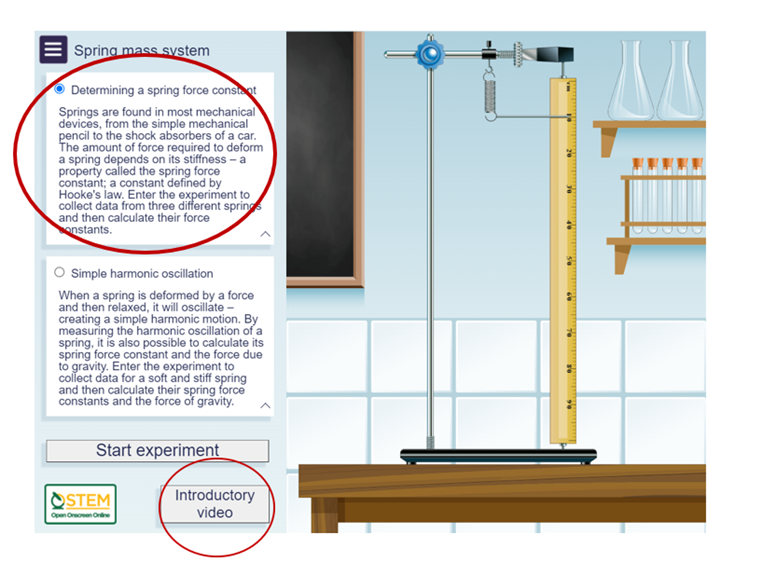
Once a student has entered the experiment the first task is to select a spring (for the purposes of this worked example, the soft spring has been selected).

Once a spring has been selected the weights are added by using the sliding bar.

And once the spring has reached its new equilibrium point, the extension and other details can then be recorded using a laboratory notebook or stored using the ‘Record data’ option. The latter will enable the recordings to be later downloaded as a CSV spreadsheet.
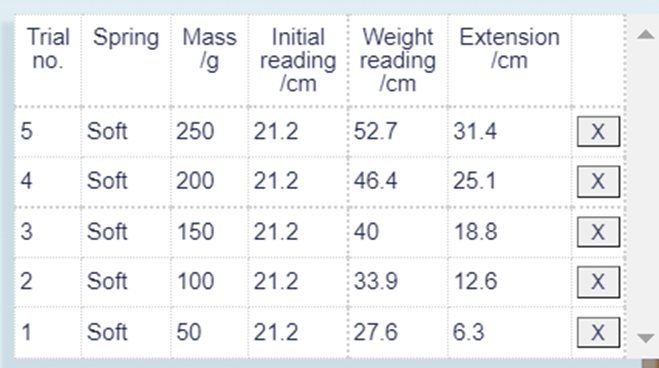
Below is the data output for a soft spring:
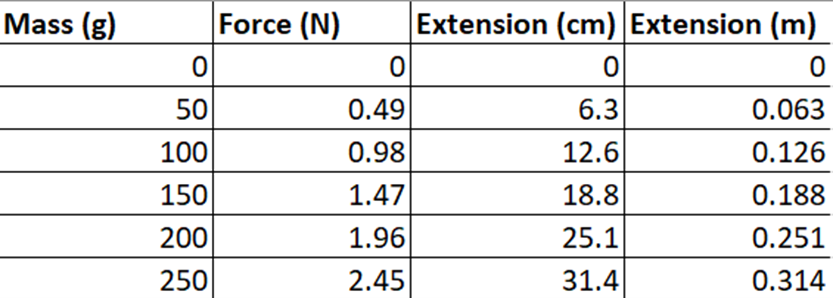
To use Hooke’s law to measure the spring force constant, the data must be transformed into the appropriate units (mass to force in newtons; cm to m) as shown below.
Hooke’s law can only be used for data collected below the limit of proportionality. To check the proportionality of the data, force (N) is plotted against extension (m).
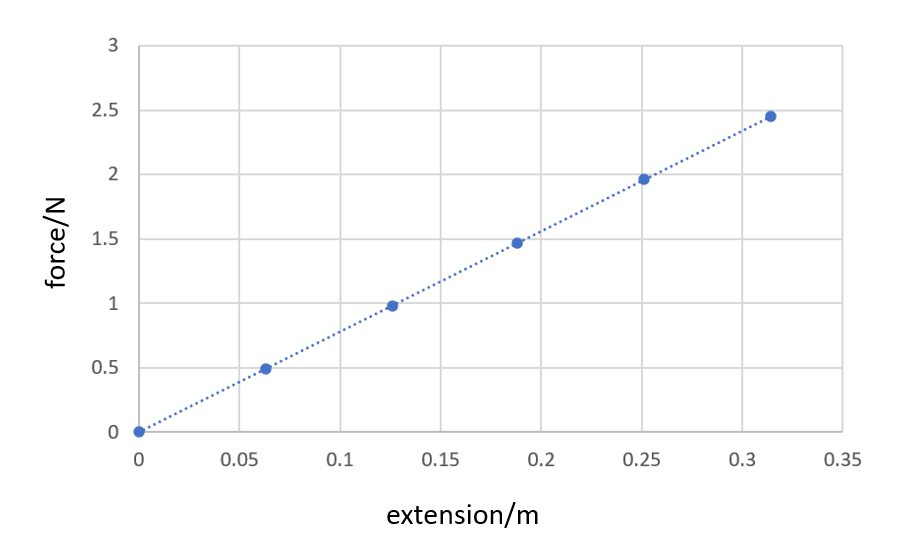
The plotted data shows that the data is linear and proportional and therefore Hooke’s law can be used to calculate the spring force constant (the slope (gradient) of the plotted data represents the spring force constant).
k = F/x
The spring force constant for the soft spring is 7.81 N/m.
Previous: Appendix 1 Next: Lesson: Determining a spring force constant