Appendix 1: Teacher notes – organisation of the lesson (Calorimetry: energy in food)
Appendix 1: Teacher notes – organisation of the lesson
Combined with using the Calorimetry: Energy in food, this lesson links to the following units in the Teaching Syllabus for Chemistry:
- SHS 1 Section 1 Introduction to chemistry, Unit 2 Measurement of Physical quantities
- SHS 2 Section 1 Energy and energy changes, Unit 1: Energy changes in physical and chemical processes
- SHS 2 Section 1 Energy and energy changes, Unit 2: Energy cycles and bond enthalpies
- SHS 3 Section 2 Basic biochemistry and synthetic polymers, Unit 1: Fat and oils
- SHS 3 Section 2 Basic biochemistry and synthetic polymers, Unit 2: Proteins
- SHS 3 Section 2 Basic biochemistry and synthetic polymers Unit 3 Carbohydrates
Ideas for organising this exemplar lesson link directly to activities and teaching examples in the OpenSTEM Africa CPD units Linking Science to everyday life and Using ICT to support learning.
A full list of the OpenSTEM Africa CPD units can be found at: https://www.open.edu/openlearncreate/CPD_units
Overview
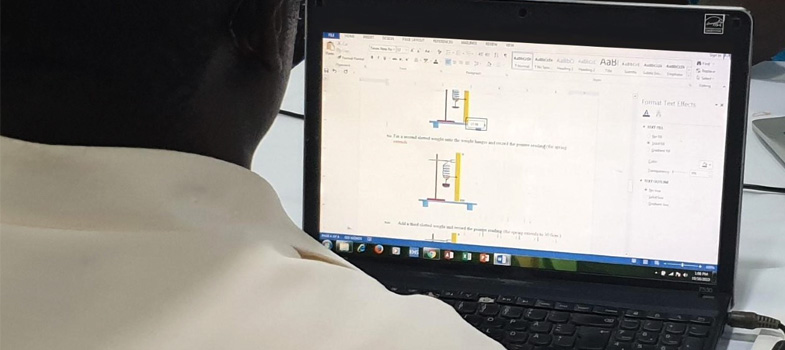
If it can be arranged through your Head of Science and the Head of ICT, this lesson should take place in the ICT Lab in your school. If the lesson takes place in the ICT Lab, it may be possible for each student to work individually at a computer; otherwise divide the class so that students are in small groups at a computer.
If it is not possible to use the ICT Lab for this lesson, then try to set up this lesson in your classroom. You may be lucky enough in your school to have a set of ‘empty’ tablets or mobile phones which students can use. Or you may be able to bring a laptop connected to the internet or to your school intranet – and perhaps connected to a projector to make it possible for the whole class to view at once. If access to ICT is a real challenge in your school but you want your students to view an experiment, you might be able demonstrate it to small groups of your students at a time using your own mobile phone.
Whatever way(s) you set up the class, it would still be helpful to the students to be able to work in pairs or small groups for at least some of the lesson. Do remember as well that students need desk space to be able to write in their notebooks and to draw diagrams.
Steps in organising the lesson
Step 1: This takes place in the lesson before the one where you and your class access the OpenSTEM Africa Virtual Laboratory Calorimetry: energy in food application. Have students work in pairs to pre-read the Background section of the exemplar lesson. They should ask each other the questions in the Background section and check with each other that each understands the answers. You may want students to complete their reading of the Background section for homework or continue into a second lesson. If you do allocate more than one lesson to the Background work, consider changing the pairs of students around. In that way each student can check their understanding of what they have learned with a new partner. While they are doing so, you may want to walk round the class, checking they can identify macronutrients and understand their contribution to the energy stored in food. Understanding how to determine the energy transferred in the combustion of food using data from calorimetry experiments is essential for successful completion of the lesson.
Step 2: At the beginning of this exemplar lesson, check students’ understanding of relevant chemistry by asking (again!) the questions in the Background section. Organise the class, if possible, to work in the same pairs as in the previous lesson. Have each person in the pair create the tables for their experimental data in their own laboratory notebook in preparation for their data collection from the practical activity.
Step 3: Within each pair, have them check each other’s work and that each has set the tables out correctly with the correct headings.
Step 4: Make sure that each pair has access to/can see the computer screen to begin the actual investigation and observation and carry out the calorimeter experiments. Ensure that each pair knows how to perform the experiments – or if you are using a laptop/projector, that you draw on the expertise of the class as you go through each step of the investigation, selecting food, taking measurements of mass and temperature, using equipment – e.g. ask them what the next step is.
Step 6: Have the class follow the instructions. Make sure, if working in a pair on a PC, that each student in the pair gets to follow all the steps; if working in a group on a PC, have the group leader ensure that everyone in the group is involved.
Step 7: Five to ten minutes before the end of the lesson, tell the students to complete the quiz.
Previous: Lesson: Calorimetry: energy in food Next: Appendix 2