4.1 Introduction
This module provides a framework for developing and conducting a welfare assessment scheme (WAS). This includes criteria for selecting appropriate OWIs, comparing scoring systems under different contexts, and key considerations for interpreting results from OWIs collectively and reaching a conclusion on a WAS.
When assessing animal welfare, it is crucial to understand the diverse approaches available, each tailored and structured to a specific purpose. Even for the same species at the same life stage, OWI selection, scoring systems, analytical methods, and conclusions that can be derived from the assessment can vary widely depending on whether or not the assessment is for routine monitoring, certification audits, or research on stressor impacts.
Regardless of the underlying purpose, certain features should be present in any welfare assessment: completeness, validity, feasibility, and the setting of reasonable thresholds for 'acceptable' welfare. Aspects of these features have already been explored, others will be elaborated on in more detail within this module.
Completeness - A well-rounded WAS should at least attempt to include both animal-based and risk-based OWIs. This ensures both welfare risks and their actual impacts on animals are identified, covering both accountability and opportunities for improving quality of life. Output-based WIs should cover both physical and mental aspects, including measures that represent positive welfare (i.e., behavioural assessments).
Validity - WIs must be explicitly tested to ensure they are valid indicators that reflect at least a partial/aspect of the animal's welfare state. Validation can be achieved by correlating with other established measures, or by using multiple tests under varying conditions that are likely to increase / decrease the animals' welfare state (e.g., stressful husbandry events).
Feasibility - As discussed in Module 3, OWIs must be simple & practical enough to use on-farm, without excessive time or resource demands. For this reason, most WASs favour non-invasive, remotely operable WIs that cause minimal disruption to the animals or farm routines.
Setting thresholds for acceptable welfare - A key challenge here is determining a what point a specific indicator or farming condition is considered adequate enough to be meeting an animal's welfare needs. Determining the severity of welfare issues is often very difficult; the duration and number of individuals involved in the assessment must be considered, especially with larger population sizes common in aquaculture.
WASs can be applied and evaluated by how much the animals have deviated from whatever the accepted 'norm' or 'reasonable levels' are; this is not necessarily what is 'natural' for the animals. Assessments of deviation from an acceptable normality must be based on baseline studies of farmed animals in satisfactory environments (identified through consultation with multiple stakeholders and welfare scientists).
To ensure completeness, all key aspects of welfare (as introduced in Module 1) should be considered. A general integrated welfare assessment framework (Figure 4.1 below redrawn from Hubrecht & Kirkwood (Eds), 2010) can aid in selection of important WIs for the assessment process. 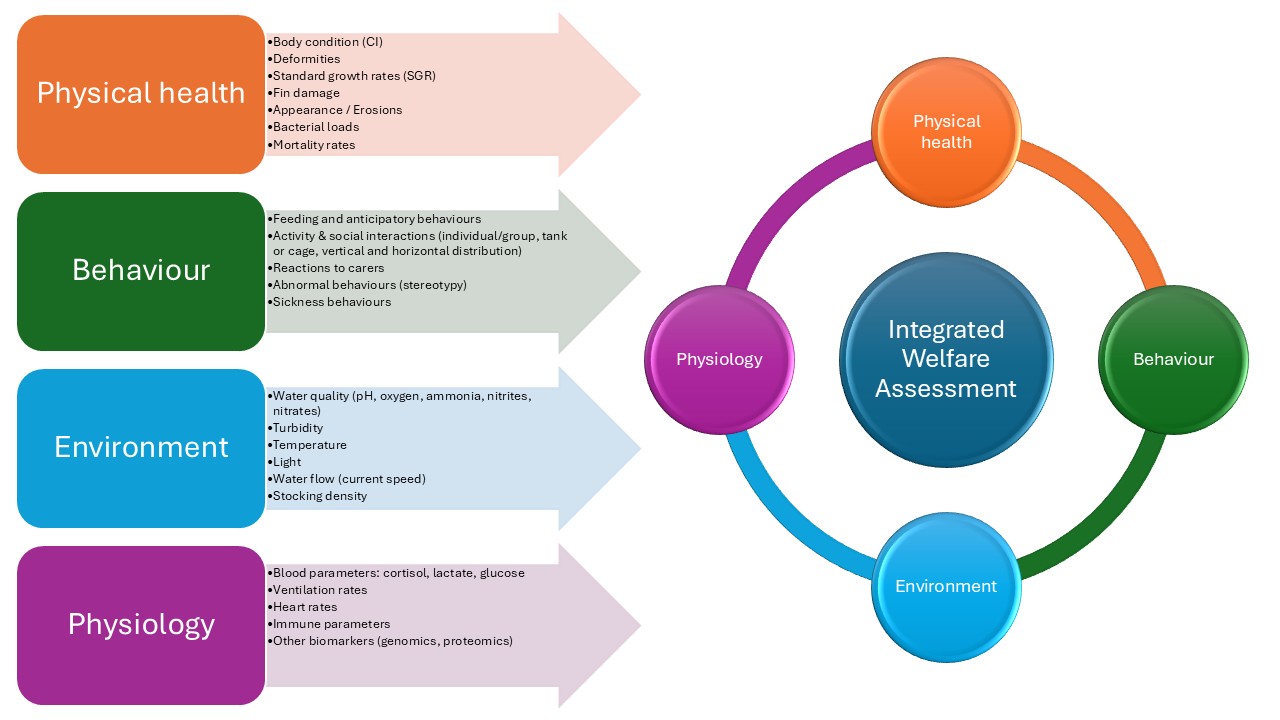 Figure 4.1: Integrated animal welfare assessment framework; please note that the list of WIs is not limited to the ones provided within this framework. A conceptual diagram showing physical health, behaviour, environment and physiology factors linked together in a circle around the text "Integrated Welfare Assessment". On the left there are text examples of each type of factor Source: Adapted from Hubrecht, R., & Kirkwood, J. (Eds.) 2010 (The UFAW Handbook on the care and Management of Laboratory and other Research Animals).