

2.4 Step 2: Identifying specific risks
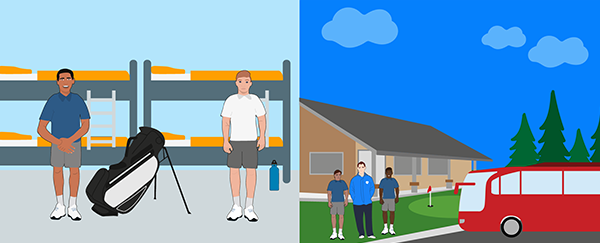
For the next two activities, imagine you are completing a risk assessment ahead of a national sports event where you have two teams attending – one of which is a team of para-athletes.
The teams will travel together with staff, on a local bus that has been hired for the week.
A lot of the athletes have never left their hometown before – they were all asked to provide emergency contact and medical information before leaving, but not all the forms have been collected.
The teams are all children, both boys and girls, and they will be staying in male and female dormitory room accommodation, with a shower and toilet block situated outside.
The accommodation has free, open Wi-Fi access, and most of the children will bring their mobile phones.
The venue for the competition is a community arena, which is open for anyone to enter and watch the matches. It has a basic medical unit, with a part-time doctor.
You have heard that local media will be covering the event, and that some people calling themselves ‘agents’ are attending to try and identify and sign-up talented young athletes.
There will be a few staff coming with the teams, some have had the standard safeguarding training, but a couple of new staff haven’t done the training yet. There will not be many women staff, so there might not be enough people to supervise the girls all the time.
 Activity: What specific risks apply to each general risk area?
In the table below, identify as many specific risks to children or other vulnerable people as you can. To help you we have provided an example for ‘People’ and ‘Venues and facilities’.
| Safeguarding risk area | Specific risks |
|---|---|
| People | Adults responsible for, or coming into contact with, children may behave inappropriately or abuse a child. |
| Venues and facilities | Facilities and amenities can be inadequate or dangerous to children (e.g. a leaking changing room roof). |
| Information | |
| Travel and accommodation | |
| Communication and social media | |
| General welfare issues | |
Comment
Here are some examples of risk we identified – note, this is not a complete list. You may have noticed that many of these risks will apply to every activity or context. Others may be more dependent on the specific activity or environment.
| Safeguarding risk area | Specific risks |
|---|---|
| People | Adults responsible for, or coming into contact with, children may behave inappropriately or abuse a child. |
| People may fail to recognise | |
| People may fail to report safeguarding concerns. | |
| Adults may fail to adequately supervise children. | |
| Adults may fail to adequately support para-athletes. | |
| Adults may | |
| People may behave inappropriately, bully or abuse someone. | |
| Fans may harass an athlete. | |
| Venues and facilities | Facilities and amenities can be inadequate or dangerous to children (e.g. a leaking changing room roof). |
| Inadequate supervision of changing facilities or locker rooms, or other controlled areas of a venue. | |
| Venues without controls on who can enter. | |
| Medical areas not properly staffed or stocked with appropriate supplies. | |
| Information | Absence of personal medical information. |
| People don’t understand their safeguarding responsibilities or know how to report concerns. | |
| Carers for para-athletes don’t have adequate information to carry out their responsibilities. | |
| Travel and accommodation | Unsafe vehicles. |
| Inadequate supervision can lead to accidents, bullying, abuse, or children going missing. | |
| Sleeping in inappropriate accommodation, with toilets located outside, exposing them to risk. | |
| Communication and social media | Social media or e-communication used to abuse, bully, or threaten children. |
| Media covering the activity in a way that puts children and others at risk. | |
| Children accessing and/or sharing inappropriate, violent, or offensive material through accommodation Wi-Fi. | |
| General welfare issues | Person-centred approaches not used to deliver sport activities. |
| The needs of people with disability or those with mental health problems, are not met. (e.g. building not accessible). | |
| No spaces or adjustments made for athletes to practise their religion. |
The next step is to consider what action is needed to
2.3 Step 1: General safeguarding risk areas

