
Biochemical reactions in seeds
So far, you have learned that water is held within a seed in different ways, depending on the amount of water already within that seed. This in turn can affect the type of metabolic reactions that can go on inside the seed. By plotting the isotherm, you can see these as predictable, real-world differences.
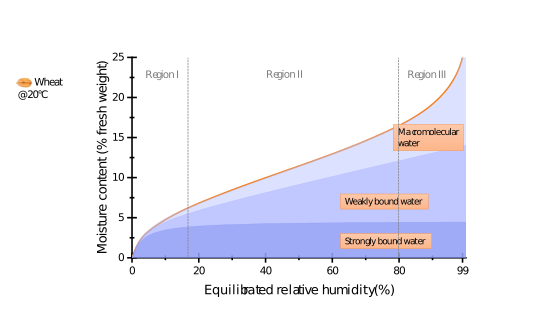
Look at Figure 7 (below), which shows three distinct ‘regions’ along the x-axis of the isotherm. These are not just lines on a graph. They relate to observable differences in metabolic reactions that go on inside the seeds. Metabolism is limited when eRH is less than 15%: we call this ‘region I’ of the isotherm. More reactions can take place at an eRH between 15% and about 80%: we call this ‘region II’. Metabolic reactions inside seeds ramp up again in ‘region III’, when eRH rises above 80%.
Activity 1
Allow 5 minutes for this activity
Examine Figure 7 carefully, then try to match the three regions to the most relevant descriptions of the behavior of water for each. There will be more than one interpretation associated with each region. Try to do the exercise yourself first, before looking at our response.
Regions:
- Region I
- Region II
- Region III
Descriptions:
- a. moisture content increases rapidly at first, then tails off as eRH increases
- b. more water is freely available than in any other region
- c. water inside seeds may be strongly bound, loosely bound or free H2O
- d. most water is strongly bound inside seeds
- e. increase of moisture content accelerates as eRH increases
- f. moisture content increases slowly as eRH increases
When you are ready, press 'reveal' to see our comments.
Discussion
In region I, moisture content and eRH are both low. Most water inside seeds is strongly bound, so there is little water available for aqueous reactions. In region II, moisture content flattens out while eRH continues to increase. Inside seeds, there is weakly bound water and some freely circulating water, which increases the scope for certain types of metabolic reactions. In region III, relatively high quantities of freely available water allow ever more water-based reactions to take place.
Region I
a. moisture content increases rapidly at first, then tails off as eRH increases
d. most water is strongly bound inside seeds
Region II
c. water inside seeds may be strongly bound, loosely bound or free H2O
f. moisture content increases slowly as eRH increases
Region III
b. more water is freely available than in any other region
e. increase of moisture content accelerates as eRH increases
Behavior of water inside seeds