
Drying seeds in genebanks
In module 3, you learned that international genebanks have devoted quite a lot of research to finding the best methods for drying seeds. You were introduced to the scientific evidence in favor of initially drying rice seeds at high temperature, before continue to dry according to the Genebank Standards. Here is a reminder of the evidence from trials at the International Rice Research Institute (IRRI) that you first saw in the section of module 3 entitled ‘Dried to perfection’.
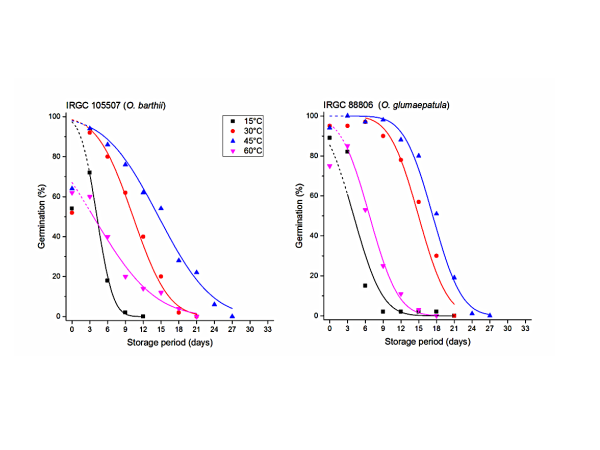
These results suggest that for seeds that have not dried sufficiently on the parent plant, it is possible to obtain improvements in longevity – often by many percentage points. These improvements in longevity were enough to convince IRRI to make changes to their drying procedures.
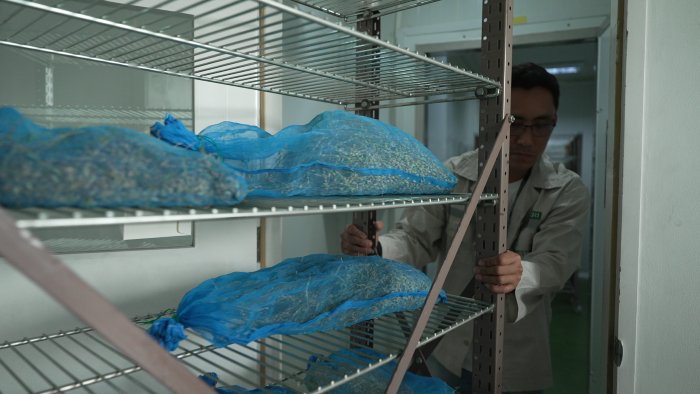
The next video tells the story of the research behind those graphs, in the words of some of the scientists who were involved. Fiona Hay, one of the pioneering scientists conducting the first research at IRRI, discusses the initial investigation on rice. Olaniyi Oyatomi and Sola Owoborode take up the story of how these findings were rolled out to legume crops at IITA. You will see the two-stage drying system adopted by IRRI as a result of these investigations, and hear scientists talk about the benefits two-stage drying has brought. As you watch, think about how scientific investigations like this can translate into improvements in genebank procedures.
Transcript: Video 4: two stage drying
Use the box below to describe IRRI’s two-stage drying, and the scientific evidence on which they based their decision to change their practice. What parallels are there between findings at IRRI and findings at IITA? You should spend up to ten minutes on this. If your reflections on the video raise any questions, please post them on the Forum, where the course moderators will be able to help you.
When you are ready, press 'reveal' to see our comments.
Discussion
In IRRI’s two-stage drying, once seeds have been checked into the database, they are dried for the first few days at a temperature of around 30°C. Then they are moved into a second drying room, where they reach equilibrium at a lower temperature. The story of the research is interesting in itself, because it shows how a hypothesis made about one crop (rice) can then be tested in other crops (Bambara groundnut and soybean). Successful scientific investigations like this provide an evidence-base to support improvements to genebank procedures.
The seed information database