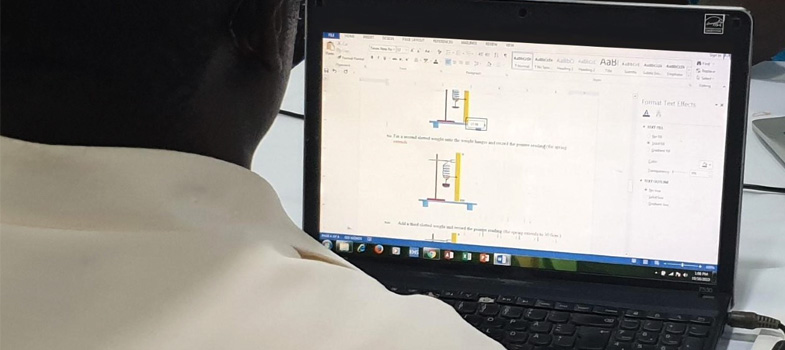
Practical activity (Calorimetry: combustion of alcohols)
Practical activity
In this online experiment you will determine the energy released in the combustion of various alcohols.
Task 1: You will perform a series of calorimetry experiments for 4 alcohols: methanol, ethanol, propan-2-ol and butan-1-ol.
Task 2: Using the data of your calorimetry experiments, you will compare the heat energy released from burning different alcohols.
Task 1: Calorimeter experiments
You will now carry out your calorimetry experiments. Remember that all your data should be recorded in your laboratory notebook. The change in the temperature of water during combustion is measured using a thermometer and it is a direct measure of the alcohol energy content. The alcohol burner is weighted before and after the combustion to calculate the mass of alcohol burned to heat the water.
Detailed instructions are provided within the experiment. In preparation for the experiment read and reflect on the following summary of the steps you will need to take:
- Choose an alcohol from the list provided.
- Weigh the burner containing the selected alcohol (with its cap on) and record the initial mass.
- Place the burner under the flask and remove its cap.
- Add 100 ml of tap water into the conical flask.
- Record initial temperature of the water.
- Use the lighter to light the wick.
- Gently stir the water with the thermometer to ensure uniform temperature throughout.
- When the temperature of water has increased by a number of degrees, the flame is extinguished by placing the cap on the burner. Note that the increase in temperature of water should be kept constant for all your trials; any increase by 20 to 60oC will provide you with suitable data.
- Record the final temperature of water.
- Reweigh alcohol burner (with its cap on) and record the final mass.
- Repeat steps 1–10 at least twice for each alcohol. The water in the conical flask will be refreshed each time. Keep the increase of water temperature by a constant number of degrees in your trials. In this interactive screen experiment you do not need to worry about other variables that are already kept constant (such as the volume of water added to the conical flask and the distance between the wick and the bottom of the conical flask).
Planning your experimental work will help your experiments to run smoothly in the virtual laboratory.
Table 2 shows a template you could use to record your observations.
|
Alcohol |
T water at start / oC |
T water at end / oC |
ΔT / oC |
Mass of alcohol plus burner at start / g |
Mass of alcohol plus burner at end / g |
Mass alcohol burned / g |
|
Methanol |
||||||
|
trial 1 |
|
|
|
|
|
|
|
trial 2 |
|
|
|
|
|
|
|
Ethanol |
||||||
|
trial 1 |
|
|
|
|
|
|
|
trail 2 |
|
|
|
|
|
|
|
Propan-2-ol |
||||||
|
trial 1 |
|
|
|
|
|
|
|
trial 2 |
|
|
|
|
|
|
|
Butan-1-ol |
||||||
|
trial 1 |
|
|
|
|
|
|
|
trial 2 |
|
|
|
|
|
|
Table 2 Calorimeter data for combustion of alcohols.
|
Calorimetry: combustion of alcohols |
|
Go to the OpenSTEM Africa Virtual Laboratory. Click on the icon to access the Calorimetry application homepage. Watch the introductory video before entering the experiment.
|
Task 2: Data analysis and discussion
Use your data from Task 1 to calculate your experimental values of enthalpy change of combustion for those different alcohols. Table 3 shows a template you could use to record your values.
|
ΔT = oC
|
||
|
Alcohol |
Mass burned/g |
ΔH combustion/ KJ mol-1
|
|
Methanol |
|
|
|
Ethanol |
|
|
|
Propan-2-ol |
|
|
|
Butan-1-ol
|
|
|
Table 3 Experimental values of enthalpy change of combustion for various alcohols.
Now let’s discuss your enthalpy change of combustion values for different alcohols and compare your data of enthalpy change of combustion to those in the Handbook of Chemistry and Physics (the largest comprehensive physical science data source available).
|
Compare the experimental combustion enthalpy values for all four alcohols. Can you explain the pattern observed in your data? |
|
Which are more efficient fuels shorter or longer chain alcohols? |
|
Predict the energy during combustion of propan-1-ol |
|
Table 4 shows handbook data for the enthalpy changes in the combustion of various alcohols. Compare these values to your experimental values and calculate the efficiency (in %) of the simple calorimeter used in this investigation. Table 4 Combustion enthalpy changes for alcohols
Data from CRC Handbook of Chemistry & Physics Suggest improvements that you could be made to the experiment set-up to obtain experimental values closer to the theoretical values in Table 4. |
||||||||||
Previous: Background Next: Summary