Brittany Blankinship Guest Lecture - Transcript
(0:03) Okay, so following on from what Dr. Bach has just shared, (0:08) I'm going to share a little bit more (0:10) about some of the studies that we have done (0:12) more recently around this topic. (0:14) So the first one I'll mention and discuss with you (0:16) will be one where we've looked at language learning (0:18) in the case of patients living with dementia. (0:21) And then the second one will be the one (0:22) that Dr. Bach just mentioned, (0:24) where we're looking at whether or not (0:25) certain types of language changes happen (0:28) in ageing multilingual people.
(0:31) So first we'll talk about language learning (0:33) in patients with dementia. (0:35) So with this study, we conducted this in autumn of 2017, (0:39) and this was a collaborative project (0:40) between the three sort of pictures you see here. (0:42) So Lingo-Flamingo, Alzheimer's Scotland, (0:45) and then the University of Edinburgh.
(0:46) So that was our research group at the University of Edinburgh. (0:49) The classes were offered by Lingo-Flamingo (0:51) and their expertise, and we conducted these classes. (0:54) I think we are seeing still the first slide.
(0:56) Oh, are you? (0:57) Oh, no. (0:58) Has it changed? (0:59) Or no? (1:02) Oh, no. (1:02) I can see it.
(1:03) We can see it now. (1:05) Oh, okay. (1:07) So it's a little delayed.
(1:07) Okay, so this now, it will be the three pictures. (1:12) So these classes were offered by Lingo-Flamingo, (1:14) but they took place in Alzheimer's Scotland, (1:16) Dementia Resource Centre. (1:18) So that's what DRC here is referring to.
(1:20) And we did these in two locations, (1:22) one in Helensborough and one in Kilmarnock. (1:24) So the classes took place at the DRCs, (1:26) and the students were patients and their carers (1:29) who would frequent the Dementia Resource Centre. (1:32) So these would be people who are not yet (1:33) living in care homes, but living independently, (1:36) typically with partners who also would function (1:38) as their caregivers.
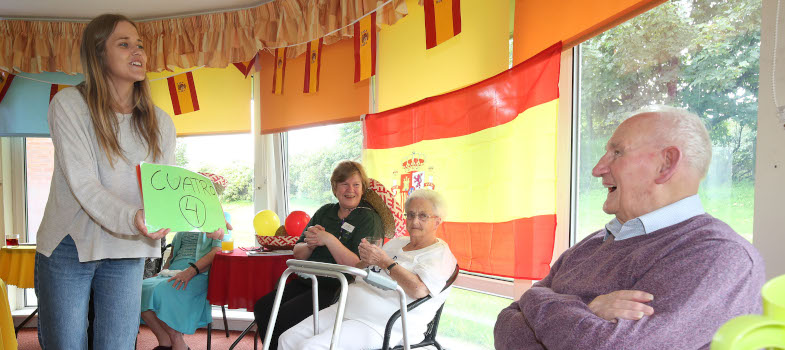
(1:40) So these classes were Italian classes, (1:42) and they happened for 90-minute sessions. (1:44) So a full sort of traditional language class length, (1:48) four times total over two weeks. (1:50) So we had two 90-minute classes each week for two weeks.
(1:56) And so what we found from this was not only (1:58) were these classes tolerable and enjoyable, (2:01) but they actually provided a long-lasting effect socially (2:05) for the people who took these classes. (2:07) So has the slide changed to the next one for you guys? (2:11) There she is. (2:12) Okay, so you can see here in this pink (2:14) sort of speech bubble, what we have here, (2:18) what we did was we conducted focus groups (2:20) with the people taking the classes, (2:23) so the students, before and after the classes, (2:25) as well as the Dementia Resource Managers.
(2:28) So this sort of blurb here in the pink (2:30) is from one of the students who was taking the class (2:32) who shared that their motivation (2:35) for wanting to take these classes (2:37) was not just to learn a language, (2:38) but actually the social side of things. (2:40) And this is something that came out of this study (2:43) that I think I could say safely (2:44) that we weren't from the research team really expecting, (2:47) but seems to be one of the most salient things (2:49) that this language learning experience (2:51) offers a opportunity not only to learn new things (2:54) and have a new experience, (2:56) but to have a new social experience (2:58) that can be meaningful and long lasting. (3:01) So from these courses, in the orange here, (3:03) these are some of the feedback that we received.
(3:05) Generally, it was met with great success, (3:09) universally described as an enjoyable experience, (3:11) that it was good fun, very good, terrific. (3:15) And importantly, some of the outcomes of this (3:18) were also suggesting that of the patients with dementia (3:22) and their carers, both of them who took these courses, (3:25) there was an increased sense of self-confidence (3:27) and self-esteem, and indeed a sense of accomplishment (3:30) for having completed these courses, (3:33) and a feeling that we're all in this together. (3:35) So this is something that came up quite a lot, (3:37) that it was a shared experience between these people (3:41) that allowed for them to have the shared experience (3:43) of attempting to learn a language (3:45) and have this experience together, (3:46) which then formed a really strong basis socially (3:50) to have a new group of friends.
(3:52) And so we followed up (3:53) with these dementia resource managers one year later, (3:55) after these classes, and found that the students (3:58) not only still remembered the experience (4:00) of the Italian classes, (4:01) but spoke of it quite often in a fond way, (4:04) and that the friendships that formed from this were lasting. (4:07) And indeed, in fact, the groups of people (4:09) who took these classes together (4:11) were more likely to continue doing other activities (4:14) offered by the Dementia Resource Centre (4:16) together as a social group. (4:18) So they sort of formed like a group, (4:20) and in fact, one of the managers mentioned, (4:22) well, if we just speak to one of their partners, (4:24) then they'll speak to everyone else, (4:26) and then they'll all come along, (4:27) and we know that we've got at least, you know, (4:28) six or seven people ready for that activity.
(4:30) So these courses not only offered a new experience (4:34) for language learning, (4:34) but really the social side of things (4:36) proved to be very, very important. (4:39) So this we would say was a great success. (4:42) And so this was only a two week course, as I've mentioned.
(4:45) So I want to say that these outcomes (4:48) were long lasting after just a short intervention. (5:02) So there's just the four 90 minute classes. (5:22) That's all it took to get this sort of positive outcome.
(5:31) So if the classes were able to be longer, (5:33) you can only imagine what sort of benefits (5:34) we might have seen. (5:35) So we had short classes here for various logistic reasons, (5:39) but it does prove the fact (5:43) that having a language learning class (5:45) is something that's feasible, tolerable, (5:47) and indeed enjoyable for people living with dementia (5:50) and their care should they be able to attend. (5:52) So the next study that I'm going to mention (5:54) is more so about, so that's about (5:57) what is the interaction between language learning (5:59) and languages in dementia.
(6:01) But what about the case where we have multilingual people (6:03) who might progress into having dementia in later life? (6:08) So this will bring me to the next sort of study, (6:11) which is about language changes in older age. (6:13) So this is something where, as Dr. Bach mentioned, (6:17) there's quite a lot of anecdotal evidence (6:19) or background around this. (6:20) So I have screenshots here of two news stories, for example, (6:25) discussing how in older age, as dementia sets in, (6:29) there's been incidences where people find (6:31) that among multilingual people, (6:33) they will revert or go back to the first language (6:36) when in fact they're surrounded in an environment (6:38) where maybe they're speaking English.
(6:40) So in this case, we have, this is a story of Gallic, (6:44) and this is a story of a mom who, (6:46) a daughter who didn't really speak Punjabi, (6:49) but needed to find a carer (6:50) that would be able to speak Punjabi to her mom (6:53) because she was living in the UK, (6:54) but wasn't able to use English so effectively anymore. (6:58) And the question of this sort of language reversion, (7:01) which I will explain a bit more in my next slide, (7:03) is something that in the scientific literature (7:06) is often understudied (7:09) as well as isn't really supported strongly. (7:11) So we have this sort of reporting of these incidences (7:16) happening among migrant communities (7:17) and multilingual families, (7:19) but the empirical foundation for this is lacking.
(7:22) And what does exist is quite inconclusive. (7:24) So a lot of these studies, in fact, (7:26) will be conducted in Australia, (7:28) looking at Dutch migrant communities. (7:30) And some of the findings from that are that, (7:33) well, maybe it's not a case of dementia (7:35) that's causing this, but it's really nostalgia.
(7:37) So a longing for things of the past, (7:40) so things of childhood. (7:41) And so that's why people are preferring (7:43) to use their first language. (7:45) Or maybe it's a case of social factors.
(7:49) So life changes, like moving house (7:51) or having their children leave the family home, (7:54) and that's causing these sort of changes. (7:56) So in this, I'm gonna move to the next slide, (7:59) the question is, is this due to these changes, (8:02) if we observe them, emotional or social factors? (8:05) And so in this table here, (8:06) I just have a little further explanation (8:09) of the types of language changes by environment. (8:11) So let me explain this table a little bit for you.
(8:13) So L1 will be language one, (8:16) so the first language that someone has learned, (8:18) and LX being the second, third, fourth, (8:21) X being fill in the number here. (8:23) So this here will be the language environment (8:25) on this row in the darker purple. (8:28) And then the lighter purple is the language (8:30) that's experiencing the change.
(8:31) So in this box, you'll have a change in L1 (8:35) while in an L1 environment. (8:37) In the literature, this will typically be suggested (8:39) to be normal ageing adults. (8:41) So as you get older, (8:42) you might find some more finding difficulties, (8:45) you might have slower lexical access (8:48) would be the sort of linguistic term for that.
(8:50) So there's a couple of changes in language, (8:52) but you're in the environment (8:54) where your native language is being spoken, (8:56) your L1 is being spoken, (8:57) and you're finding some changes in your L1. (9:00) In this next box, (9:02) this is where we have a change in the L1 again, (9:05) that's this full row, but we're in the LX environment. (9:09) So this will typically be, should, for example, (9:12) someone be from the UK and they speak English as their L1 (9:18) and they move to Spain.
(9:20) And so they speak Spanish as well, (9:22) but they might find that there's some changes (9:23) in their English in their L1 while in the L2 environment. (9:27) So that's what you would typically find (9:28) in people who are immigrating to different countries (9:31) where there's another dominant language. (9:33) Then we'll go to the second row (9:35) where we're finding changes in the L2 or LX (9:39) while in an L1 environment.
(9:40) So this would be typically attrition. (9:42) So attrition is usually what would be described (9:44) as a language change or loss of ability in the language. (9:49) So this would be a change in, say, for example, (9:52) foreign language that you learned at school.
(9:54) So if you are taking a French class (9:56) and you're quite proficient at French, (9:58) and then you sort of stop taking that class, (10:00) and so you're still in your L1 environment (10:02) and you're only learning the L2 in a classroom setting, (10:05) then you might find some changes (10:08) in your ability in that language (10:09) if you don't use it as frequently, for example. (10:12) And then the key box here will be this one here (10:14) where we have a change in LX, (10:16) so a change in, say, the second language or third language (10:19) while in an L1 environment. (10:21) So this would be what we were describing (10:23) as language reversion.
(10:25) So this is what we're talking about (10:26) just being something that is suggested (10:28) in anecdotal evidence, (10:30) but isn't really supported too strongly (10:33) in systematic studies within the scientific literature. (10:36) And so this is typically what we would find, (10:38) the population here would typically be ageing migrants, (10:40) so people who have moved countries (10:42) and they're getting older. (10:44) Maybe dementia diagnoses are happening, or maybe not.
(10:48) And so to address this question, what we have done, (10:51) and this is just my last slide here, (10:53) is we've developed a questionnaire (10:55) that will look at the prevalence (10:57) of language changes in older age (10:59) and seeing indeed, is the report of this so-called reversion, (11:04) is the report of other language changes (11:06) in ageing multilingual people? (11:09) And if so, what contributing factors are there? (11:12) So we have multiple versions of this survey, (11:14) and the QR code here and the link here (11:17) links you to the survey (11:18) if you would be interested in filling it out. (11:20) And so we have multiple versions, one for self-report. (11:23) So if you yourself are a multilingual person (11:26) and you've noticed some language changes or not, (11:28) you could fill it out, but also importantly, by proxy.
(11:31) So this would be for family members or friends (11:33) reporting behalf of a family member or friend (11:36) who they have noticed some language changes, (11:38) or indeed for professional carers (11:40) who are caring for a multilingual person (11:42) where they've noticed language changes as well. (11:44) You can fill out the survey there. (11:47) So that is quickly what I have prepared, (11:50) and then our Twitter handles are here (11:51) if you're interested in finding more (11:52) about some of the research that we do.
(11:54) Are there any questions (11:56) or anything that we have discussed?
Close this tab to return to the Guest Lecture Video.