
 In the cell, an outer membrane – the plasma membrane, performs a similar function to the City Wall or City Ring Road. It completely surrounds the cell and provides the boundary between one cell and the next. It is constructed not from bricks and mortar, but from fatty molecules called lipids. These lipids come back and form a thin, flexible, but strong covering. It is found in plants and bacterial cells too.
The cell membrane is a continuous sheet of two layers of fat like molecules with protein molecules 'floating' within it. The proteins in the cell membrane have various functions. Some are transport proteins which regulate entry and exit of material to and from the cell, others are receptors for hormones etc. For example, nutrients, such as glucose or amino-acids, need special carrier proteins to help them enter the cell. A cell must receive signals from other cells; this is done through receptors. These receive the signal and relay it across the membrane.
The cell membrane must allow materials into and out of the cell. It's important that fuel, raw materials and some signalling molecules can cross the membrane and those waste products and some manufactured products can leave the cell.
Other materials must be prevented from crossing the membrane at all. The membrane is the point at which everything that enters and leaves the cell has to cross. In practice it serves to hold the cell together in its own little micro-environment, protected from the outside elements. There is security to stop unwanted things entering and various gatekeeper molecules are responsible for carrying things in and out. There are different types of gatekeepers, designed to allow the free passage of different types of molecules.
COMPARTMENTS
Just as different activities in the city go on in different buildings or places, the cell too has its own specialised areas. Just as in a city you would not want a restaurant in the same building as a sewage works, so in the cell, different functions are separated into different compartments.
All these compartments co-exist quite happily within the outer boundary of the cell. The membranes of these internal compartments are made up of the same material as the outer membrane.
VACUOLE
The vacuole is found only in plant cells. In a plant cell the vacuole increases the cell surface area, provides storage for cell waste and other materials. It also is crucial in maintaining the plant's rigidity.
 CITY WALL / RING ROAD
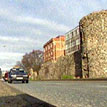
The city has a clearly defined edge. In medieval times this would have been a hard defensive wall; today, the boundary is less distinct and more likely to be a ring road, but the principle is the same. Active and productive life can carry on within the city, in the shelter offered by the boundary.
The boundary of the city is not, however, continuous. For the city to function, materials have to both enter and leave. In some cases, such as with heavy plant and lorries, it may be sensible to prevent entry.
Rate and Review
Rate this article
Review this article
Log into OpenLearn to leave reviews and join in the conversation.
Article reviews