Rewilding is a progressive and inspirational approach to conservation focused on nature and people.
It's about trusting nature to take care of itself, enabling natural processes to shape land and sea, repair damaged ecosystems and restore degraded landscapes. Through rewilding, wildlife's natural rhythms create wilder, more biodiverse habitats.
Rewilding explores new ways for people to enjoy and earn a fair and sustainable living from wilder nature.
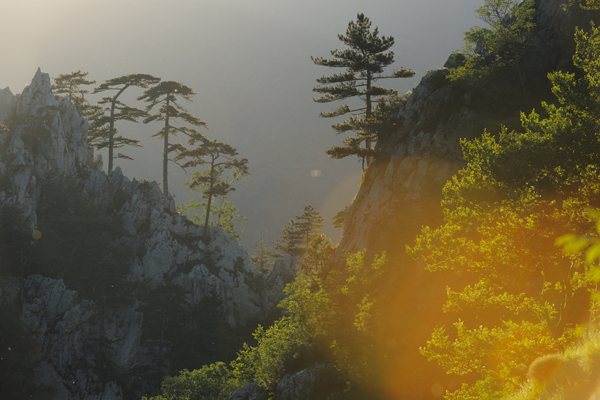
Dumbrava, Domogled National park in Southern Carpathians, Romania – a Rewilding Europe site. Credit: Staffan Widstrand / Rewilding Europe.
A holistic approach
According to The Global Charter for Rewilding the Earth, rewilding means ‘allowing natural processes to shape whole ecosystems so that they work in all their colourful complexity to give life to the land and the seas’ (Wild11, 2020).
Use the Next and Prev buttons below to view the many forms this can take and use the full-screen icon to enlarge the images.
The first illustration is of the Greater Coa Valley, Portugal. It is a vibrant rewilded landscape with diverse wildlife. It symbolises a balanced ecosystem and the richness of biodiversity in rewilding efforts. We can see mammals, birds and reptiles along with native vegetation in the rolling Portuguese hills. The second illustration is a display of an underwater seascape, the North Sea, with fish, crustaceans, molluscs, seabirds anemone, flora and human presence and infrastructure. The third illustration is of a rewilded Nordic Taiga landscape in Sweden. In the foreground, a majestic elk stands near a rocky stream, surrounded by vibrant vegetation. Fish leap in the water, while a bear wades nearby. A variety of birds, including one perched on a tree and others soaring above, fill the scene with life. A herd of reindeer moves through the valley, and two canoes with people paddle along the river. Snow-capped mountains rise in the distance, while teepees and a cabin can be seen on the banks of the river, blending human presence with the wild landscape. The fourth illustration is of the Danube Delta, Ukraine/Romania/Moldova. It is an illustration of a wetland area in the Danube Delta. We can see birds like Pelicans, Bee-eaters and Cormorants and Mammals like Water Buffalos and Wild Boars. On the river a tourist boat shows the beauty of the landscape while a fisherman is checking his nets.
Definitions of rewilding
There are many definitions of rewilding, some of which include other perspectives on subjects such as species reintroduction, self-sustaining ecosystems, and ecosystem function.
During this course, we will focus on rewilding as a progressive approach to conservation. An approach that enables nature to take care of itself through the restoration of natural processes.
Rewilding's focus on creating self-sustaining ecosystems, and taking action to restore natural processes, sets it apart from other types of conservation and restoration. It embraces a degree of uncertainty, with a long-term, open-ended outlook.
This contrasts with more traditional forms of conservation, which typically focus on the protection of certain species or the attainment of specific targets over defined timelines.
Use the Next and Prev buttons below to view the many forms this can take and use the full-screen icon to enlarge the images.
The text on the first slide says. Rewilding practitioners use different approaches to enable natural processes to restart and nature to heal itself, starting by removing or overcoming the barriers that prevent natural processes. You will learn more about these approaches in Module 2, and how they are applied on land, in freshwater systems and at sea in Modules 5, 6 and 7. The text in the second slide says. Rewilding is a holistic, inclusive approach that delivers social as well as ecological benefits. The success of rewilding initiatives depends on engaging and working with people of all backgrounds, both within and around sites that are being rewilded, and across Europe. You will learn more about these aspects of rewilding in Module 3 of this course. The text in the third slide says. Rewilding also offers transformative opportunities to develop new nature-based economies. This is particularly important in places where traditional livelihoods are no longer viable, or where existing economies are based on the unsustainable exploitation of natural resources. You will learn more about these opportunities in Module 4. The text in the fourth slide says. Module 8 is where all of your learning comes together and you make your own personal rewilding plan. As you will see, rewilding needs people of all different backgrounds to succeed, and we can all help to drive forward the rewilding movement in Europe.