

What is rewilding and why is it important?
3 Social context: rural depopulation and opportunities for rewilding
3.1 The challenge and opportunity of rural depopulation
People have been moving from rural areas to towns and cities across Europe for decades. As a result, more than two-thirds of the EU population now live in urban areas.
The shift of people away from agricultural production in rural areas is widely referred to as ‘land abandonment’. Recent estimates indicated that around 30% of agricultural areas in the EU are under at least a moderate risk of land abandonment by 2030 (Castillo et al., 2018). While ‘abandonment’ is hard to define and measure, it suggests that the landowner or user has made a choice to leave, which is not always the case.
Rural depopulation means an increasing amount of land across Europe is being left with little or no human management or usage. As people leave, many rural communities across the continent face huge socio-economic challenges, as services such as shops and schools become unviable, and jobs become scarce.
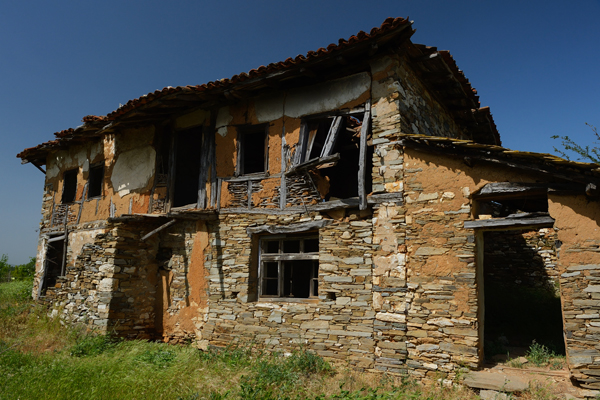
Abandoned house in the Rhodope Mountains, Bulgaria. Credit: Staffan Widstrand / Rewilding Europe.
Rural depopulation and land abandonment also offer a huge opportunity for rewilding. As more and more land ceases to be managed by humans, there is more space for nature to recover, which can help to address issues such as climate change.
There is also a growing opportunity for rewilding – as a holistic approach to conservation – to provide a new and optimistic outlook for rural communities through the development of sustainable, nature-positive economies. As such economies develop and provide jobs and income, they can help to revitalise areas by encouraging people to return and repopulate rural areas.
You will explore the economic opportunities of rewilding and the connection between rewilding and climate change later in this course.
What people leaving does to the land
Rural depopulation and land abandonment are leading to the decline and disappearance of animal husbandry across many parts of Europe. This, in turn, means many European landscapes are experiencing a significant decrease in grazing. At natural population densities, herbivores can help to promote semi-open, biodiverse landscapes through their grazing impact. By reducing the amount of combustible vegetation in the landscape and creating natural firebreaks, they can also reduce the risk of catastrophic wildfire outbreaks.
In places where people are no longer grazing animals, shrubs and other woody vegetation can start to take over. In some situations, this can negatively impact biodiversity and the cultural value of the landscape. It also heightens the risk of catastrophic wildfires breaking out. Such wildfires are becoming increasingly common in many European landscapes as climate change leads to longer droughts and more extreme heatwaves. They can reduce biodiversity, damage property, and lead to loss of human life.
In such places, the reintroduction and restocking of free-roaming populations of wild and semi-wild herbivores, such as European bison, deer, horses, and Tauros, can be an important contribution to reducing the risk and impact of fires (Johnson et al., 2018). This is why populations of such wild herbivores are often known as ‘grazing fire brigades’. Read the article Rewilding – the natural way to minimise wildfire risk to learn more about this.
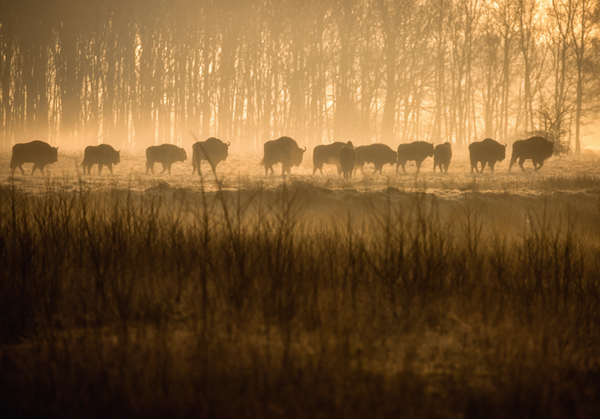
European bison in De Maashorst, The Netherlands. Credit: Hans Koster.
However, the changes in the ecosystem as people leave and nature recovers vary with context.
Natural forest regrowth on unmanaged fields and pastures has contributed significantly to the increase in Europe's forest cover over many decades. Between 2000 and 2020 there was a 5.5% increase in forest cover across European countries. This is an ongoing upward trend.
Fewer people and more forest cover can improve the conditions for wildlife comeback, particularly when combined with stronger protection measures for certain species, such as raptors and large carnivores, as well as improved hunting regulations and practices. Birds, mammals and reptiles have all spontaneously returned to new areas across Europe.
The natural regeneration of forests can also capture carbon, helping to mitigate climate change, and deadwood provides a rich habitat for many invertebrates, providing food for birds and mammals and re-starting the circle of life.

