

Nature recovery
1 Core concepts
1.5 Barriers
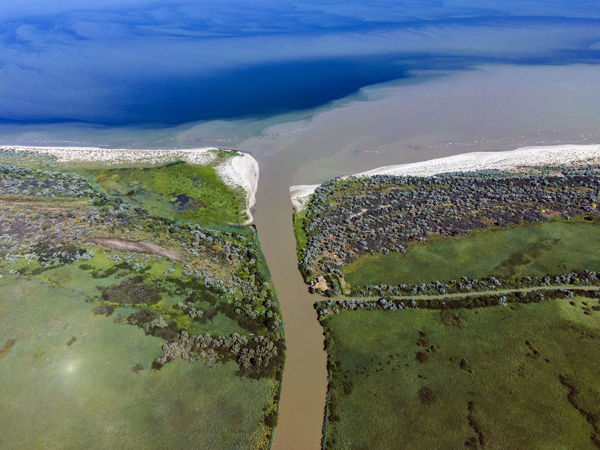
Aerial view, Distributary channel of the Danube River flowing into the Black Sea, Danube Biosphere Reserve in Danube delta. Credit: Andrey Nekrasov
At the start of practical rewilding initiatives we may need to intervene to create the right conditions for nature to restore itself. This frequently involves removing artificial barriers that have been created by people in the landscape. While many of these barriers are now old and obsolete, they still prevent natural processes from functioning as they should and stop wildlife from moving freely.
Examples of such barriers include:
- Artificial dams, levees, or dykes that prevent flooding, erosion, and deposition, or drainage channels that remove water from natural wetlands.
- Roads, railways, power lines, and fences, which cut through landscapes and prevent wildlife from moving and seeds from dispersing.
- Areas where intensive production is taking place, such as highly managed monoculture plantations, or over-hunted or over-grazed areas that offer little beneficial habitat and which prevent the natural regeneration and dispersal of plants and animals.
- Shipping lanes at sea, where the marine environment is highly disturbed and species such as whales and dolphins are often killed or injured by ship strikes.
|

Another example is the restoration of Arctic rivers in Sweden's Nordic taiga landscape, which you will learn more about in Module 6.

Absence can be a barrier
Barriers may be the presence of something that prevents natural processes from taking place but the absence of a natural element within a landscape can also act as a barrier.
The absence of carcasses in a landscape prevents many natural processes from taking place. When animals die in nature their carcasses are consumed by scavengers like vultures, foxes, and an array of insects, which are part of intricate local food webs. Eventually, aided by the action of microorganisms and fungi, the decomposition of once-living flesh returns nutrients to the soil which then helps new plants to grow, providing food for living animals.
This chain of interactions is referred to as the ‘circle of life’. As you can see from the diagram below, the absence of carcasses can negatively impact entire ecosystems.

The role of large mammal carrion can be considered a keystone. A taurus carcass can trigger a series of natural processes and interactions called ‘Circle of Life’. Credit: Jeroen Helmer / ARK Rewilding Netherlands.

