

Nature recovery
3 Give nature a helping hand – bringing back wildlife
3.2 Species translocations
Species translocations involve the movement of wildlife species including animals, plants, or fungi, by people, from one place to another. Translocations can be beneficial when it’s unlikely or impossible for a species to return to a rewilding site, due to the extent of local extinctions or barriers that we cannot remove, like mountains or seas. Translocations can also be used to enhance the growth and health of a small existing population – this is called restocking.
In passive rewilding, wildlife species return by themselves, and people have no say in this process. In active rewilding efforts like species translocations, people make choices about what wildlife to move, when, and where to. In reality, many species can and will come back on their own, if the necessary conditions for that species to survive and thrive are present.
When making decisions about supporting spontaneous wildlife comeback, or active reintroductions and population enhancements, rewilders consider which natural processes are missing from or degraded in an ecosystem. Then they can identify which species would be best suited to restoring them. In an area where large herbivores are already present, the ecosystem could benefit from scavengers such as vultures to eat the carcasses, and dung beetles to assist with the breakdown and distribution of the dung.
When looking at the role of wildlife in its natural environment, it's important to look at how groups of species interact with each other. These groups are called ‘guilds’ or ‘assemblages’. A guild of herbivores comprising of species such as European bison, deer, and semi-wild horses, will have a certain impact on a landscape. If only one species is present the impact will be different.
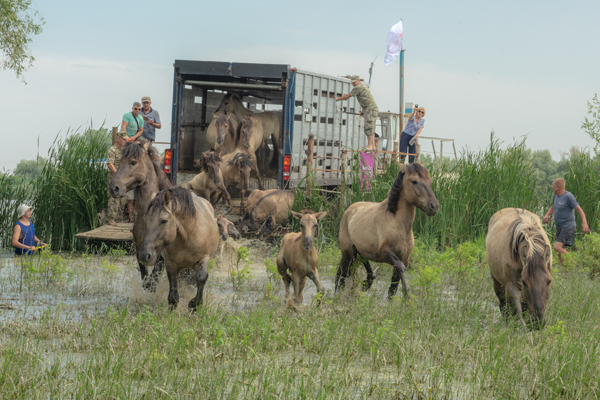
Herd of 17 Konik horses from Latvian nature reserves was released by Rewilding Ukraine on Ermakov island in the Ukrainian Danube delta to maintain mosaic landscape and biodiversity through natural grazing. Credit: Andrey Nekrasov / Rewilding Ukraine.
The selection of which wildlife to translocate as part of a rewilding initiative should consider many different factors, including:
- Whether the species was once naturally present in the area.
- How the presence of the translocated species may impact other wildlife species in the area.
- Whether the current state of the habitat in the new site is suitable for all life stages of the species, and how the habitat may evolve in the context of climate change.
- Whether stakeholders connected to the area where the proposed translocation will take place will welcome the selected species, or if there will be resistance and coexistence issues.
- What economic impact it will have.
- Whether there is a source population in the wild or in captivity from which individuals can be transported, with a healthy genetic base.
- What permits are needed for the selected species in the source and recipient countries.
- If the knowledge, skills, and equipment are in place to capture, move, and release the species at the time and place(s) needed.
These questions are typically answered as part of a feasibility study, which explores and assesses whether it is possible and advisable to move forward with a translocation. This study considers biological feasibility, genetic considerations, animal welfare, and social and legal feasibility, following guidelines established by the International Union for Conservation of Nature (IUCN).
The legalities surrounding translocations can be complex. Public and private lands may require different permits. The legal status of a particular wildlife species can relate to factors such as whether it is endangered and if it is considered native to a country. This can affect management requirements and permits. Such status will vary by country and by species and different permits may be needed for capture, holding, transport, and/or release. This makes the translocation process complex.
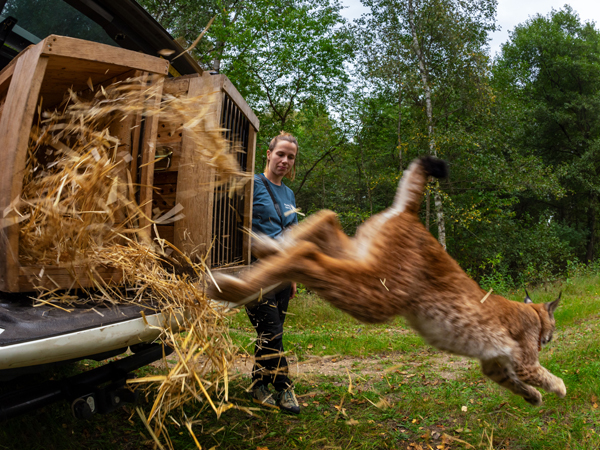
A Eurasian lynx is released from a crate by Wildlife Comeback Officer Wiebke Brenner in the Oder Delta, Poland. Credit: Neil Aldridge / Rewilding Europe.
Some wildlife species are considered wild, while others are considered domestic, even if they roam free in the wild. This classification determines which animal health laws apply to each species and therefore how much handling of the animals is legally required. It can also affect who is responsible for their management once they have been released (e.g. hunters for so-called ‘game’ species).

