The rewilding of terrestrial landscapes can deliver a wide range of ecological, social and economic benefits.
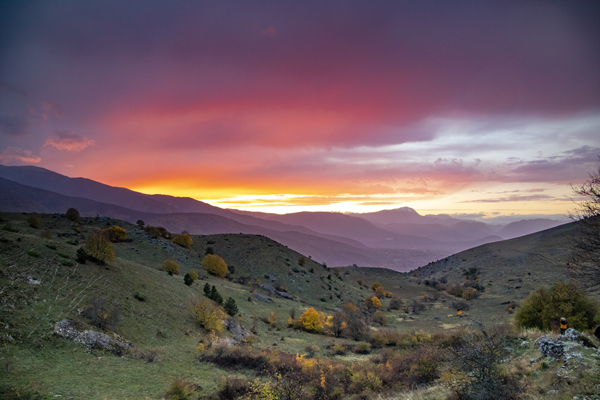
Sundowner hike during gathering in Pettorano Sul Gizio Credit: Nelleke de Weerd / Rewilding Europe.
Activity: Ecological, social and economic benefits
Allow 10 minutes
Match the types of benefits with their corresponding examples.
Decide whether it is an ecological, social or economic benefit and drag each example into the correct box.
The examples are as follows. Biodiversity enhancement: rewilding supports the recovery of wildlife populations and the restoration of natural habitats, thereby boosting biodiversity. Recreational opportunities: rewilded landscapes offer spaces for outdoor activities such as hiking, birdwatching, and nature photography, contributing to physical and mental well-being. Nature-based economies: rewilding can generate new business opportunities and income for local communities, for example through nature-based tourism, the sale of natural products, and carbon finance. Sustainable agriculture: integrating rewilding with farming practices can enhance agricultural sustainability, safeguarding the long-term supply of agricultural products. Cultural value: restoring natural landscapes can preserve cultural heritage and traditional land management practices. Community engagement: involving local communities in rewilding initiatives fosters a sense of ownership and stewardship, enhancing social cohesion. Ecosystem services: enhancing the health and functionality of ecosystems through rewilding can amplify the benefits they deliver to people, such as water purification, soil stabilisation, flood control, reduced risk of catastrophic wildfire, and carbon sequestration. Mitigating the scale and impact of climate change: healthy, well-connected ecosystems are more resilient to environmental changes and extreme weather events, and they enable wildlife species to adapt to our changing climate. Rewilding can help to address climate change directly by enhancing the capacity of ecosystems to capture atmospheric carbon. The correct answers are as follows. Ecological benefits. Biodiversity enhancement: rewilding supports the recovery of wildlife populations and the restoration of natural habitats, thereby boosting biodiversity. Ecosystem services: enhancing the health and functionality of ecosystems through rewilding can amplify the benefits they deliver to people, such as water purification, soil stabilisation, flood control, reduced risk of catastrophic wildfire, and carbon sequestration. Mitigating the scale and impact of climate change: healthy, well-connected ecosystems are more resilient to environmental changes and extreme weather events, and they enable wildlife species to adapt to our changing climate. Rewilding can help to address climate change directly by enhancing the capacity of ecosystems to capture atmospheric carbon.Social benefits. Recreational opportunities: rewilded landscapes offer spaces for outdoor activities such as hiking, birdwatching, and nature photography, contributing to physical and mental well-being. Cultural value: restoring natural landscapes can preserve cultural heritage and traditional land management practices. Community engagement: involving local communities in rewilding initiatives fosters a sense of ownership and stewardship, enhancing social cohesion.Economic benefits. Nature-based economies: rewilding can generate new business opportunities and income for local communities, for example through nature-based tourism, the sale of natural products, and carbon finance. Sustainable agriculture: integrating rewilding with farming practices can enhance agricultural sustainability, safeguarding the long-term supply of agricultural products. Job creation: rewilding initiatives can create jobs in conservation, land management, and nature-based tourism.