

Marine rewilding
4 Passive marine rewilding
4.1 Reducing human pressure: changing where people fish
Marine Protected Areas (MPAs)
MPAs are an essential tool for ocean conservation. Within them, habitats and wildlife species that make up healthy, functional marine ecosystems are safeguarded.
You have already learned that areas of land may be set aside for the protection of a particular species or habitat. The same is true in the ocean. Some MPAs are designated to protect specific species while others are designed to protect ‘blue carbon’ habitats such as seagrass beds.
Ultimately, the purpose of an MPA is to provide protection from damage caused by people, so that marine species can recover and natural processes like predator–prey interactions can resume. MPAs enable nature to lead the recovery of marine habitats and resources.

MPAs exist in all areas of the marine realm. They can be found in the open ocean far from shore. Some protect the coast while others extend across estuaries and deltas.
Click on each icon below to learn more about MPAs.
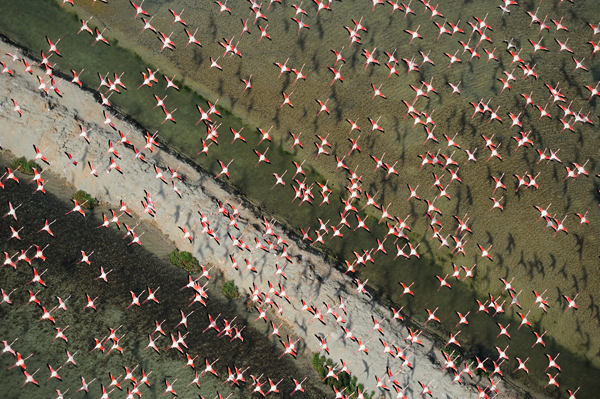
Flamingos over saltmarshes in Bahía de Cádiz Natural Park, Cádiz, Andalusia, Spain. Credit: Diego López / Wild Wonders of Europe.
OECMs
Alongside MPAs, there is growing interest in ‘other effective area-based conservation measures’ (OECMs). These are defined as managed areas that deliver effective conservation of biodiversity within a given site regardless of whether that is the goal. In the marine context, examples could include measures to conserve fish stocks or protect a shipwreck or marine war grave (WWF, n.d.).
Offshore infrastructure like wind farms also offer opportunities to give space to nature. While they may cause harm to some species the exclusion zones found around such infrastructure sites can prevent destructive human practices. They can also act as artificial reefs and provide valuable habitat for oysters. As with OECMs, these zones can help marine nature to recover: enhancing wild nature within the zone, and also benefitting the surrounding area, as plants, crustaceans, corals, fish and marine mammals spill out beyond the zone boundary.
On the other hand, the development of offshore wind farms can have potentially negative impacts on seabirds, as is the case with terrestrial wind farms. Seabirds risk death by colliding with turbine rotor blades and risk being blocked or displaced from important foraging habitats or migration routes. The impacts of wind farms on birds can be mitigated by siting them carefully, employing a range of technologies and painting the turbines (Plymouth Marine Laboratory, 2024).

