Conducting a Risk Assessment
2. ICE RESURFACER & EDGER MAINTENANCE
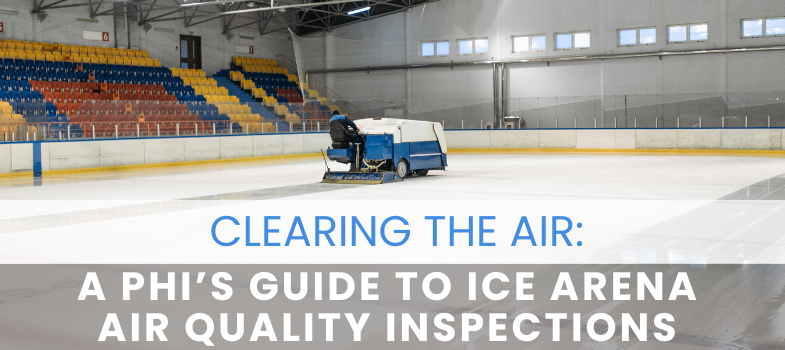
Ice pads are cleaned and smoothed by ice resurfacing and edging equipment. Ice resurfacers maintain the entire ice surface, while ice edgers shave near the boards where the ice resurfacer cannot reach.
Ice resurfacing is typically conducted frequently, as often as every hour, while edgers are used less frequently but can still significantly contribute to emissions. Increasing ventilation during and after edger use, as well as on ice maintenance days, is recommended.
Ice arena operators must follow regular maintenance schedules as per the manufacturer's instructions for ice resurfacers and edgers.
Service of ice surfacers should include exhaust gas analysis and engine adjustments to reduce air pollutant emissions. The richness of the fuel or air-fuel ratio can be adjusted to decrease pollutant emissions. Routine maintenance of ice resurfacers includes tune-ups and replacement parts when needed (i.e. spark plugs, plug wires, timing belts, and fuel system components).
The goal is to maintain carbon monoxide and hydrocarbon levels at the lowest possible levels. Ice arena operators should produce a record of the last ice resurfacer emissions test at the time of inspection.
Where emissions are elevated or a problem is identified, the PHI should direct the operator to have the equipment assessed and repaired by a qualified technician and to obtain a new emissions test following the repairs.
In addition to routine maintenance, ice resurfacers should be warmed up outdoors or in a room equipped with a carbon monoxide alarm and sufficient ventilation for at least five minutes prior to use, allowing the catalytic converter to reach the appropriate operating temperature.
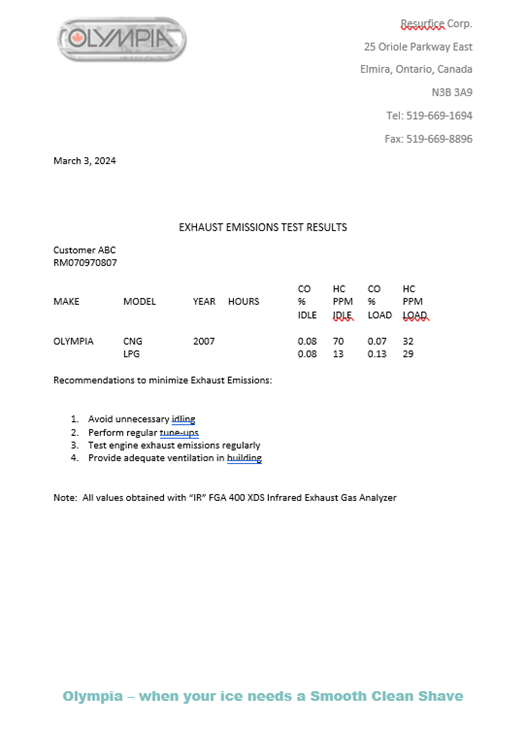
SAMPLE EMISSIONS TEST
Definitions:
LPG = Liquified Petroleum Gas (propane)
CNG = Compressed Natural Gas
IDLE = Lower Engine RPM, Idling Speed
LOAD = Higher Engine RPM, Operating Speed
Pass/Fail
It is not a simple pass or fail threshold; the goal is to achieve the lowest exhaust emissions possible.
The following factors must also be considered:
· volume of space in the building,
· extent of the air make-up system in the building,
· typical daily usage of the ice resurfacer, and building standards for air quality.
However, technicians try to achieve less than 0.10 – 0.20% CO and less than 100 HC (under LOAD).
Note: To convert CO% to PPM, multiple by 10,000, (i.e., 0.10% = 1,000 PPM).
Troubleshooting High CO or HC:
· High CO – Rich fuel mixture, defective oxygen sensor, defective fuel control valve, defective computer, defective catalytic converter.
· High HC – Ignition problems, fuel mixture, mechanical problems like oil consumption or camshaft, vacuum leaks.