
Assessment
1. The final assessment
Purpose
Validate your learning and bring together everything you have built into a complete CPD portfolio.
Overview
The Final Assessment is a portfolio assessment. Most of the content already exists from your module activities. In this module you refine, connect and present it as a coherent whole. Allow 3-4 hours.
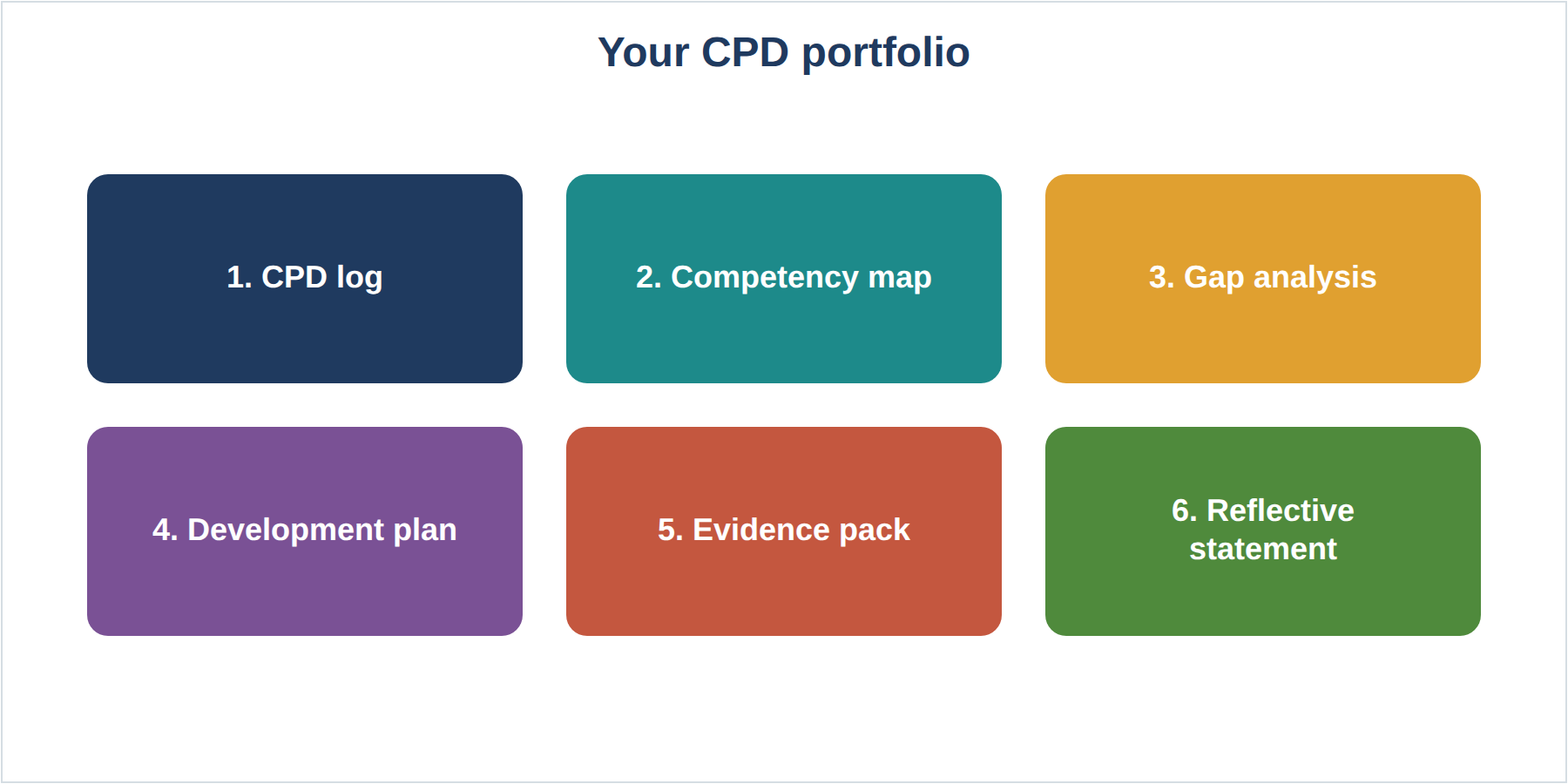
Assessment components
| # | Component | Requirements | Built in |
|---|---|---|---|
| 1 | CPD log | Minimum 5 entries covering at least two CPD types. Each entry includes outcome, application, competency link and evidence reference | Module 4 |
| 2 | Competency map | 6-10 competencies with maturity ratings (1-5), justification and an evidence example for each | Module 5 |
| 3 | Gap analysis | Current versus target levels, calculated gaps, priorities and at least 3 development opportunities | Module 7 |
| 4 | Development plan | 6-month plan with 2-3 goals, milestones and at least 3 tasks linked development, competency, CPD and evidence | Module 8 |
| 5 | Evidence pack | Evidence for at least one competency with a claim and explanation, plus your appraisal evidence pack | Modules 6 and 9 |
| 6 | Reflective statement | 500-700 words, described below | New |
Reflective statement guidance
Write a first-person reflection of 500-700 words answering:
- How has your understanding of CPD changed during this course?
- What did the gap analysis reveal that surprised you?
- Which competency are you most committed to developing, and why?
- How will you use your CPD portfolio in your next appraisal or career step?
- What will you do differently from now on?
Include at least two specific references to your portfolio.
Assessment criteria
Each criterion is judged as Developing, Secure or Excellent. To pass, aim for at least Secure in every criterion.
| Criterion | Developing | Secure | Excellent |
|---|---|---|---|
| Completeness | Some components missing or thin | All components present and meeting minimums | All components complete, polished and well organised |
| Quality of entries | Mostly describes activities | Records learning and outcomes | Clear outcomes, applied learning and honest reflection throughout |
| Competency mapping | Links vague or unsupported | Links clear and justified | Ratings realistic, justified and consistently supported by evidence |
| Evidence | Limited or weakly related | Relevant and specific | Strong, varied, authentic evidence with clear explanation |
| Planning | Goals general | Goals specific with dates and links | Realistic, prioritised plan that clearly flows from the gap analysis |
| Reflection | Descriptive | Shows insight and learning | Insightful, self-aware and forward-looking with concrete next steps |
Submission checklist
- All six components are included
- Everything is dated and files have clear names
- Confidential or personal data are removed or anonymised
- Competency links and evidence references are consistent across documents
- You have proofread the reflective statement
- Your portfolio is saved in a single folder or compiled document
Knowledge check (optional)
- Name the five stages of the CPD cycle.
- Give one difference between CPD and competency development.
- What makes a CPD log entry "strong"?
- List three qualities of good evidence.
- How is a gap calculated, and how should gaps be prioritised?
- What links does the development chain require for each plan item?
- What does SARL stand for?
Suggested answers: (1) Reflect, plan, act, record and evidence, evaluate. (2) CPD is the activity; competency development is the capability built. (3) It records outcome, application, competency link and evidence, not just attendance. (4) Any three of relevant, authentic, current, specific, sufficient. (5) Target minus current; prioritise by importance and urgency. (6) Development need, competency, CPD activity, evidence. (7) Situation, Action, Result, Learning.