
Module 4
1. Building your CPD log
Purpose
Teach you how to create and maintain a CPD log that is quick to keep, useful to read and ready for appraisals and professional body reviews.
Learning objectives
By the end of this module you will be able to:
- Decide what counts as CPD
- Distinguish formal, informal and experiential CPD
- Write a clear, outcome-focused CPD entry
- Link entries to competencies
- Use your log as appraisal evidence
4.1 What counts as CPD?
Ask three questions:
- Was it intentional? Did I do it to learn or improve, rather than by accident?
- Did it change something? Do I know, can I do, or do I behave differently as a result?
- Is it relevant? Does it connect to my role, career goals or profession?
If the answer to all three is yes, it is very likely CPD. Always check your professional body's rules, since some set specific categories or limits.
4.2 Types of CPD
| Type | Description | Examples |
|---|---|---|
| Formal | structured, often assessed or accredited | courses, certifications, degrees, conferences. |
| Informal | self-directed and unstructured | reading, podcasts, webinars, communities of practice, mentoring conversations. |
| Experiential | learning by doing and reflecting | stretch assignments, leading a project, shadowing, lessons-learned reviews, teaching or presenting. |
A healthy mix draws on all three. Experiential learning is often the most powerful and the most under-recorded.
4.3 Recording CPD entries
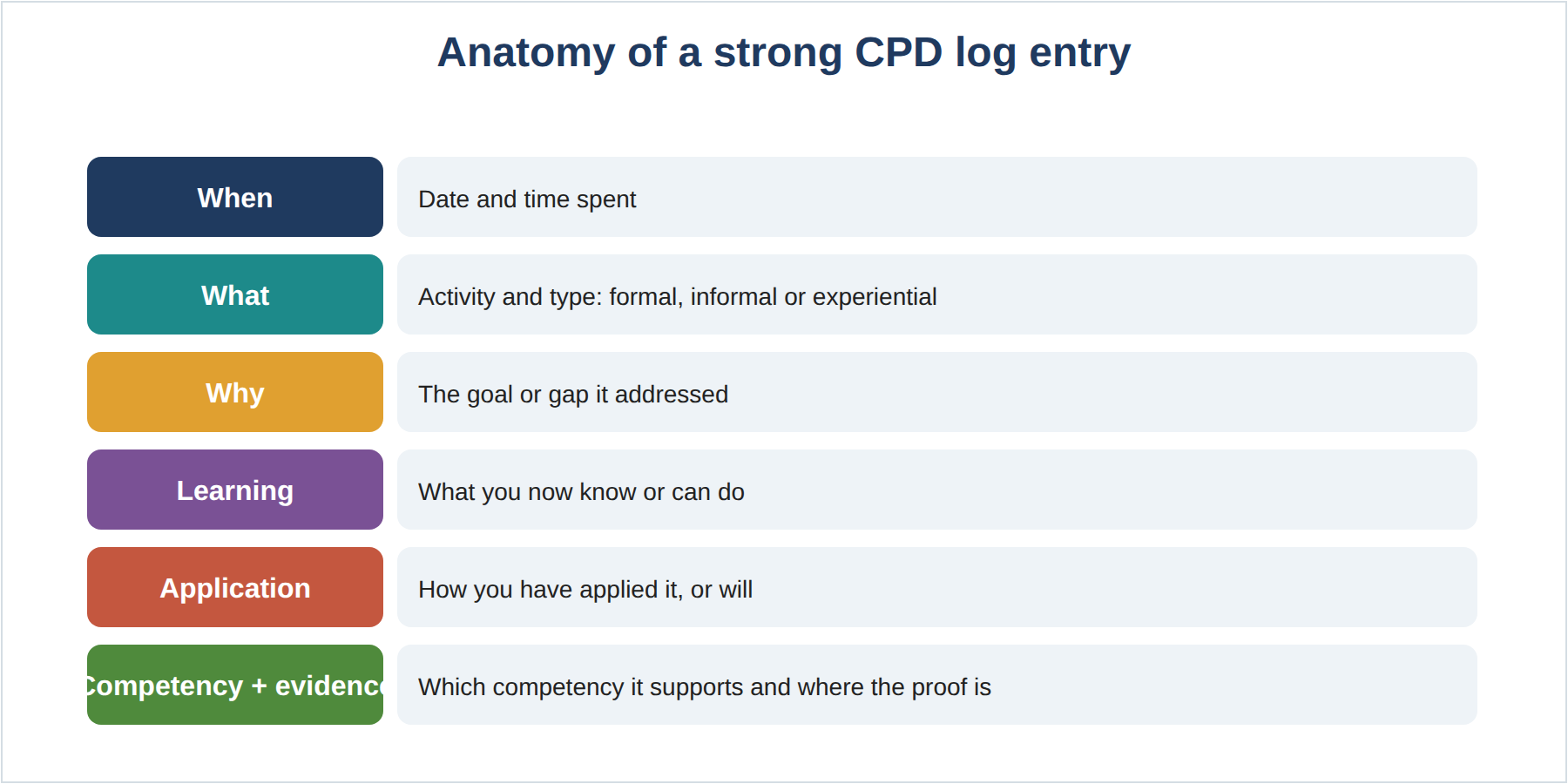
Suggested CPD log template
| Date | Activity | Type | Hours | Learning / outcome | Application | Competency | Evidence link |
|---|---|---|---|---|---|---|---|
Weak entry: "Attended risk webinar, 1 hour."
Strong entry: "Attended webinar on quantitative risk analysis (1 hr, informal). Learned how to use three-point estimates to express schedule uncertainty. Applied it to our Q3 plan and presented a P80 date to the sponsor. Supports Risk Management (working to practitioner). Evidence: updated plan and sponsor email."
The second version takes an extra minute and is many times more useful.
4.4 Linking CPD to competencies
Every entry should point to at least one competency. This turns a list of activities into a map of capability growth. For now, use your job description or professional body framework and name the closest match. Module 5 covers frameworks in detail.
4.5 Using CPD logs for appraisals
A well-kept log gives you a chronological story of your year, concrete examples for your self-assessment, proof of initiative and consistency, and a natural starting point for discussing next steps. Log within a week of each activity while the detail is fresh. Ten minutes a week beats a day of reconstruction at year end.
Key takeaways
- CPD must be intentional, change something and be relevant
- Mix formal, informal and experiential activity
- Strong entries record outcomes and application, not just attendance
- Link every entry to a competency and to evidence