Module 2
1. Who CPD is for?
Purpose
Show the broad audience CPD supports and help you locate yourself within it.
Learning objectives
By the end of this module you will be able to:
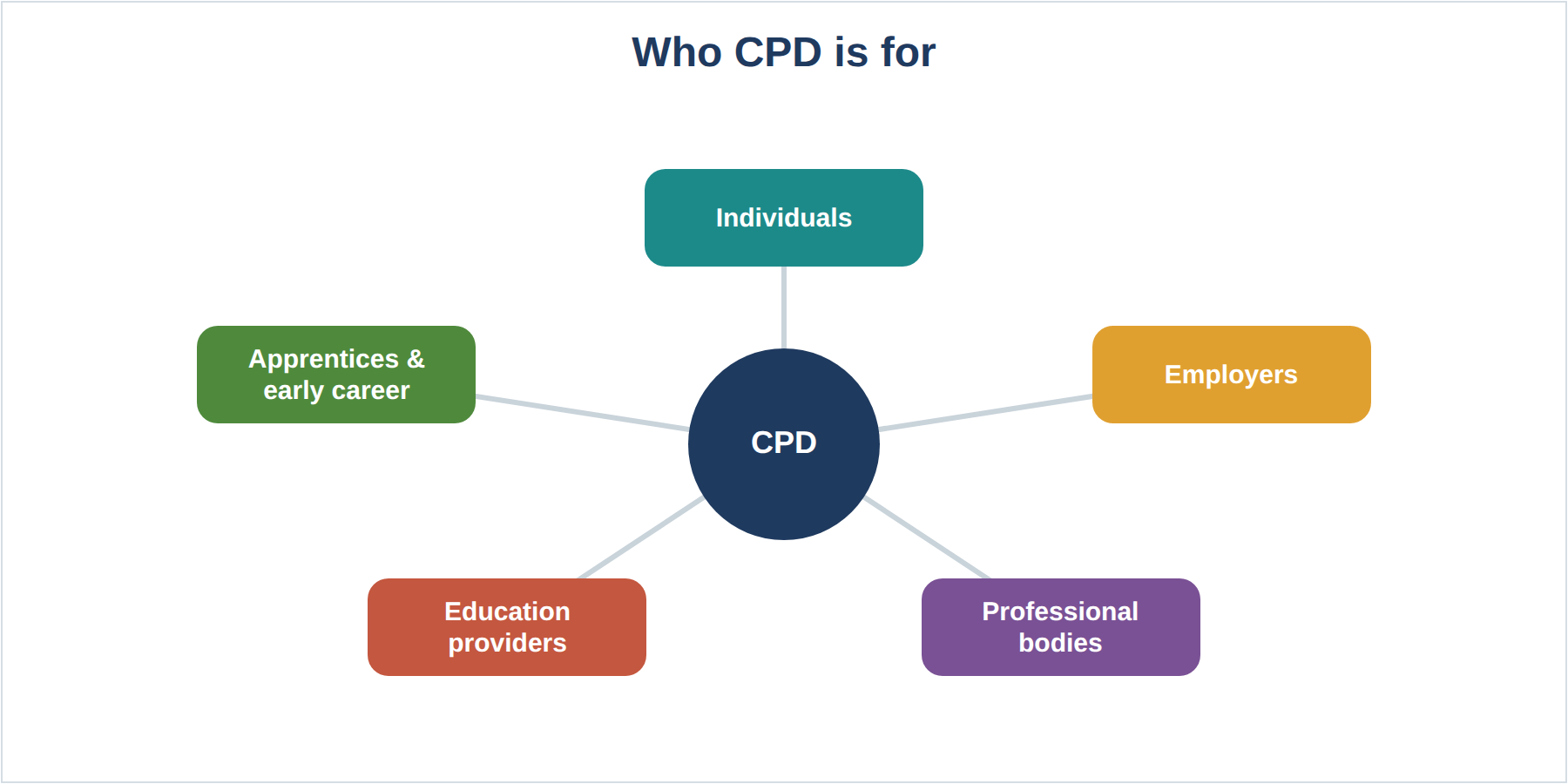
- Describe how CPD benefits individuals, employers, professional bodies and education providers
- Explain the role of CPD for apprentices and early-career learners
- Identify where you are in your own professional journey
2.1 Individuals
CPD is first of all personal. It is how you take ownership of your career. Individuals use CPD to:
- Build skills for their next role, not just their current one
- Stay employable as the market changes
- Show evidence of growth to employers, clients and professional bodies
- Feel more in control of their direction
An early-career professional may focus on foundations and exposure; a mid-career professional on leadership, specialism or breadth; a senior professional on strategy, mentoring and influence.
2.2 Employers
A workforce that practises structured CPD tends to be more adaptable, better engaged and easier to plan for. Employers can support CPD by:
- Making development a normal part of appraisals and one-to-ones
- Providing time, budget and stretch opportunities
- Using competency frameworks to describe what good looks like at each level
- Recognising CPD evidence when considering promotion and pay
For line managers, CPD records give a factual basis for development conversations.
2.3 Professional bodies
Professional bodies use CPD to protect standards and public trust. They typically:
- Set CPD expectations for members, and for chartered or certified status
- Publish competency or skills frameworks
- Offer learning resources, events and communities of practice
- Sample or audit CPD records
If you belong to a professional body, your CPD record is partly a compliance document. Doing it well also makes it a career tool.
2.4 Education providers
Universities, colleges and training providers use CPD in two ways: as a product they offer (short courses, micro-credentials, professional programmes) and as a habit they want to instil in students. Embedding CPD in education helps learners move smoothly from study into work.
2.5 Apprenticeships and early-career learners
Apprentices and graduates are learning on the job and need to show progress quickly. CPD gives them:
- A way to capture on-the-job learning that might otherwise go unrecorded
- Evidence for apprenticeship portfolios, reviews and end-point assessment
- A head start in building the logging habit
- Language to describe their development to managers and mentors
A first presentation, a shadowing day or a new system learned are all legitimate CPD when reflected on and recorded.
Case study: CPD for career changers
Priya spent eight years in retail management and wants to move into project coordination. She has strong people and operational skills but no formal project experience. Over six months she:
- Completes an introductory project management course (formal)
- Volunteers to coordinate a store refit, applying scheduling and risk basics (experiential)
- Asks a project manager at a partner company to mentor her monthly (informal)
- Logs each activity, noting which competencies it supports
- Collects evidence: the refit plan, feedback from the store director and a course certificate
When she applies for a coordinator role, her log and evidence pack let her demonstrate transferable capability, not just claim it.
Discussion questions:
- Which of Priya's activities would a tick-box approach have missed?
- How did linking activities to competencies strengthen her case?
- What would you advise Priya to do next?
Key takeaways
- CPD serves individuals, employers, professional bodies and education providers, each with different aims
- Employers and managers can use CPD records to make development conversations evidence-based
- Apprentices and early-career learners benefit hugely from starting good habits early
- Career changers can use CPD to translate existing experience into new-role language