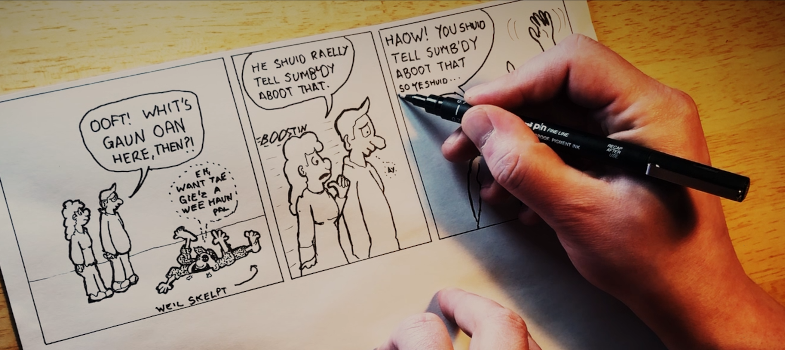
Unit 4 Application Task
Wan i thi furst things ah learnt when a began teechin in FE is the need tae be flexible and adapt quickly to, if no shiftin sands, shiftin timetables an classes.
I hud originally planned to exlpore Scots wurds in a mental health context wi a group ae ‘care’ students.’
Thi group ur aw adult returners wi ages rangin fae early twenties tae late forties. Like ma ither group they ur also Scottish Wider Access Programme (SWAP) candidates oan the ‘Access to Nursing’ course. Indeed, sum ae them ur already sittin oan offers fae local universities (HEI) tae advance thur studies next session.
Maist will pursue General Adult Nursing but some will progress intae Mental Health Nursing. In addition, ithers huv elected tae remian in FE an pursue an HNC either in Healthcare or Social Services and may progress tae HEI thi followin session.
Ah deliver a stand alane unit in Mental Health issues. This unit intoduces not only a cleerur unerstaunin ae diverse mental conditions an treatments but also the stigma and changes in attirudes baith in delivery a services and the reposnses ae wider society towards mental health an wellbeing.
Oor academic year is in twa semesters. A hid anticipatit deliverin the unit as wi began Semester twa. A hidne taught this group previously tae this. However, at the last minute ah hid tae accomodate three significant amendments tae ma timetable and discovered that ah hid to share the delivery ae this unit wi a colleague. Afore a went intae panic as this wid effectively hiv halved the inishul teaching time ah hid wi them ma colleague an a met and devised a plan. A would take the group fur the furst few weeks and prepare them fur the class exam whilst he would pick up thi class as we approachit Easter and prepare them fur an investigative report.
This meaqnt a cud focus on changing attitudes and stigma whilst he cud facilitate thur learnin ae different conditions.
Ma task wis, wit a thocht, a simpul adaptation ae a current activity. Usually, when deliverin this unit, a invite thi candidates to consider thi type ae language society uses within mental health contexts. This includit consideration ae derogatory wurds. Oan a side note, ah dae huv tae express that oor candidates, that is wans counsiderin pursuin the caring dirsciplins, ur reticent about expressin mony ae these wurds. Ah aye tak that as a sign ae hope furra futir.
Thi ammendit activity wud see this shiftin slightly away fae a focus on thi language wi yuise as labellin tae a consideration ae Scots insteed.
Ah confess that ah wis overly optimistic. Logistically I found it haird tae get thru ma teachin material quick inuff tae instil a sufficient level ae trust in thi students wi me tae express thur deliberations. Ah hid established a rapport wi them quickly inuff but thi trust needs tae be deeper tae enable them to yuise thi type ae language we need to considur. So, a felt a hid tae push back thi date a intended fur this task.
In the meantime, a met wi a colleague who hid been deployit in the State Hospital (Carstairs) furra large pairt ae his career in mental health services. Ah hid expectit him tae hiv hid a wide experience ae Scots wurds yuise in the hospital towards the patients/inmates., Hooever, we struggled tae hink ae mony. He said that they would rotuinely enquire ae the inmates/patients “Hoo’s thi heid thi day?” And, atween us, wi could come up wi contenders such as ‘bampot,’ ‘eejit’ an ‘spangle.’ None ae these, a course, tended tae express wit a wis hopin tae achieve.
In addition, ma internet searches thru various Scots langwage repositories tendit tae draw blanks. In ma naivity a hauf expectit tae perform a fairly simplu search an be offerit a barrage ae wurds. A even anticipatit mony tae be derogatory. A drew almaist a complete blank. A found sum archaic wurds an a cupl ae different dialects.
Followin oan fae unit three a wis keen tae further develop ma experimentation ae Interdisciplinary Learnin (IDL). A felt the blendin ae Scots and sociology thru cultural and social capital hid been successful albeint needin further refinement.
A wis buoyed wurkin through Unit 4 especially the IDL aspect ae Modern studies and the exploration ae the wurld ae work. Thi excellent exampuls focussed oan traditional agricultural an heavy industries so wis confident that a wud hiv a similar outcome investigatin the professional wurk within mental health servies.
Ah intend tae complete thi task oan Monday 9th February. A’ll add tae ma poast wance a hiv sum feedback fae the students tae share wi ye.
Unit 4 - Nicky
I opted to explore weather as this was something which the pupils learned about in their S1 Social Subjects course (and I'm very appreciative to the Social Subjects department for being so free with their resources - they told me where to find things and then let me play about with anything I fancied!).
We looked at the BBC weather symbols and worked out what each symbol meant in English. I then gave the pupils a word bank of a range of different weather and asked them to find suitable Scots versions for the symbols. If there were different Scots words ('overcast' has a multitude, unsurprisingly), we had a brief discussion about being able to use different words to mean the same thing. I then gave the pupils a printout of Moray (they initially identified it as Italy - but that particular issue seems beyond the scope of Scots language teaching to solve) and they had to draw on their weather symbols and label it with an appropriate Scots word (they could reuse ones or the word bank also included different ones). Their forecasts could be completely unrealistic so long as there were Scots words. The more confident ones were then invited to 'present' their forecast to the class.
-
What do you think worked particularly well in your classroom application?
Having had a successful lesson and a not so successful lesson, I got the balance right this time. There was enough Scots to challenge them but it and the activities were sufficiently scaffolded so the pupils didn't lose confidence. I also noted that every pupil participated in some way - the quiet and more shy stuck to their map (but were using the word bank and transferring the Scots) while the more confident ones were motivated to 'present' so wanted their map to be good enough to be shown under the visualiser. -
Is there anything you would do differently if you were to repeat this lesson?
The presentations were mostly in English. Occasionally, the pupils would pronounce the Scots words they had chosen, but for the most part, they relied on pointing to the Scots then using English to describe it.
Going forward, I would maybe have each group create a 'bingo' card of Scots words, so that while they presented, their audience ticked off which Scots words were used. The group would be 'the winners' if they remembered to say enough Scots words for the audience to get a line or house. This would also be a fun way of promoting pronunciation (instead of mumbling) so the audience actually have to hear the presenters saying the Scots. -
What are the next steps for your learners? / How will you provide further opportunities to practise and reinforce the use and awareness of Scots language?
One other unit the pupils complete in Social Subjects is 'Pirates' (related to History). But I wonder if there's an opportunity to make links with our land-based version of 'pirates' in terms of whisky smugglers and the like. Given that my subject is English, I think there would be a great opportunity to explore the different stories as well as look at details such as setting (which is also where we could return to Geography in terms of place names or Scots words for our surroundings).
As discussed in the Unit 4 tutorial, this is development work for next year, but given Moray is the home of whisky, there would surely be lots of opportunities. (And as I type this, I know Chemistry have DYW links with local distilleries so that's also an additional IDL angle).
Weather words - Waddir wirds
S2 pupils – Social Subjects
The aim was to extend use of local descriptive weather words. I found a Shetland fishing and weather words booklet a few years ago in school and kept it to use.
Firstly I asked the pupils to brainstorm any Shetland words they knew relating to the sea or weather and write them on a piece of paper. I encouraged them to think about hearing parents/grandparents speak. We discussed what they had gathered so far, which was quite limited so I knew I would have to adapt the lesson as I went on.
I distributed pages form the booklet and asked them to read over and include words to their sheet they had heard before/would use but forgot to write down. Thankfully a lot more words were added.
Pupils then had to colour code words, green for weather and blue for sea. We had a brief discussion about quantity and possible reasons for this.
Any discussion aspect was like getting blood from a stone, usually they are very good at contributing but there was a strange dynamic, maybe because we should have been doing ‘Home Economics’. Whatever it was, I wasn’t getting much from them.
I wanted the pupils to think about the importance of knowing and understand the weather before technology, phones, tv etc in this community. They did mention that local jobs were mainly fishing and crofting and the impact weather would have on those jobs They agreed that’s why there were so many words specific to describing the wind and sea.
In groups I asked them to compare to the impact of weather now in this community and living away from the sea – a city for example and make notes. They spoke about travel disruptions, local ferries not running, impacting people getting to and from work, goods not getting to Shetland and the exports not leaving Shetland thus affecting price due to ‘age’ of fish, mussels etc. Compared to flooding, trees falling over causing accidents etc, they thought the weather wouldn’t impact them as much.
In my head this lesson was more interesting than reality… I imagine a Social Subject teacher would be shaking their head at my attempts at a geography lesson!
Asking them to write a weather report was a non starter. Instead I asked them to collaborate on a powerpoint to make slides for word of the week display. This gave them the opportunity to choose interesting words and look for images to match the description. And maybe that activity and having a visual display in the school will embed these words into their everyday use and have a greater impact.
Hi Pauline
This lesson took a few twists along the way didn’t it! Dis group o S2s soond lik dey keep dee on yir tippie-taes!
The booklet definitely came in handy. Always good to have a prompt ready. I really like the idea to start colour coding the words – especially because it requires them to consider the words and having discussion about what they mean / how they can and should be used…what a shame they turned on you! But that happens. It sounds like the shift to discussing the importance of why a knowledge of the words/concepts is important went better. They certainly show an understanding of the disruptive elements of bad weather! Even with their island vs city bias…
(Jamie is a Geography teacher so we can hear from him what the verdict is on your lesson 😉)
It sounds like an interesting lesson to me. Maybe the detail of how it should have been a Home Ec period played more of a part than anticipated. I’d definitely recommend trying the lesson again with a different age group – maybe upper primary? The end activity of creating the powerpoint would work there too.
As we move into the Units that focus more on creativity and stories then we are maybe about to shift into lessons that will go more as planned and have more engagement. (And there’s copies of the new book from Jane coming to the school soon that can be planned in, if you like 😊) The factual side of using language in the classroom doesn’t work for everyone/every class and we might be moving into a more imaginative side of lessons just at the right time for you. I definitely really like what you planned here and hope you get a chance to try it again with another class.
Speak soon
Bruce
reply to Nicky
I like the idea of a Bingo card and a bit jealous at the whisky distillery links!
I did wonder about doing place names as a lesson too, I think that would have been more interesting to them. Kinda pirate related... In Shetland, there are a lot of hidy holes along the shore, they were used for men to hide in from the pressgangs during the Napoleonic wars! I wonder if there are holes around the Scottish mainland coast too? Would make an interesting writing lesson.
Hiya Nicky
These S1s sound like a great bunch! It’s always worth celebrating a lesson when you can say, as you do here, that everyone contributed something! (This detail of them not recognising where they are on a map is a strange one though!) It sounds like you got really creative with the material, and provided the correct supporting resources for the pupils to get their teeth into these activities. I love the detail of the discussion around “being able to use different words to mean the same thing” because that will come up a lot in any Scots lesson, particularly when the word can look and sound so similar to the English one. Going through those points as a class discussion does usually help a lot. You made great choices along the way in this lesson, allowing them to be as unrealistic (creative!) as they want or needed then having the most confident present to the class. Out of interest, was it the pupils who are always the most confident who presented, or were there any surprises who were confident enough to share? The bingo card idea is definitely one to follow-up on, that sounds brilliant, particularly if they are demonstrating they can listen and understand, even if their talking skills aren’t as advanced. It certainly resembles what happens in other Modern Language classrooms where the pupils can be farther on in terms of understanding when listening than they are at delivering instructions or asking questions etc. That’s a very important detail and something to keep in mind for the future. The fun aspect of the Bingo plan should add a great detail in terms of keeping everyone involved also!
Great work on this unit and with the material. Love the sound of where you plan to go next and can’t wait to chat about it more 😊
Bruce
Hiya Bobby
I’m really enjoying your posts. The perspective you bring with your FE students who are a range of ages, returning to education, is incredibly interesting. And I’m really impressed with the work you are creating for them. No matter where all of us on this course are from in Scotland (or where we currently live in Scotland) then I’m sure we all appreciate the benefits that someone pursuing Adult Nursing or Mental Health Nursing would get for their practice if they had some knowledge of Scots, and of the social stigma that will so often be attached to speakers of the language. So it’s brilliant to see you creating this material for them to engage with and discuss. You certainly didn’t panic - despite the goalposts keeping moving in front of you! I think the detail of needing to establish a rapport shouldn’t be underestimated in terms of the time and effort it takes, particularly when you then need the important trust depth that you identify also. Reading about the journey you went on with the resource material, I wonder how much consideration could have been given simply to accent as opposed to vocabulary? The simple fact of sounding Scottish, or working class, or whatever the unique circumstances are…and if that plays a much bigger part than anticipated (more so than specific examples of language) and if that’s worth exploring next time? Either way, I think you definitely should keep exploring IDL and blending Scots and Sociology with the students, that’s a rich source of attitudes, learning and reflection for them I recon.
Really looking forward to hearing more,
Bruce
More weather (ridiculously late as I wanted the chance to teach it first this time!)
I planned a lesson for an S1 English class, with a Scots focus, which could potentially work in a cross-curricular fashion with Geography.
The class were introduced to the idea of there being a vast array of different weather words in Scots (hundreds for snow alone) and challenged to come up with as many as they could - they got quite competitive!
They then watched the BBC Blethering Scots, 'Scots Words for Weather' clip with Michelle McManus, and chose some of their own favourites (there were more cold than warm ones unsurprisingly).
This was followed up by reading and listening to the poem 'Here's the weather' by Stuart A. Paterson, and working together to identify all the Scots weather terms used. I had to remind them to focus on the words for weather only, as some just started picking out any Scots they could find. This proved trickier, and we had some interesting debates around what counted, as some phrases were merely describing reactions to the weather, or giving advice on what to wear, rather than being directly related to the type of weather itself. LIT 2-07a.
Next, I provided a range of weather icons (from a Twinkl resource) and got the pupils to match-up the correct Scots words with the pictures and English equivalents. They coped well with this overall, and it seemed to work to embed some of the key terminology. Perhaps swapping the order of the tasks and doing this before the poem in future would be better though.
It ultimately led to them working in groups, to write and present a short weather report in Scots. We looked at an example first (in standard English) to build confidence, and discussed what to include/how to structure it etc. When ready, I projected a map of Scotland onto the board, and got them to interact it with it using the printed icons, while talking through the forecast and using as much Scots as possible. LIT 2-10a/3-10a. LIT 2-06a/3-06a.
I was really impressed with how engaged they were with this activity - some groups got really into it and were super keen to present, which isn't always the case... One team in particular assigned a different region to each person, and the individuals took responsibility for telling us what the weather would be like in that area, even trying to incorporate specific dialect words to suit. They also recommended appropriate activities and things people would need - using RGU's Doric Dictionary to support them - it was great! I wish I had recorded some of them and would hope to do so if I had the opportunity again.
I enjoyed reading Jennifer's post and the part aboot the weans talking about oor reactions tae the wethur, espcially whit tae waur, and juist pickin oot Scots wurds resonatit wi me. How mony times huv we laboured ower an activity only tae find oor students gaun doon another tangent. That said, it also shows the powerfull engagement fae the weans.
Ah also liked thi idea ae the weans takin different areas an drawin upoan dialects.
Cheers
Having dictionaries to hand is such a good idea. We use both the hard copies of The Shetland dictionary and find the online dictionary from Shetland ForWirds, which is proving useful outwith the classroom too.
Hiya Jennifer
This is wonderful work! Weather is of course a popular one – for so many classes and from many different angles. Great use of Blethering Scots, bringing in Michelle McManus and the Stuart Paterson poem, then bringing out the variety of vocabulary available in Scots for the topic.
My attention is drawn to this comment, “I had to remind them to focus on the words for weather only, as some just started picking out any Scots they could find. This proved trickier, and we had some interesting debates around what counted, as some phrases were merely describing reactions to the weather, or giving advice on what to wear, rather than being directly related to the type of weather itself.” We definitely find this time and again in Scots lessons. Whether it is distinguishing between vocabulary and accent, or the value of modern idioms vs historical words etc it does often come down to putting each learner, and their conception of Scots, on a scale. It is perfectly fine if the input for a lesson, or the response from the class is looking more like Literacy with a Scottish context, than exploring unique Scots language vocabulary. When that is the result it is rarely the fault of the planning (as we see in your post, there was good input material used) and we often find that it can show how little knowledge of either Scots language or Scottish identity there is amongst that particular group of children and young people. Which is never wrong or bad, it just illustrates their perception of Scottish identity, and what their individual linguistic journey thus far has been in life.
As you discuss in your post, when asked to separate Scots from its surroundings, they knew what they were doing, so it could simply be that an alternative route was the best one.
I think it’s brilliant that the lesson ended the way it did: “I was really impressed with how engaged they were with this activity - some groups got really into it and were super keen to present, which isn't always the case...” It is clear how engaged they were – which we know isn’t always the case for an S1 English class!
I’ve never thought of trying this before: “One team in particular assigned a different region to each person, and the individuals took responsibility for telling us what the weather would be like in that area, even trying to incorporate specific dialect words to suit.” It’s an excellent idea!!
I really hope you get to try this lesson again with a class this coming year – and if you do, definitely record it because it would be amazing to see 😊
Bruce
Thanks again Bruce.
Your comments oan accent as a focus rather juist oan vocabulary ur certainly wurth pursuin an ah'll explore this.
Cheers
Unit 4 Theme: Connecting local heritage with Scots language development -The Life of John James Robertson
CfE Links:
Level: Upper Primary / Early Secondary – modern studies/history idl transition task for new S1 pupils
- SOC 2-03a / 3-03a (people, past and society)
- LIT 2-02a / 3-02a (reading for understanding)
- LIT 2-09a (exploring Scots language)
- HWB 2-10a (respect for identity and community)
– J.J.Robertson, 1898 – 1955 - son of the village of Aith, Shetland. Under Secretary of State for Scotland (1945-1951) - Author, Philosopher, - Socialist and Craftsman - Bodyguard to ‘Lawrence of Arabia’, Champion Middleweight Boxer - Campaigner for Social Housing and Fair working conditions for Seamen.
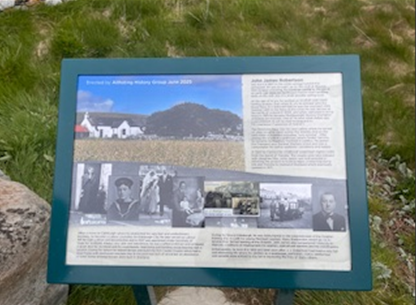
This learning experience, centred on the life of John James Robertson, provided a meaningful opportunity to connect local heritage with Scots language development. What stood out most was how relevant it felt for the learners. Local history is such a powerful resource—if something sparks my own interest, it nearly always captures theirs too. The story behind the memorial adds to this; it is relatively new and came about when a visiting speaker at a school prizegiving was looking for a meaningful “(left?) hook” to inspire the bairns, using a local story they could relate to.
Visiting the memorial in Aith and exploring the life of someone from their own community on the Westside of Shetland really helped to engage the pupils and build a sense of identity and pride in where they come from. There was a genuine curiosity about his life and achievements. Bringing Scots into the learning felt very natural within this context and supported learners to see that the language they hear and use in everyday life is valued and belongs in the classroom just as much as Standard English.
Reviewing Hannah Mary Goodlad speaking in Shaetlan in the Scottish Parliament as she was sworn in as an MSP helped bring politics right up to date, this certainly brought a smile to their faces and also, a sense of pride in hearing this too, with the following discussion a positive one.
Introduction + Scots Exploration
Starter:
- Ask if anyone has any prior knowledge of John James Robertson (note: he is not as well known here as perhaps he might be!)
- Share a short biography of J.J. Robertson (include Shaetlan vocabulary for the initial information of John as a bairn)
Pupils highlight unfamiliar words (note: this may not just be due to language differences but also to ensure contextual understanding)
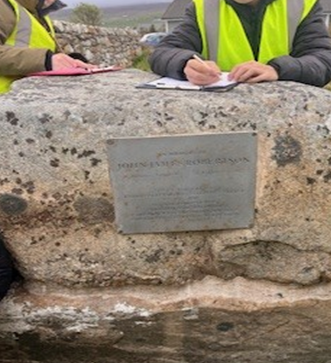
Local walk to see memorial
- Observation task:
- Whit does da memorial tell wis?
- Why doe we mind folk lik him?
- Quick note-taking or sketching
Deepening Understanding
Reading & Comprehension
- Key questions:
- Why wis Robertson’s childhood important tae his later life?
- Whit challenges did he face fae a young age?
- Why wis his wark as an MP important?
- Whit wye did he improve life for idders?
- Whit maks him a “local hero”?
Creative Task
- Pupils create a short Shaetlan/English biography poster or timeline
Politics & Rights (Cross-curricular)
- Link to:
- fair wages
- housing rights
- workers’ rights
Discussion:
- Should folk be allowed to use dir ain language in Parliament? See new MP’s sworn into Parliament recently, including Hannah Mary Goodlad who chose to spaek in Shaetlan Hannah Mary Goodlad sworn in at Holyrood with Shaetlan oath | Shetland News
- Is language part of identity and rights?
Gathering Learner Feedback
To consider:
- Something I enjoyed
- Something I found tricky
- Something I learned
- One thing I would change
- Traffic light - aifl
Hi Ingrid
I absolute love this lesson. It was actually a story I hadn’t heard – JJ Robertson wasn’t someone I’d heard of so if I’d been in the class would have learned a lot!I think the IDL approach, bringing LIT, SOC and HWB together worked excellently. It’s definitely a great way to put a meaningful local story and piece of history in context and national perspective. Which is exactly what the curriculum is looking for in Social Subject outcomes.
I totally agree when you say, “Visiting the memorial in Aith and exploring the life of someone from their own community on the Westside of Shetland really helped to engage the pupils and build a sense of identity and pride in where they come from.”
It’s great to hear that bringing Scots into the learning was natural and that it segued seamlessly to discussion of language in the modern day classroom experience – capped nicely with the Hannah Mary Goodlad video and use of Shaetlan in the Scottish Parliament. An important question moving forward after all this hard work you’ve done will be ensuring these values carry on through the school as the pupils move into other classrooms, work with different teachers and (most importantly) find the approach to learning that has the most educational benefit to them.
We always want to inspire learners, whatever the context, and I definitely have to praise work such as this, that takes a local figure from history and asks the question “Whit maks him a local hero?” not only teaches them about where they and their community has been, but also helps to inspire in them that they can be local heroes by contributing to their community and the wider world.
Fantastic work, as always.
Bruce