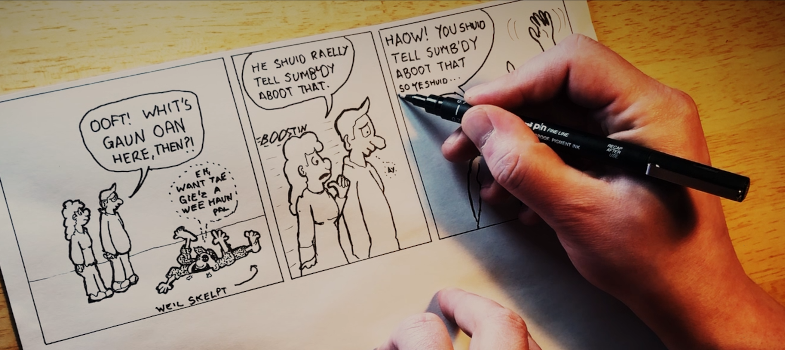
Unit 7 Task Application
I'm a little ahead of the course calendar only because it's coming up to end of term and I want to be sure I get my final lesson taught before the inevitable disruption!
Our timetable has now changed so I no longer have the same class I was teaching previously. This means my Unit 7 lesson will be to a class who have had no prior input around Scots. However, they are an older cohort (S3 instead of S1) and I would say a higher percentage have difficulties or lack confidence around literacy. Therefore, an opportunity to discuss the key concept that "Scots does not have a standard or one correct answer for how it should be written" might open up interesting discussions from this class.
My plan is to frame a discussion around Michael Dempster's question "Hou dae A best write sae thit fowk ken hou tae read oot whit it is that A’m writin?". We'll then look at a handful of examples of different words from Borders, Doric and Shetland. In most examples, two of the words are the same, so does that mean the third is 'wrong'? In one case, all three are slightly different (one is just a switch of vowels), so which one is 'right'? I hope the initial discussion will mean I can circle back around to the idea that comprehension is more important than standardisation.
I know this doesn't touch on the rules which do exist within Scots nor really tackles the fundamentals behind the differences in pronunciation but I anticipate that the lesson will serve as an introduction to emphasise that Scots stands as its own language.
Thanks Nicky, this sounds braw. Unfortunatlei am at thi ither end o thi spectrum; I'm ahint. Indeed, maist o ma students huv feenisht an ur seeking wurk ower thi sumer afore headin tae Yooni.
That said a kin identify wi pickin up a class group whi huvnae ony experience ae Scots. That is precisely wit happened tae me an ma previous activity. A hidnae primed thi student so it wis a wee bit o a mess.
Given your prep a hink your activity will go down a treat.
Cheers
It's difficult to catch some groups of pupils/students at this time of year! If I had our S4/5/6s as my focus groups, I'd have had to have everything wrapped up by Easter as they all disappear for exams.
I remembered your experience about trying something with a new group. That did inform my own thinking when I came up with this lesson. I was ready for it to fall flat... but the pupils got on board and made some great contributions.
Good luck on catching up - we're almost there! :)
Just an update:
I went a little rogue on my delivery. I began the lesson by asking how the class would define what makes a 'real' language (versus, for example, a toddler's babbling). They came up with a few rules including something which a group of people can understand and which has a shared consistent meaning.
We then looked at the selection of Scots words and highlighted the same words in one colour and different words in another. I asked if the 'different' ones didn't count. But because the words sounded similar, the class agreed it was still a language. Even with the different spelling, it was possible to see/hear a similar word and so still understand the meaning.
Then, because they were genuinely invested in the discussion, I put up Michael Dempster's question and asked someone if they wanted to have a go speaking it aloud. Luckily, one pupil did. So I emphasised that she was able to do this because the words were spelled more phonetically (compared to English). A few other pupils then voiced a preference for the non-standardised spelling as they struggle with this in English but not having this worry would free them up in Scots.
Overall, it was a pleasure to see the pupils engaging with the ideas, particularly as they were receiving this lesson 'cold'. One pupil asked the next day (in a different class) if we were going to do more Scots because it was 'actually interesting' (I chose not to take that personally!). I think they enjoyed getting a glimpse of the nuts and bolts behind a language.
I only see this class for one period a week (another teacher has them for their other English periods) but I'm wondering if this can be my tester-class for upper level BGE Scots (the rest of my lessons, I did with S1s) with a view to building towards offering a Level 4 or 5 Scots Language Award class in Senior Phase. I'm really interested in exploring further how Scots might provide them with a freedom to play/explore with language in a way which can't be replicated in English (be that due to the rigidness of the language or formality of the classroom). I know I approach teaching Scots in a completely different way to how I approach teaching English which will also have it's own influence on things.
Hiya Nicky
I have to say, I’m so impressed with this!
First of all, your class changed, but you did exactly what a confident, adaptable teacher should and totally went with it, using all the prior knowledge you’ve gained from the course and – even if it took a rogue turn or two – you made it work with a whole new bunch of bairns. And perhaps most impressively, bairns who had no prior input around Scots!
I think it’s amazing that you took the opportunity to discuss such a complicated (but obviously key) concept like “Scots does not have a standard or one correct answer for how it should be written" and seeing what interesting discussions the class respond with.
Michael Dempster's question "Hou dae A best write sae thit fowk ken hou tae read oot whit it is that A’m writin?". Is of course a great place to start and a great use of the unit material to support you in your lesson. And I wish I could have been there to see the examples of different words from Borders, Doric and Shetland being used as the class discuss their thoughts on the question. You have pin pointed a really good and important point, “In most examples, two of the words are the same, so does that mean the third is 'wrong'? In one case, all three are slightly different (one is just a switch of vowels), so which one is 'right'?” You have totally gotten a thorough understanding of not only Scots as a language but also what the implications of using a language like Scots in the classroom, when there is no standard and possibly no rules. You set the stage perfectly for the class to discuss and dissect the linguistic issues at play.
The bairns were clearly engaged. How wonderful that you got one to read Michael’s work out loud. I find it so interesting that “a few other pupils voiced a preference for the non-standardised spelling as they struggle with this in English but not having this worry would free them up in Scots.” Because at what point does “a few” become the majority, or to spin the question round and look at it from a GIRFEC perspective: how few does it need to matter to, even if it is only 1 then it is worth being aware this is how that 1 learns best…
I really hope you get to teach Scots more often because you are clearly not only knowledgeable but also very inspiring to the classes you teach. I love the plans you have for this moving forward. You would be a fantastic Scots Language Award teacher in Senior Phase. It is brilliant to hear about what you’ve learned on this course and what effect it has had.
Great post to read,
Bruce
I really like the idea of asking the class what a 'real' language is - I am intrigued as to what they might say, I think i'll ask my class that too - another magpie moment! thanks
Robert (aka 'Bobby') Wallace Post 7 in reply to 1
• 27 June 2026, 9:19 PM • Edited by the author on 27 June 2026, 9:21 PMUnit 7 Application Task; Tak tent ae Scots
Lesson Activity Tak tent o Scots (Unit 7)
Ma stairtin point is that the College academic session finshees earlier than the school academic session. Maist o ma students have completit and mony o them ur seekin employment ower thi summer afore stairtin yooni in September.
But this isnae an excuse. Rather it’s indicative ae puir planin oan ma pairt. Oan reflection a shud ae looked aheid at Unit 7 an designed a class activity afore noo. At this point it is wurth reflectin ower Nicky Bothams’ comments in the Course Forum an ma ain experiences when intraducin Scots tae a new group. It is clear that students need time tae trust an explor thur ain yuise ae Scots. It shudnae be rusht.
Am also indebteit tae her explanation that she hid went 'rogue' wi Unit 7.
So, inspirit by Michael Dempstr's video and commentary an bouyed by Nicky's confession ah thoat ah wid try an redeem masel. As a hid nae students left an thi time pressures ae the loomin summer break, a set aboot devising a wee session wi sum colleagues tae explore Scots fur this activity.
It is wurth notin that this almaist goes full circul whaun we reflect ower oor baseline survies away back in Unit 1. Then, ah relied heavily oan Humanities colleagues. Noo, a sought the opinions an considerations fae ma colleagues within the carin disciplines.
A also felt this dovetailed neatly wi twa ae the Key Learning Points ae the unit;
-
to understand the importance of dialect diversity for both written and spoken Scots
-
to develop teaching ideas and assessment techniques for Scots spelling and pronunciation
This ad hoc cohort consitit ae individuals who hid, an in sum cases still, pursuit professional careess rangin fae Nursin, Soshyal Wurk, Coonselin, residentshual units and diet an nutrition speshulists
They aw deliverit across oor range ae care courses an varied in age fae young twenties tae mid sixties.
Ma main aim wis tae disciver whethur they made a distingshun between the ritten an spoken forms as intraducit and explorit by Dempster.
A must also confess that, again, at this time o thi session mony ae ma collegues hiv alreadi feenisht up fur the summer hiven TOIL tae tak an so oan. So, A producit a wee case study an a series ae kwestions. A, took these wi mi tae a wee nicht oot we hid arranged fur the department an ah distributit the activity sheets afore tae much alcohol hid been consumit-it goat thi night aff tae a flyer.
Ha! I go rogue with most things. Glad I managed to entice someone else into the chaos ;)
Also, be kind to yourself - it's not poor planning, just the way of it. I disappeared entirely for Unit 6 due to Qualification Scotland exams. Peaks and troughs!
In terms of your task, I think this is a really interesting way of getting people to reflect on their own response to Scots. I imagine it probably highlighted some unconscious bias amongst your group, but also, in doing so, reframed how important it is for people to be able express themselves in their own way.
It might have been interesting to get your colleagues to complete the activity 'before' and 'after' their refreshments!!
Aware that I am coming from a very theoretical angle - presenting a lesson for others to teach -
Voices of Deer: Writing in Scots and Doric
Stage
P5–P7 (adaptable)
Curriculum Areas
- Literacy and English
- Social Studies
- Expressive Arts
Relevant CfE Experiences and Outcomes
- LIT 2-10a – I can communicate clearly when engaging with others within and beyond my place of learning.
- ENG 2-27a – I can create texts using my knowledge of structure, language and style.
- LIT 2-20a – I enjoy creating texts of my choice and regularly select subject, purpose, format and resources.
- SOC 2-03a – I can make links between my current and previous studies and show my understanding of how people and events have contributed to life in Scotland.
LI To create a short piece of writing in Scots or Doric inspired by the Book of Deer and local history.
SC
I can use Scots or Doric vocabulary in my writing.- I can create an authentic voice.
- I can explain why I chose particular words and spellings.
- I can share my writing with others.
Activities
1. Starter (10 mins)
- Explore images from the Book of Deer.
- Discuss what we can learn about life in medieval Aberdeenshire.
- Identify local place names and links to the area.
2. Language Exploration (10 mins)
- Introduce a selection of Scots and Doric words.
- Discuss different spelling choices.
- Explore how Scots reflects spoken language and local dialect.
3. Main Writing Task (25 mins)
Pupils choose one perspective:
- a monk writing in Deer
- a traveller visiting the area
- a local child describing daily life
They create:
- a diary entry,
- short poem,
- letter,
- or dramatic monologue
using Scots or Doric vocabulary.
4. Sharing and Reflection (15 mins)
- Read work aloud.
- Discuss language choices.
- Celebrate different spellings, dialects and voices.
- Identify words that felt particularly expressive or authentic.
Resources
- Images from the Book of Deer
- Scots/Doric word bank
- Dictionary of the Scots Language (teacher reference)
- Writing scaffolds
Challenges
- Some pupils may lack confidence using Scots in writing.
- Learners may worry about "correct" spellings.
- Vocabulary knowledge will vary significantly.
- Some pupils may initially see Scots as informal speech rather than a language for creative writing.
Impact?
- Increased confidence in using Scots and Doric.
- Improved understanding of local history and identity.
- Greater appreciation of dialect diversity.
- Development of literacy skills through authentic writing.
- Increased engagement by connecting language learning to local culture and heritage.
This lesson builds on my interest in the Book of Deer and the wider themes of the course. It combines language, history and creativity while giving pupils permission to use the language they already bring to school. In an Aberdeen context, it also creates space to value Doric within the wider Scots language tradition. Rather than focusing on finding the "correct" answers, the lesson encourages learners to experiment with language, develop confidence and recognise their own voice as something worth hearing.
As the designer of this lesson, one of the strengths I can see is the way it connects Scots language learning with local history, creativity and pupil identity. Using the Book of Deer as a stimulus provides an authentic North-East context and allows learners to explore Scots and Doric through meaningful content rather than isolated vocabulary exercises. The lesson also creates opportunities for pupil choice through different writing formats and encourages learners to draw on language they may already use at home or within their community.
Another positive aspect is its flexible approach to Scots. Rather than focusing on finding the "correct" spelling, the lesson encourages experimentation, discussion and reflection. This could help build confidence, particularly for learners who may be reluctant writers or who are uncertain about using Scots in a formal educational setting.
However, I am also aware that successful delivery would depend heavily on the confidence and understanding of the teacher presenting it. A teacher unfamiliar with Scots or Doric may feel uncomfortable discussing language variation or responding to different spelling choices. Equally, if the emphasis shifted too far towards historical content, there is a risk that the Scots language element could become secondary rather than remaining central to the learning.
If I were refining the lesson further, I would provide additional language supports, such as model texts, vocabulary banks and examples of different Scots and Doric spellings. This would help ensure consistency regardless of who was delivering the lesson. I would also consider building in more opportunities for oral language, as many pupils are often more confident speaking Scots than writing it.
The next steps for learners would be to continue exploring Scots across different contexts and genres. They could compare historical and contemporary Scots, create performances based on their writing, or investigate local language through family and community interviews.
To reinforce learning, pupils would require regular opportunities to encounter, discuss and use Scots across the curriculum rather than through a single lesson. Repeated exposure to reading, writing, listening and talking activities would help develop confidence and encourage learners to view Scots and Doric as valued parts of their linguistic and cultural identity. There may even be the though of linking with Gaelic and the book of Kells - more well known but could track similarities and links across cultures?
I've had to google The Book of Deer, sounds like a really interesting activity. I have, like you, been flexible with spelling in my lessons. There are so many variations in Shetland, it would be impossible to agree.
Hiya Mhairi
This (together with the other post) is really brilliant! I think this would work really well in many different contexts and classrooms. The idea to begin with the “weel kent” and proceed on a carousel is perfect. As with so many good Scots lessons, it is founded on Listening and Talking skills, within Literacy, and seeks to develop inspiration, then build confidence and knowledge.
I really like all the teaching techniques and professional experience being applied here: the visual grids, sentence starters, the Guess Who hook…and you correctly identify what would no doubt be the main hurdle (for any teacher in any class) that the time to deliver the lesson as designed will always be influenced by the confidence that is already in the room, and the pace at which the learners respond to the material.
The end point of the presentation is definitely a great place to get to come the end – where possible, of course – it could be that creating a poster and/or writing their findings/ideas simply for 1-2-1 sharing is most suitable for some bairns.
I really like the design of this lesson from a local, national, ‘where are we in the world’ perspective, looking not only at Scots spoken today but also the historical development of the language. It suits not only Social Studies outcomes, but also the Cross Curricular and IDL aspect of what you’ve planned. I could see the language links to influences on Scots, such as links to Gaelic, working really well and being very inclusive. This could be adapted to feature many languages which have influenced Scots, and/or be adapted to the languages spoken by the learners in the room. And this could definitely be expanded, where appropriate, to include lessons looking at different cultures where those languages are spoken.
Brilliant work 😊
Bruce
Hiya Bobby
I love thit yir taen sae muckle fae the comments ithin the Forum. Certainly nae need ta say onything aboot puir planning – yir ey taen siccan an enthusiastic an committed approach thit thir naewye onybody could dae onything ither as praise aa the wark yir achieved in very unique an complicated circumstances.
Everyone on the course would agree that this work should never be rushed – but everyone knows that sometimes it is – that is just the nature of the beast!
I really like this post and the approach you’ve taken “tae tak tent” and reflect, whilst bringing back in colleagues. Coming around full circle from the initial baseline activity is a perfect end point – particularly taking the opportunity to now include the opinions and considerations from colleagues in the caring disciplines.
The novel approach you’ve taken and the new ground you’ve covered has been interesting for all of us, every step of the way, and the findings you’ve been able to share will definitely shape Scots policy in this area moving forward.
Great stuff,
Bruce
PS
Is thir ony photies fae the night oot wi yirsel an the ither staff... ;-)
Debate - Should Scots (Shetland) be taught in the curriculum
P67 class
Literacy – Listening and Talking
When I engage with others, I can respond in ways appropriate to my role, show that I value others’ contributions and use these to build on thinking. LIT 2-02a
For this lesson I wanted pupils to think about whether Scots should be taught in the curriculum or not.
I asked for their thoughts and rightly so pupils answered briefly ‘yeah, becis it’s interestin’’ or ‘no, becis I dunno lik poems’ and so on. I knew that this would be the case, so in advance I used AI to prepare for and against statements to help support their arguments.
We discussed what a debate was and wasn’t, some of the language used and gathered 4 statements on the board to use to rebut.
In pairs, pupils read either the pro or against statements and chose 3 for their best argument. They had a mini debate then swopped over. I gathered the sheets and split the class at random. Pupils chose a statement each and the group leader decided the order of their argument. It wasn’t perfect but the bairns really got into their roles with some pupils speaking as broad Shetland as they could and it was good to see them be so passionate for both sides.
At the end, pupils completed a self-evaluation, results shown below. If I were to repeat the lesson it would be the final lesson of a sequence of lessons on debating. I would have liked more time to discuss both sides of the argument. I would also invite another class in to listen and vote.
Do you think of your first language as English, Scots / Shetland, other
Scots/Shetland - 14
English - 5
Other - 1
Have you enjoyed learning more about Shetland language
Yes - 15
No / Not really – 4
I didn’t mind learning about it, I found it really interesting
Do you think it should be part of the school curriculum?
Definitely – 1
Yes - 13
Maybe - 2
No – 4
Thanks Pauline - an interesting debating challenge - something that many adults struggle with - or have strong opinions on. I wonder what other year groups would think - and also their reasons for their answers.
It's the sort of thing that ideally we would have as part of a national debate - or even as part of the UNCRC - what do learners want to learn - and how this is best facilitated. I have enjoyed following your class and activities!
Hiya Pauline
This is great! Perfect timing to ask this question after all the lessons you’ve done, and brilliant to get the mood of the class in this format.
I was tickled by your two quotes, ‘yeah, becis it’s interstin’ & ‘no, becis I dunno lik poems’. Somethings never change! Haha. I feel like we will always get these answers…and these bairns will hear the same answers from their bairns!
I really like the idea of prompting the questions with the for and against statements. Sounds like it worked exactly the same as sentence starters etc in creative writing or similar lessons…helps get beyond the blank page and moves the lesson forward so the pupil response can really begin. And building the Scots/Shaetlan question into lessons around what any debate should be is a good way to introduce the material. The method of beginning the debate, swapping, the splitting the class seems to have been great – whatever the topic of a debate in class then the fact the bairns responded to each argument so passionately is a brilliant outcome. It would have been amazing to be there and see/hear the ones who spoke in as Broad Shetland as they could! An excellent demonstration of their abilities and skills I bet. Bringing in another class (and another teacher!) would be an excellent experience too. I love the idea of one class who have done all this work, putting it all on show in a debate, for another class. I recon it would be really interesting and very popular. If the class who had done the work were P7, then bringing in a P5/6 and saying this is what you’ll be doing next year could be really powerful. And it would be amazing to then hear from that other class on what they thought of the debate and the points made.
(I’d be keen to hear more about what those who said they didn’t enjoy these lessons gave as their reasons!)
I love all this 😊 Great stuff,
Bruce
Ingrid Smith Post 21 in reply to 1
• 25 August 2026, 12:16 AM • Edited by the author on 25 August 2026, 12:16 AMTranslating Stories for Young Children intae Shaetlan
CfE level 2 outcomes for P7 but also relevant for listening and talking outcomes at Early/First level for P1,2,3
Learning Intention:
I can explain how translating a story into Shaetlan helped me understand that language, culture, identity and community are closely connected.
Success Criteria
I can use my knowledge of Shaetlan language and resources, such as the Shetland Dictionary, to translate parts of a familiar story.
I can explain and justify the Shaetlan words, phrases and spellings I have chosen, recognising that there may be different dialect variations.
I can work with a partner to create and share an illustrated text that celebrates Shetland language, culture and identity.
For my final Scots Language project for this course, Primary 7 explored Shaetlan as a language in its own right through a translation and illustration task. Learners worked in pairs to select a familiar Early Level book and translate it from English into Shaetlan before creating accompanying illustrations. What began as a simple translation activity quickly developed into a rich exploration of language, identity, creativity and inclusion.
Using the Shetland Dictionary alongside their own knowledge of spoken Shaetlan, pupils debated vocabulary choices, pronunciation and spelling. As expected, there was variation between groups, reflecting the different dialects and language experiences learners brought with them. Rather than seeing this as a challenge, it became one of the most valuable aspects of the project. Learners began to understand that Shaetlan, like Scots more broadly, does not have one standardised form and that dialect diversity is an important feature of the language.
This led to fascinating discussions about what makes a "real" language. Many pupils initially associated language with fixed rules and standard spelling. Through the translation process, they discovered that languages develop and change over time and that spoken language can be represented in different, equally valid ways. We discussed the importance of consistency within an individual's writing while simultaneously recognising and valuing variation across communities and families.
The project naturally incorporated elements of flipped learning. Learners drew on language they heard at home and in the wider community, bringing this knowledge into the classroom. An interesting question emerged: although many pupils hear Shaetlan regularly, are they truly listening to it? By asking pupils to think carefully about vocabulary and meaning, they became more aware of the richness of the language surrounding them and the role it plays in everyday life.
From an inclusion perspective, the task proved highly effective. Learners who sometimes find standard English spelling challenging, including pupils with dyslexia, were able to participate confidently and successfully. The focus shifted from finding the "correct" answer to communicating meaning, making creative choices and justifying language decisions. This very much reflected the principles of GIRFEC, providing opportunities for all learners to achieve success and contribute meaningfully. I think the Level 4/5 Scots language awards are a very welcome option, showcasing skills that are perhaps not as well recognised and appreciated as they could be and would also help to challenge negativity.
Most importantly, the project helped pupils develop a sense of pride in their linguistic and cultural heritage. By transforming well-known stories into Shaetlan, they were not simply learning about language; they were actively using it, shaping it and bringing it into contemporary contexts. Learners began to see Shaetlan not as something belonging only to previous generations but as a living language that remains relevant today. This task took longer than first anticipated but it was worth the extra commitment as all were very engaged and keen to make a good adaptation of the original that others would enjoy and understand.
Reflecting on the experience, I was struck by how closely it aligned with the themes explored throughout the Scots Language course. Like Gerda Stevenson's work, the project highlighted Scots and Shaetlan as vehicles for creativity, storytelling and connection to place. Through translation, illustration, discussion and reflection, learners engaged with language across multiple forms while celebrating their own voices and experiences. In doing so, they strengthened their understanding of identity, belonging and community, while projecting Shaetlan forward into the future. Far from being a language of the past, Shaetlan became a tool for creativity, inclusion and self-expression, ensuring that local stories and local voices continue to have a place in the lives of future generations.
After reading the finished stories to each other – and a little constructive feedback from peers and editing – the books were ready to be read to the children (1 - 1) in Primaries 1,2 and 3 to a delighted audience. The stories were so well received are they now on display in the school library and available for anyone to read at their leisure.
I have thoroughly enjoyed this course. The reading, tutorials and work done by colleagues has provided much food for thought, challenged some of my assumptions and inspired me to think differently about the role of Scots and Shaetlan within education at all levels (really useful working in a Junior High). Most importantly, it has given me the confidence to value and develop these languages more intentionally within my practice, helping learners to connect with their culture, identity and community while finding and celebrating their own voice.
Through translating familiar stories into Shaetlan, learners not only developed language skills but also gained a deeper appreciation of their cultural heritage and the value of their own voice. "The pith o' sense, an' pride o' worth, are higher rank than a' that.” - Robert Burns.
Thank you for this excellent post, Ingrid. Exploring Shaetlan as a language in its own right is a brilliant note to end on. The link you have made been minority language rights is powerful in terms of its relevance to education, and is exactly the sort of evidence that proves the value of such inclusivity.
It’s amazing to see how well you’ve linked the language aspect to the rich exploration of communication, identity, creativity and inclusion. These cross curricular themes are notorious difficult to weave into class lessons – but is exactly what this Scots course seeks to explore. Of course Literacy and Communication is the foundation, but when done well, it touches on so much more. It’s excellent to see the how well you incorporated variation and diversity, “As expected, there was variation between groups, reflecting the different dialects and language experiences learners brought with them. Rather than seeing this as a challenge, it became one of the most valuable aspects of the project. Learners began to understand that Shaetlan, like Scots more broadly, does not have one standardised form and that dialect diversity is an important feature of the language.” This point often bamboozles those who are not working directly in education, but in lessons such as these is not a problem, instead it is the solution and the route to the wider educational benefits.
This point is particularly important, “This led to fascinating discussions about what makes a "real" language. Many pupils initially associated language with fixed rules and standard spelling. Through the translation process, they discovered that languages develop and change over time and that spoken language can be represented in different, equally valid ways. We discussed the importance of consistency within an individual's writing while simultaneously recognising and valuing variation across communities and families.” What we see in this course time and again is that by advocating for something which has previously been in the minority, giving it respect, time and attention, the bairns in the class are the ones who make the links to its history, development, the wider community and the role it plays in everyday life – both past and present. As you rightly say, “This very much reflected the principles of GIRFEC, providing opportunities for all learners to achieve success and contribute meaningfully. I think the Level 4/5 Scots language awards are a very welcome option, showcasing skills that are perhaps not as well recognised and appreciated as they could be and would also help to challenge negativity.” There are opportunities for learners within this context for them to contribute in ways they may not be able to in more traditional education experiences. You rightly point out that this does closely align with ideas that are incredibly traditional and well-known: creativity, storytelling, connection to place…these links need to be strengthened, built in and never seen as an add-on. It could be the strongest of all the threads in these experiences for children and young people.
I love the idea of the older bairns reading their work to the younger ones :-) And I hope the new additions to the school library will be celebrated for long to come! What a fantastic way to finish.
Great work,
Bruce