5 Working with the diversity of the trans community

Trans people are a diverse group and there is no one story or experience that holds true for everyone. In the next section, we focus on three types of experiences that the ICTA data suggest are important for therapists to be aware of when considering this diversity.
It might not be (just) about being trans
All of us have multiple, overlapping identities. ICTA researched specific groups that might have additional marginalisations within trans healthcare or were otherwise overlooked. Overall, the study found that these other identities could further complicate the trans healthcare experience. This finding is in line with the concept of intersectionality.
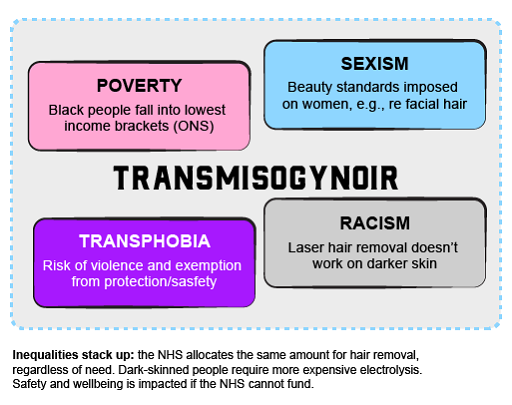
‘Intersectionality’ is a term coined and developed by Kimberlé Crenshaw (1993). It can be defined as an analytical framework that describes how a person can experience discrimination that is specifically produced by a combination of two or more social categorisations, such as class, race, sexuality, gender identity and disability. An example of this would be how black trans woman experience a combination of racism, sexism and transphobia; this is termed ‘transmisogynoir’ (Krell, 2017) to indicate the way in which these factors combine and cannot be treated separately.
Find out more about the ICTA study findings by doing the next activity.
 Activity 5.1: Extra barriers faced by some trans people
Consider the ways in which more marginalised trans people may face extra difficulties by pairing the following statements. As you engage in the activity, consider what the impact of these additional difficulties might be for counselling with such clients. Drag and drop each of the statements into the relevant cell in the table. Alternatively, you can download the accessible PDF version below.
Discussion
The ICTA project specifically explored the experiences of trans people living in rural locations and trans people with low income and/or low educational attainment, Black trans people and trans People of Colour, disabled trans people and trans people with chronic illness, and older trans people. ICTA also found additional discrimination for neurodivergent (e.g., autistic) trans people and those with mental health problems. In particular, participants with mental health problems talked about their experiences of being seen as not mentally stable enough to transition even if a significant cause of their mental health difficulties was not being able to transition.