
2 Humour in online meetings
As you will know from experience, humour can affect the dynamics in online meetings. In Unit 3 you read about how the chair will often set the tone of a meeting, using humour to either intensify or reduce already existing hierarchies (Taylor, Simpson and Hardy, 2022).
By poking fun at their own abilities or making a humorous remark about a mistake, a chair can lighten the mood. By sharing their experiences and errors, they can encourage other participants to feel more comfortable (Holmes and Marra, 2006; Taylor, Simpson and Hardy, 2022). However, humour can also be used to help disguise insecurities by making light of one’s shortcomings in an attempt to ward off criticism from others (Holmes and Marra, 2006; Tabassum and Karakowsky, 2023).
Meeting participants can use socially accepted excuses in humorous ways to hide that they made a mistake or forgot to prepare something for a meeting (Holmes and Marra, 2006). Socially accepted excuses are dependent on the context, but may include having a child who is unwell, being held up due to a delay on public transport, or not having had your morning coffee. Leaders can use these excuses to distract from an error they’ve made and then use humour to reduce the embarrassment of admitting a mistake (Holmes and Marra, 2006). For colleagues with a lower status within an organisation, it is often safer to make a joke at their own expense so as not to challenge the workplace hierarchy (Kotthoff, 2022).
Humour can also be used to project one’s self-image, like when a more senior staff member wants to seem down-to-earth and ‘one of us’. At the same time, humour can help those in higher positions maintain control in online meetings while appearing collegial (Holmes and Marra, 2006; Kotthoff, 2022). For instance, giving an unwelcome instruction or request in a jokey way to minimise the unpleasant fact that refusal is not an option: ‘And as a special treat, lucky James will get to stay late to proofread and format the report’. Therefore, hierarchies, and power, can be established and reinforced through the use of humour (Downing, Marriott and Lupton, 2021; Karl, Peluchette and Aghakhani, 2022).
Figure 1 shows some of the effects of humour or ways that humour can be used. Some of these examples may be intentional or unintentional. Have a look – can you think of occasions when you have used, witnessed or been the recipient of any of these?
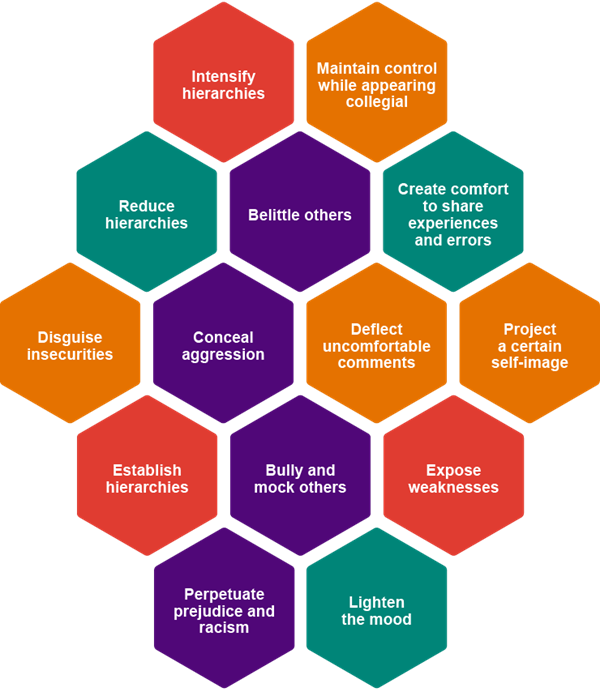
As discussed in Unit 2, some communication styles can negatively impact interactions in online meetings. If humour is used as a tool to mock or bully others, and if excessive mockery is directed at one person more than others, or if humour is used to belittle someone based on their gender, age or ethnicity, this humour will be experienced as aggressive (Kotthoff, 2022; Ólafsdóttir, Petúrsdóttir and Rúdólfsdóttir, forthcoming; Taylor, Simpson and Hardy, 2022). Humour can conceal the aggression behind a joke (Grugulis, 2002). This makes it difficult for the target to argue that it was offensive, as the typical response would be that it was ‘just a joke’ (Kotthoff, 2022).
Making fun of another’s abilities, belittling them, making jokes at their expense, or humorously exposing their weaknesses to a group is bullying. Moreover, this behaviour is detrimental, not only to the colleagues but also to a collegial and equitable work culture (Kotthoff, 2022).
1 Humour at work